

Adobe Commerce (formerly Magento) has long been recognized as one of the most powerful eCommerce platforms for flexibility, extensive customization capabilities, and enterprise features. It has been the preferred choice for brands that require complex catalogs, multi-store management, and highly tailored customer experience.
However, great power comes with operational responsibility. Running Magento is often compared to maintaining a Formula 1 race car. While Magento can deliver exceptional performance, it requires specialized expertise, sustainable infrastructure resources, and continuous tuning. For many businesses, these requirements become challenges that justify their investment.
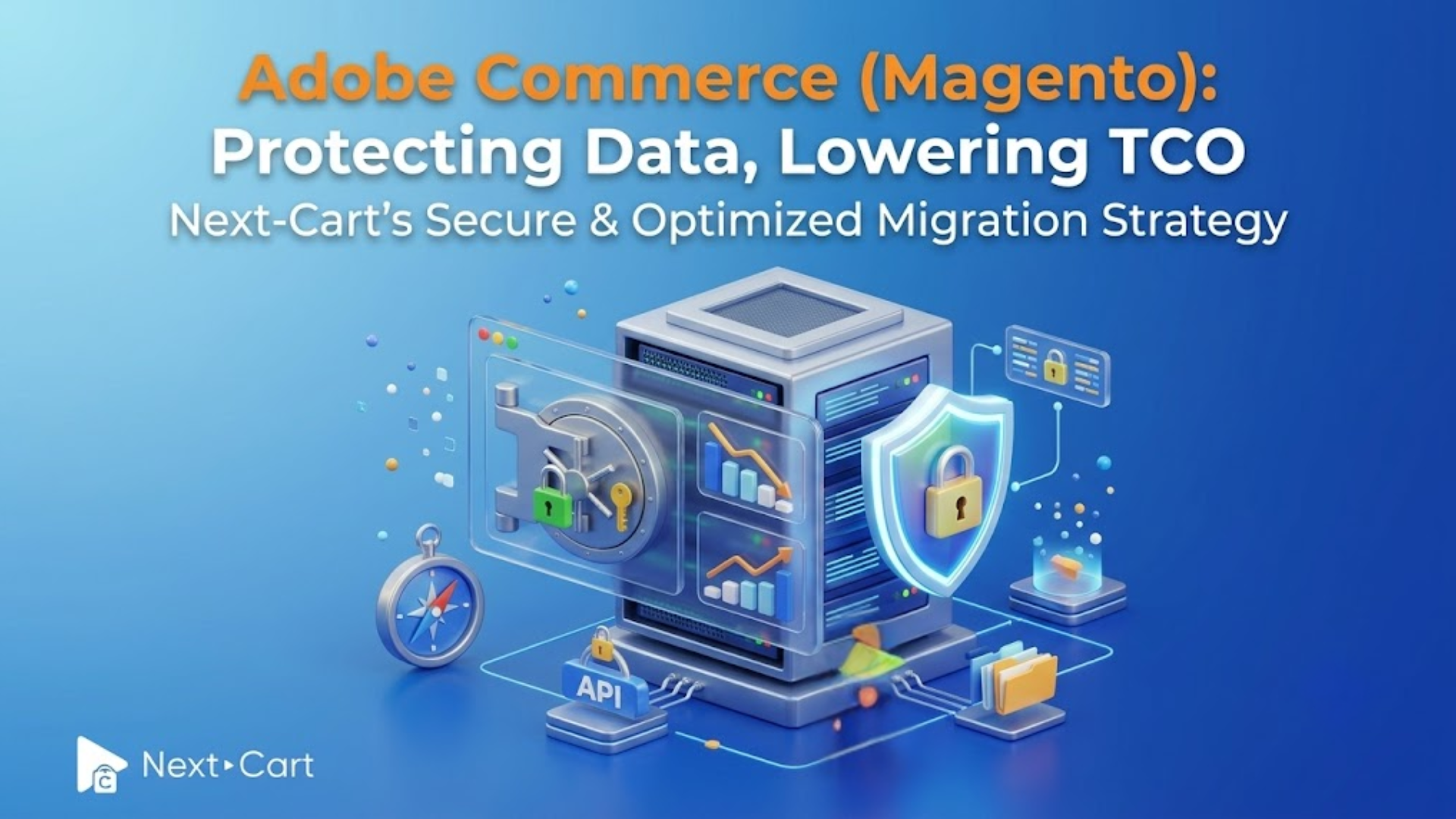
While businesses are increasingly evaluating how to protect sensitive customer data, they must reduce their Total Cost of Ownership (TCO) to continue to evolve. From implementing an SSL Certificate to optimizing databases and evaluating database migration strategies, merchants must strike a balance between security, performance, and long-term financial sustainability.
Hardening Magento security by securing confidential assets
Security is among the most critical responsibilities for any Magento store owner. Every day, eCommerce websites process sensitive customer data, including personal profiles, email addresses, shipping information, billing details, and transaction histories. A single security breach can result in financial losses and damage to customer trust.
Why an SSL Certificate is non-negotiable
SSL Certificate is the foundation of modern eCommerce security. An SSL Certificate encrypts communication between customers and the web server as it travels over the internet, protecting sensitive information. It also authenticates the website’s identity and enables HTTPS, allowing shoppers to see the familiar padlock icon before they enter payment information.
Without this encryption, customer credentials and payment details become vulnerable to interception by malicious actors, especially during checkout.
For Magento merchants, SSL implementation should extend beyond the checkout page. Every customer-facing page should operate over HTTPS to ensure consistent protection.
Staying current with security patches
In reality, SSL Certificates represent only one layer of defense. Adobe regularly releases security patches to address new vulnerabilities, targeting critical weaknesses that could expose Customer Data.
Unfortunately, many businesses delay implementing these patches due to concerns about compatibility, custom code conflicts, or resource limitations. Yet this hesitation can leave their systems exposed for extended periods.
Instead, it is recommended to implement a disciplined patch management process. This involves monitoring Adobe security advisories, testing updates, and verifying third-party extensions. Also, organizations should establish a deployment schedule and conduct post-update validation on performance and functionality.
Otherwise, businesses that frequently postpone updates accumulate technical debt and face complex, expensive maintenance cycles.
Protecting against database injection and unauthorized extraction
Magento databases, including product catalogs, customer profiles, order histories, and transactional records, all reside within interconnected database structures. Attackers often target these repositories through SQL injection to extract Customer Data.
To protect Magento databases, multiple layers of defense are required:
-
Businesses should restrict database permissions according to the principle of least privilege.
-
Web application firewalls can help filter malicious traffic before it reaches critical systems.
-
Regular vulnerability assessments, secure backup procedures, and periodic access reviews can also strengthen the security posture.
-
Finally, security should be an ongoing commitment, never be viewed as a one-time project.
Performance hardening: Reducing server strain
Solid security is a great foundation for businesses’ success, but it is not all. A secure store can struggle if its performance affects the customer experience.
As databases grow, much more Magento resources are consumed, causing slow page loads, delayed search results, and sluggish checkout. All of these negatively impact conversion rates and customer satisfaction.
Fortunately, organizations can address these performance bottlenecks through optimization efforts.
Optimizing heavy database tables
Through indexing operations, quote management, customer sessions, and visitor tracking, Magento generates substantial database tables that will become performance hotspots: indexed tables, quote tables, customer session records, and visitor logs. Over time, these tables become bloated with outdated data, increasing query execution times and straining database servers.
Then, regular database maintenance plays a critical role in resolving outdated records, fragmented indexes, and inefficient queries that directly affect customer experiences. By routinely cleaning unnecessary data and reviewing query performance, businesses can improve responsiveness while reducing infrastructure strain.
Data cleansing involves removing duplicate, corrupted, or improperly formatted records before they create larger operational problems. Maintaining high-quality data helps preserve long-term database integrity and system efficiency.
Leveraging Varnish Cache for faster delivery
Generating pages on demand can be resource-intensive on Magento. Every time a customer visits a category page, product page, or the homepage, the platform must execute multiple database queries before sending the final page to the browser. These repetitive operations place pressure on application servers and databases.
Varnish Cache is one of Magento’s most effective performance tools, storing rendered content and serving it directly to visitors rather than repeatedly generating identical content via database queries and application processing. Varnish can significantly reduce CPU utilization, database query volume, and server response times, resulting in a faster shopping experience and less infrastructure pressure.
For example, when a user requests a page that already exists in the cache, Varnish can deliver it almost instantly without involving Magento’s application layer or database.
Using Redis to reduce SQL dependency
While Varnish accelerates content delivery for storefront pages, Redis manages data behind the scenes.
Magento relies on database interactions for customer sessions, cache storage, shopping carts, and various temporary processes. Without optimization, the platform may generate thousands of repetitive SQL queries.
Redis is an in-memory data store designed to handle these workloads. It caches accessed data in memory, enabling Magento to avoid resource-intensive SQL queries. Session data, cache entries, and other temporary information can be retrieved more efficiently from memory than from traditional database queries.
Together, Varnish and Redis create a powerful performance foundation for Magento stores to operate more efficiently. Varnish handles full-page delivery at the edge, while Redis optimizes internal data access and cache retrieval.
Re-evaluating the Magento equation: Scaling vs. Total Cost of Ownership (TCO)
Optimization can improve Magento’s performance and security. But when considering TCO, a broader strategic question is asked: Is continued optimization still the most cost-effective path forward?
Auditing hidden operational costs
A realistic Total Cost of Ownership extends well beyond platform licensing fees. When calculating their TCO, organizations must account for all costs associated with hosting infrastructure, content delivery services, security tools, developer resources, upgrade projects, extension licensing, and ongoing optimization efforts. TCO also involves activities such as troubleshooting incidents, testing compatibility updates, and maintaining custom integrations, all of which also consume resources.
In many cases, organizations discover that developer time alone accounts for a substantial ongoing expense. Security patch testing or custom code maintenance all require specialized expertise that increases as systems become more customized.
When optimization is no longer enough
A highly optimized Magento environment can be expensive to operate. There are several warning signs for that:
-
Businesses often encounter recurring upgrade-related disruptions, increasing hosting expenses, and growing dependence on specialized developers.
-
Performance bottlenecks continue to emerge despite optimization efforts.
-
Custom functionality becomes more resource-intensive to maintain.
-
Security management and infrastructure upkeep consume a disproportionate share of the technology budget.
At this stage, organizations may benefit from strategic alternatives
Considering database migration as a financial strategy
Database Migration is often viewed solely as a technical process. In reality, it can also serve as a financial optimization strategy.
Database Migration involves transferring data from one system to another while preserving data integrity and business continuity. Modern alternatives may include SaaS commerce platforms or headless commerce architectures.
Headless Commerce, for example, separates the storefront experience from the commerce backend, providing greater flexibility and performance.
When maintenance costs consistently outweigh business value, migration appears a more sustainable long-term path. The goal is to determine whether Magento still aligns with your organizational priorities and budget expectations.
As migration becomes the preferred path, Customer Data must remain the highest priority throughout the process. Successful migrations depend on several critical disciplines:
-
Data Mapping - ensures that information from the source database is correctly matched to fields within the target platform.
-
Data Migration Validation - verifies that all records have been transferred accurately and securely.
-
Delta Migration - allows stores to continue accepting orders while transferring newly created data before go-live.
When combined with SSL protection, secure data-handling procedures, and comprehensive testing, these practices help ensure a smooth transition.
In conclusion
Adobe Commerce remains one of the most capable eCommerce platforms available today. Yet it also demands continuous maintenance, specialized expertise, and significant operational expenses.
To protect Customer Data, businesses must prioritize security fundamentals such as an SSL Certificate, timely security patching, and proactive database protection measures. At the same time, it is important to reduce server strain through database optimization, Varnish Cache, Redis, and regular maintenance.
However, as infrastructure requirements and maintenance costs for optimization continue to rise, organizations must consider a planned Database Migration.
With years of experience handling enterprise-level Magento projects, Next-Cart understands the challenges of extracting, securing, and migrating massive volumes of eCommerce data. But whether optimizing an existing Magento environment or migrating to a new platform, the ultimate objective is still protecting customer trust while building an efficient and sustainable future for online growth.