

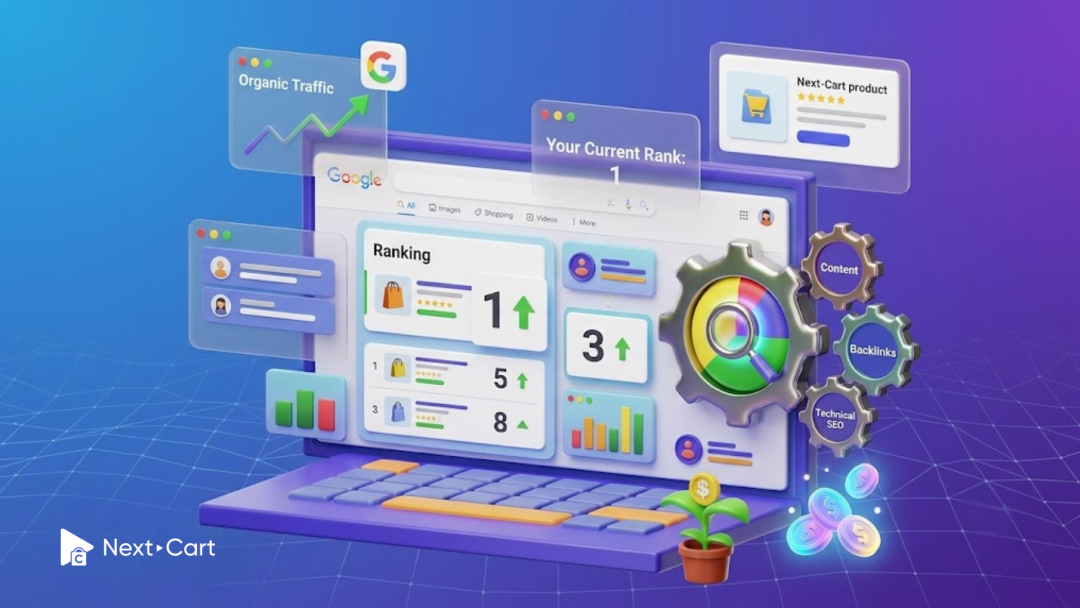
Sarah had spent years building her online fashion boutique into a successful business. Her store, which had been carefully optimized, slowly but surely climbed Google’s rankings. Organic traffic became her most reliable source of customers to generate sales.
As her business grew, however, the limitations of the current eCommerce platform led her to finally migrate to a modern platform that could support the next stage.
The migration appeared successful. Products, customer accounts, orders, and content were all transferred. The new store looked sleek and professional.
But within weeks of launching the new site, the Google traffic dropped by nearly half. Pages that once ranked on the first page disappeared from search results. Even worse, when customers clicked old links, they encountered error messages instead of products. Sales began to decline, and it quickly turned into anxiety.
Sarah’s story is not unique. Many merchants share the same fear when planning to replatform: what if moving to a new platform destroys the SEO value they’ve spent years building?
The good news is that migration itself is not the cause. It is about failing to protect the existing search authority during the transition. This process is known as SEO Preservation, and when handled correctly, it allows businesses to move their stores without sacrificing their organic visibility.
A well-planned website SEO migration is supported by implementing 301 Redirects, ensuring that search engines, customers, and valuable backlinks continue to find the right pages after the move.
In most cases, businesses can complete a migration with little to no impact on their rankings, preserving the traffic that is driving their growth.
Demystifying the Jargon: What is SEO Preservation and Link Equity?
Technical SEO terminology, such as SEO Preservation, Link Equity, URL Redirects, and Data Mapping, often makes migration seem more complicated than it really is. But the concepts behind them are easy to understand.
SEO Preservation simply refers to the process of protecting a website’s search performance during a migration. The goal is to maintain the rankings, organic traffic, indexed pages, and authority. Think of it as carefully transporting valuable assets from one location to another.
One of the most valuable assets that must be protected is Link Equity. If SEO Preservation is the moving process, Link Equity is the reputation points your website has earned over the years. Every time another website links to one of your pages, it signals to Google that your content is trustworthy and useful. Imagine a respected industry publication links to one of your product pages. Each of these links contributes to your website’s credibility in Google’s eyes.
Now imagine changing the URL of that page without informing search engines where it has moved. The backlinks still point to the old address, but the content is no longer there. Visitors arrive at an error page, and search engines encounter a dead end. The authority attached to that URL may no longer benefit your new page.
This is why SEO Preservation matters during migration. Without it, years of accumulated trust can become disconnected from the content that earned it.
301 Redirect vs. 302 Redirect: The post office analogy
To understand redirects, imagine moving to a new home.
When you relocate, you need to notify the post office about your new address. This ensures that letters, packages, and important documents are delivered to you rather than the old property.
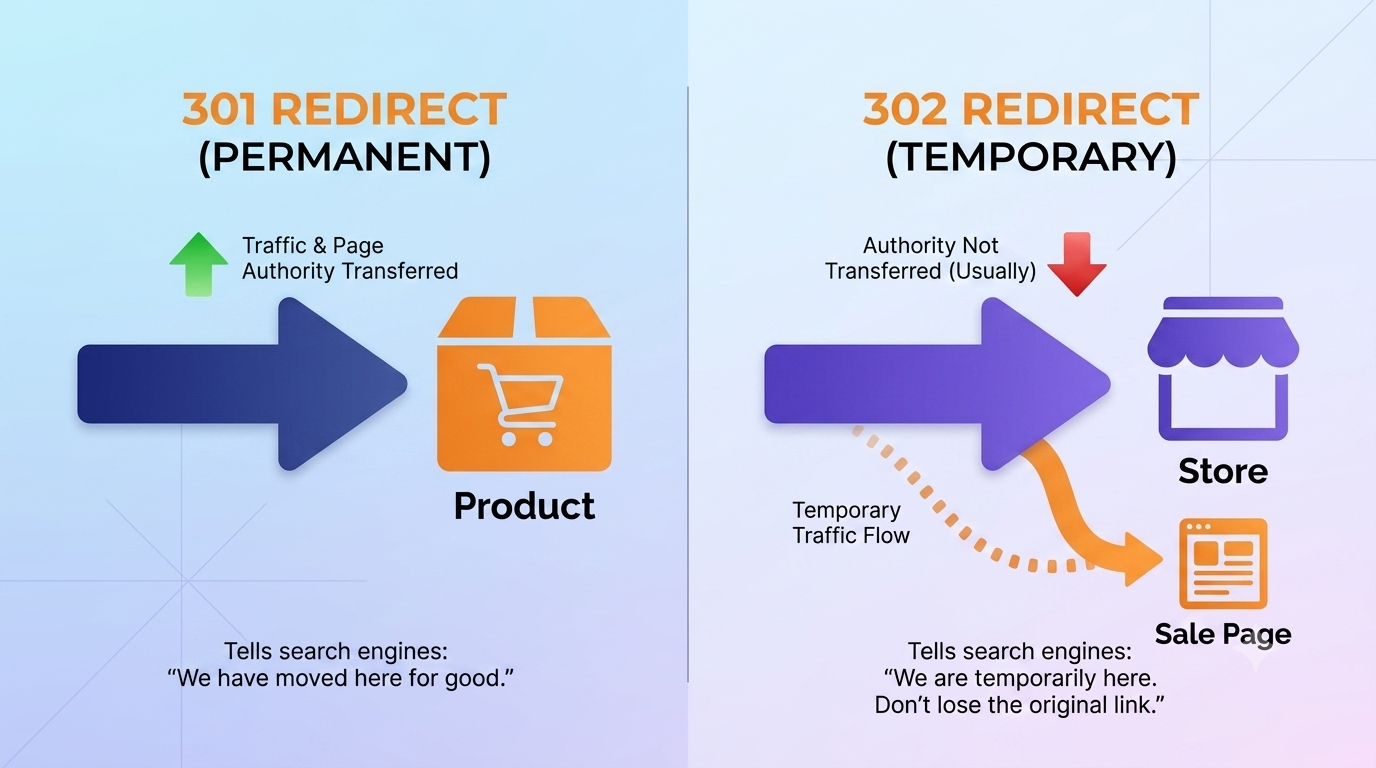
Website migrations work in a very similar way.
Every page on your website has an address in the form of a URL. When those URLs change during migration, search engines need to know where the pages have moved. Redirects serve as forwarding services that guide both visitors and search engines to the correct new destination.
A 301 Redirect acts like a permanent change notice. It tells Google that a page has permanently moved to a new location, so it should transfer any authority associated with the original page to the new one. This redirect helps businesses preserve Link Equity and maintain the rankings.
A 302 Redirect, on the other hand, tells search engines that the change is temporary. In effect, the message says, “We’re temporarily operating from another address, but we’ll eventually return to the original location.”
Understanding the distinction between the two redirects is critically important. A 302 Redirect can be useful for temporary campaigns, seasonal promotions, or short-term testing, but it is generally not for a permanent migration. Using a 302 Redirect when moving an entire website can confuse search engines and prevent ranking signals from being transferred.
Returning to the post office analogy, using a 302 Redirect during a permanent migration is like telling the postal service you’re on vacation, but in fact you've sold your house and moved.
For businesses looking to preserve years of SEO investment, the 301 Redirect is one of the most important tools for protecting organic visibility during a platform transition.
Why do URL changes happen during migration?
Some store owners assume that if their products remain the same, Google will automatically recognize them after migration. Unfortunately, search engines don’t think like humans.
Different eCommerce platforms are built on different database structures, content architectures, and URL frameworks. As a result, identical content receives a different URL when moved to a new platform.
For example, a WooCommerce product page may use a URL structure such as: yourstore.com/product/red-running-shoes. Meanwhile, Shopify may generate: yourstore.com/products/red-running-shoes.
To a human, the difference between these two URLs appears minor. To Google, however, these are two completely separate pages.
Without proper redirects, the old page disappears. Search engines continue attempting to access that page, only to discover that it no longer exists. Moreover, visitors clicking old search results encounter 404 Page Not Found errors. Valuable backlinks point to dead pages rather than active content.
This situation is similar to moving into a new home without updating your address anywhere. Friends, relatives, and service providers continue visiting the old location, unaware that you’ve relocated.
The challenge becomes greater for larger stores when hundreds or thousands of product pages, category pages, blog articles, and landing pages all receive new URLs during migration. Without a systematic process for connecting old URLs to new ones, the risk of traffic loss increases.
This is why Data Mapping plays such an important role in SEO preservation.
How to execute a bulletproof SEO migration plan
Successful SEO Preservation requires a structured migration process that accounts for every page on the existing site.
The first step is auditing the source platform.
Before migrating any data, businesses should create a complete inventory of active URLs. It includes product pages, categories, blog posts, landing pages, and other content that receives traffic or backlinks.
The next phase involves Data Mapping.
This process creates a connection between every old URL and its corresponding one on the target platform. Think of Data Mapping as creating a detailed relocation plan for every page.
After that, the 301 Redirects can be implemented.
This direct map serves as the bridge between the old website and the new one. The redirects automatically guide visitors to the new destination when they enter the old URL. Search engines also receive the same guidance.
Completing the migration with Data Migration Validation.
After launch, businesses should thoroughly test the new website to verify that redirects function correctly. Important pages should remain accessible, and search engines should be able to discover the new URLs. Validation serves as a final quality assurance process.
When these steps are followed carefully, Website SEO Migration becomes far less risky than merchants often imagine.
The Next-Cart edge: Automated redirection and expert guidance on SEO Preservation
For many store owners, the challenge is finding the time and technical expertise to execute SEO Preservation properly. This is where Next-Cart helps simplify the process.
Built by professionals with extensive experience in eCommerce services and data migration, Next-Cart helps businesses move between platforms safely. Our team has worked with major platforms, including Magento, WooCommerce, WordPress, Shopify, and BigCommerce, with a deep understanding of the technical and SEO challenges.
One of the most valuable advantages of the Next-Cart migration solution is the ability to streamline URL redirection. The tool automates much of the redirect workflow, reducing the risk of errors that could affect search visibility.
For businesses that prefer a hands-on approach, Next-Cart’s Standard Migration option provides powerful tools alongside technical support. Merchants can manage their migration project while benefiting from our experienced technicians for any issues that arise.
For those who would rather focus on running their business, the Managed Migration offers a fully hands-on solution. Here, Next-Cart specialists handle the whole migration process from start to finish, including Data Mapping, redirect implementation, validation testing, and troubleshooting.
Beyond SEO Preservation, Next-Cart supports migrating products, categories, customers, orders, blog posts, images, and customer data. At the same time, we provide secure cloud-based infrastructure and 24/7 technical assistance throughout the process.
Final thoughts: Don’t let SEO fear keep you stuck
It’s understandable to be nervous about replatforming. No business owner wants to risk their organic rankings and valuable traffic because of a technical mistake.
However, staying on an outdated platform simply because you’re afraid of losing SEO is equally costly. Slow performance, poor user experiences, limited scalability, and outdated functionality can all restrict your future growth.
Meanwhile, the right SEO Preservation strategy, with accurate Data Mapping, proper 301 Redirect implementation, and thorough validation, can help maintain authority and visibility as you move to a better platform.
Just as you would never move homes without updating your mailing address, you should never migrate a website without informing search engines where your content has gone. A properly executed redirect strategy ensures that ranking signals continue to reach the right destination.
Finally, replatforming should be viewed as an investment in your store’s future, not a threat. With the right migration partner and a commitment to SEO Preservation, you can adopt a new platform while maintaining your existing Google ranking.