
B2B eCommerce is fundamentally different from traditional B2C retail that focuses on customers, straightforward product catalogs, public pricing, and individual customer accounts. Wholesale B2B businesses, on the other hand, operate within a far more complex ecosystem. Every B2B transaction may involve contracts, tiered pricing structures, corporate purchasing hierarchies, custom catalogs, inventory allocations, and specialized product specifications. Database architecture becomes a critical component of business success.
BigCommerce has been a go-to eCommerce platform for B2B businesses, including manufacturers, distributors, and industrial suppliers. The platform offers powerful B2B capabilities for advanced pricing models, corporate account management, and flexible product information structures.
However, simply enabling these features is not enough. It is essential for businesses to design a scalable Database Schema to organize Customer Data and Product Data to maintain accuracy across all processes. Without a well-structured database, wholesalers could experience pricing inconsistencies, slow product searches, duplicate records, or broken customer account relationships, all of which could negatively affect customer experience and revenue.
For organizations with thousands of products and hundreds of business accounts, it is also important to structure custom fields, organize customer account workflows, and preserve data relationships during platform migrations.
Optimizing B2B Database Schema for frictionless ordering
A well-designed Database Schema is the foundation of every successful wholesale operation, as it determines how Customer Data, Product Data, pricing rules, and account relationships interact across the platform. Unlike B2C stores with a single public price, B2B merchants often manage multiple pricing structures simultaneously.
Building multi-tiered wholesale pricing structures
One of the most important requirements in wholesale commerce is managing multi-tiered pricing. A distributor may offer different prices to different enterprise customers. Also, for each pricing group, they may add discounts depending on order quantity or contractual agreements.
In these scenarios, storing pricing information as static values within product records does not work. Instead, there should be dedicated pricing tables that link products, customer groups, and discount rules via relational structures, enabling BigCommerce merchants to display the correct pricing based on customer credentials and purchase conditions.
As a result, customers can immediately see the rates that apply to their account. At the same time, internal teams benefit from centralized control over pricing policies. Search and ordering performance also remain fast even as the database grows.
Managing parent-child relationships within Customer Data
In B2B operations, customer account management differs significantly from consumer commerce, as it involves multiple users, departments, or branch offices. Therefore, many wholesale organizations operate them under corporate structures that are owned by a single parent company. For example, they might separate purchasing teams to different regions, but still operate under a centralized corporate account.
In this scenario, the Database Schema must support parent-child relationships to maintain unique workflows for each department, while remaining connected to the parent organization. A properly structured Customer Data model enables centralized reporting, purchasing oversight, and streamlined account management. It helps sales representatives easily track activity across the entire organization while giving procurement teams flexibility without sacrificing control.
Moreover, as businesses scale, these hierarchical account structures ensure that new users, branches, and departments can be added and integrate smoothly into existing workflows.
Leveraging custom fields for industrial-grade product catalogs
Wholesale businesses often manage extensive product catalogs that contain far more information than those of standard retail storefronts. For example, industrial suppliers often need to store and present technical information for buyers to help them make purchasing decisions.
This is where they must leverage custom fields for these industrial-grade product catalogs.
Extending product data beyond standard catalog information
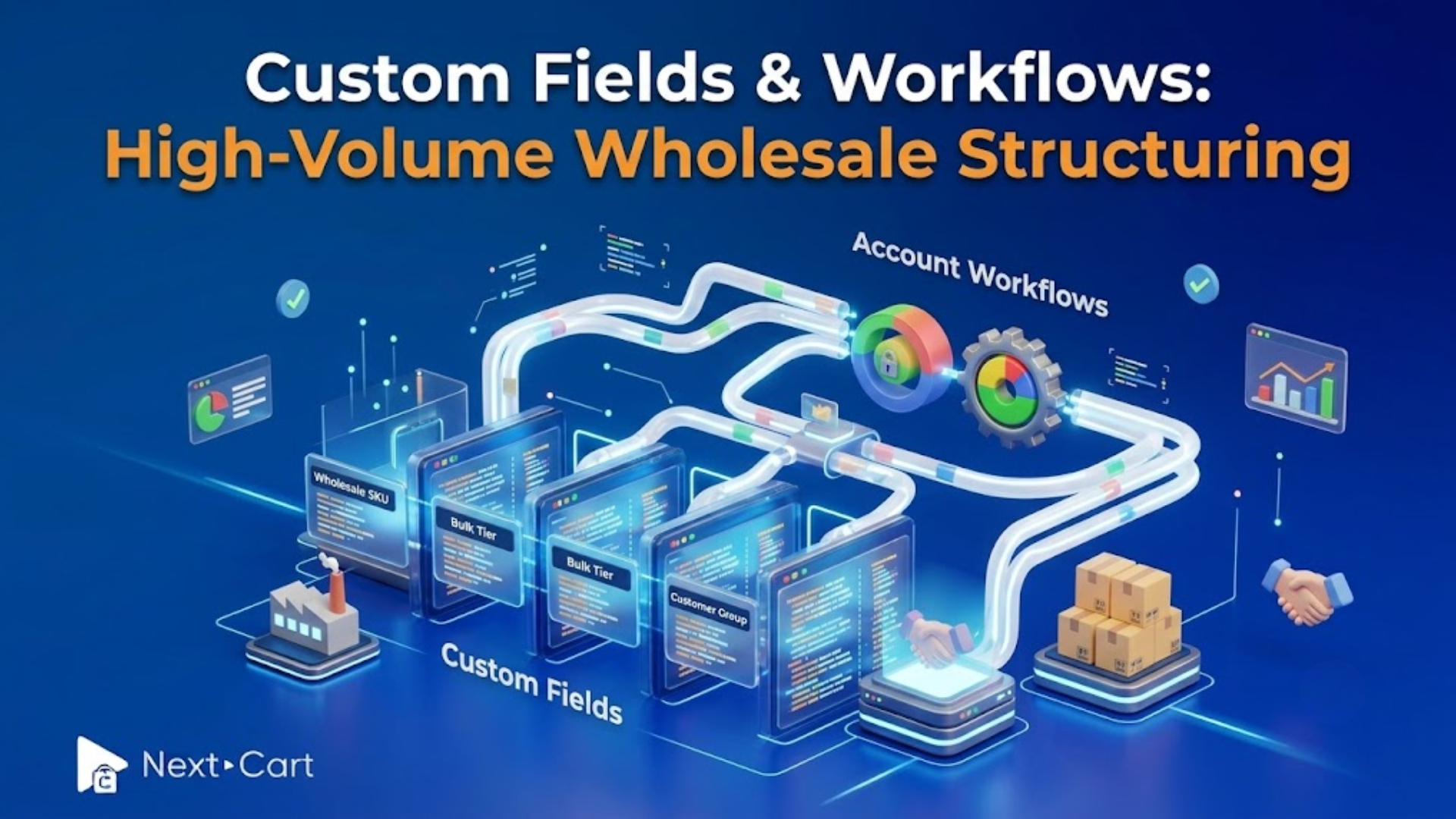
Custom fields allow businesses to expand Product Data structures, capturing unique information to their industry. These fields can also be used to store multiple operational details, such as manufacturer part numbers, technical specifications, compliance certifications, compatibility references, and warehouse location codes. All of these may be difficult to manage within standard product descriptions.
Moreover, for industrial buyers, it is often more important to access accurate technical information than marketing content. Engineers and procurement professionals frequently search for products using precise identifiers such as MPNs or specification values rather than product names alone.
In this scenario, structured custom fields allow BigCommerce stores to retrieve and display relevant results much more efficiently. As a result, buyers spend less time searching and make quicker purchasing decisions.
Restructuring custom fields for better search performance
The true value of custom fields lies in their capability to integrate into the overall Database Schema. Instead of treating technical attributes as supplemental content, businesses can organize them as searchable metadata that can be indexed and filtered.
For example, a maintenance manager searching for a replacement component may enter a manufacturer part number into the search tool. If that value exists within a structured custom field, the search engine can locate the correct product. Otherwise, if it is buried within a lengthy description, search relevance and speed may suffer.
Structured Product Data also simplifies catalog management by storing information such as location codes, compatibility references, and inventory identifiers within dedicated fields. Consider a distributor with more than 100,000 SKUs spread across multiple warehouses. If they maintain all this information inside product descriptions, they may encounter significant administrative challenges. Custom fields can resolve these challenges and ensure consistent updates at scale.
Furthermore, structured custom fields can help improve integration within ERP systems, Product Information Management platforms, and inventory management software. For enterprise systems that rely on clearly defined data structures rather than unstructured content, this is essential for long-term scalability.
How to move complex legacy ERP and Wholesale Databases
Migrating a standard online store often involves customers, categories, and orders, which is far more straightforward than wholesale migrations with deeply interconnected business rules and custom database structures.
Why do standard migration tools fail for wholesale data?
B2B organizations often build their custom workflows around ERP systems, pricing engines, customer hierarchies, and specialized inventory processes. These systems also often contain thousands of relationships. This makes standard migration plugins simply impossible to handle.
Most drag-and-drop migration tools focus on transferring basic Product Data and Customer Data while ignoring the business logic that connects them. As a result, critical relationships of tiered pricing structures, customer price books, workflows, custom product attributes, and parent-child accounts may be lost.
Implementing Next Cart’s Custom Migration workflow
To address this complexity, Next-Cart offers a Custom Migration approach that is specifically designed for businesses with extensive B2B requirements. With this workflow, rather than applying a one-size-fits-all migration process, our engineering team will analyze the source database and identify critical relationships.
The first step involves database discovery and schema analysis. Engineers review ERP databases, custom tables, integrations, and pricing structures to understand how Product Data and Customer Data are connected.
Once the data structure has been fully documented, custom mapping tables are developed. These mappings act as translation layers between the source platforms and BigCommerce, ensuring that data relationships remain intact throughout the migration process.
For example, if contract pricing is stored within proprietary ERP tables, custom scripts can extract those records and associate them with the appropriate customer groups inside BigCommerce. Similarly, parent-child customer relationships can be recreated to preserve permissions and account hierarchies.
Validating data integrity after migration
A migration cannot be considered successful simply because data has been imported. Instead, every relationship, workflow, and dependency must function correctly within the new environment.
Next-Cart engineers conduct comprehensive testing to verify that product records, pricing rules, customer hierarchies, and search functionality all remain intact and operate as expected. Also, integration points with ERP and inventory systems are reviewed to ensure uninterrupted business operations.
By combining schema analysis, custom scripting, mapping strategies, and validation procedures within the Custom Migration service, Next-Cart helps B2B businesses migrate complex wholesale databases without sacrificing accumulated operational intelligence.
In conclusion
As high-volume wholesale businesses require a robust database rather than merely technical capabilities, their operational engine must drive pricing accuracy, customer management, inventory visibility, and long-term scalability.
BigCommerce provides one of the strongest foundations available for B2B commerce, and realizing its full potential requires thoughtful Database Schema design. Additionally, properly structuring Customer Data enables corporate account hierarchies, and correctly organizing Product Data supports faster product discovery and more efficient purchasing experiences.
Custom fields also play a critical role in supporting industrial-grade catalogs, allowing businesses to manage specialized product information with precision
Finally, migrating from legacy platforms for wholesale B2B businesses requires a strategic approach to data management to preserve the complex relationships among pricing structures, customer groups, and ERP systems. While generic migration tools often fail to preserve the intricate connections within wholesale operations, Next-Cart's Custom Migration workflows can help retain critical B2B data structures, validate data integrity, and ensure a seamless transition.
As wholesale commerce continues to evolve, organizations that invest in clean, scalable database foundations will be better positioned. A well-structured wholesale database is a strategic advantage that drives sustainable business success.