

Customer expectations in eCommerce are no longer shaped solely by online stores themselves. They are shaped by every AI-driven digital interaction customers experience across search, content platforms, social media, and digital services. As a result, what customers consider a “good” shopping experience has quietly changed. And let see how AI changes what customers expect with Next-Cart right now!
A small change we didn’t expect - AI changes what customers expect
During one recent store migration, a client told us something that beared in my mind:
“Our customers complain even when the site loads in just two seconds.”
A long time ago, two seconds felt fast. But today, customers use AI-powered apps, marketplaces, and platforms every day. As a result, they carry those expectations into every online store they visit without realizing it.
AI is redefining customer expectations in eCommerce
Many eCommerce businesses struggle to explain why engagement weakens even when performance metrics look stable. Pages load fast, checkout works well, product information is accurate. However, customers hesitate, abandon, and rarely return. The problem isn't a failure in execution. It's a mismatch between expectations and customer needs.
AI is the force behind this shift. As AI is integrated into digital environments, customers begin to expect systems to adapt, anticipate, and respond intelligently. They do not consciously demand this, they just feel frustrated when it is missing.
Customers now expect eCommerce stores to “know them”
In the past, personalization was a great extra. Today, customers expect it.
They expect:
- Product recommendations that make sense
- Homepages that change based on what they like
- Emails that match their real interests
After migrating a fashion store to a more flexible platform, we saw repeat visits increase once AI-based recommendations were activated. Customers didn’t say, “This store uses AI”. They simply stayed longer and came back more often. And the fact is, customers evaluate whether the experience is aware of their intent.
From a technical point of view, this only works when customer data is migrated correctly. If the data is broken, AI can’t “understand” anything.
How AI resets the definition of a good eCommerce experience
AI does not simply improve personalization. It redefines what “good” means. A good experience is no longer one that functions correctly. It is one that evolves continuously.
[caption id="attachment_18457" align="alignnone" width="1920"]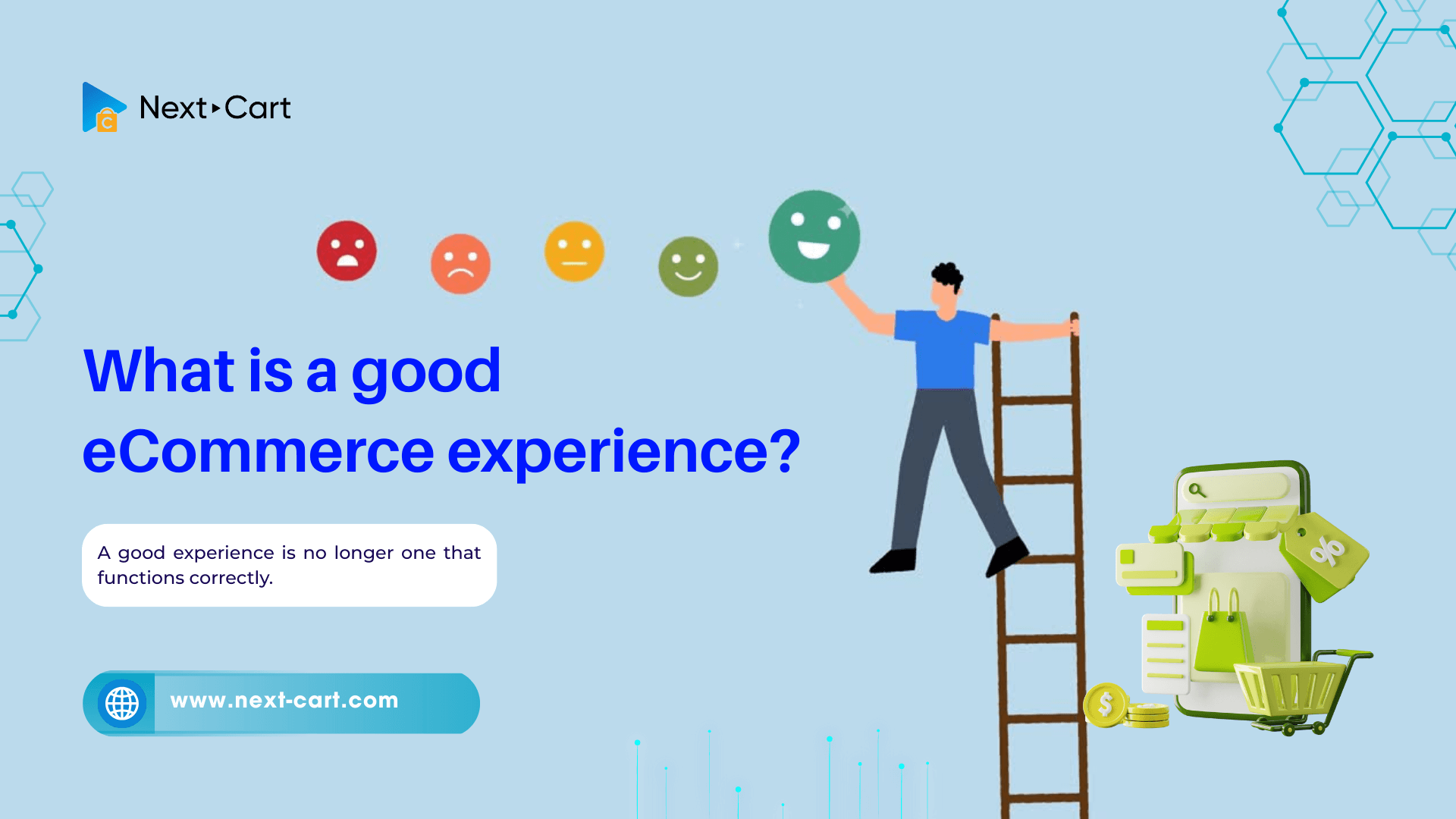 What is a good eCommerce experience?[/caption]
Speed is no longer technical - It’s emotional about a good experience
As technicians, we often talk about milliseconds, servers, and optimization.
But from the customer's perspective:
- A slow search feels frustrating
- A delayed filter feels unreliable
- A laggy checkout feels unsafe
In one project, AI-powered search reduced “no results found” issues right after migration. Nothing magical happened. The search just became faster and smarter.
The lesson is simple:
Customers compare your store to the fastest experience they’ve ever had, not to your competitors.
Support must be instant - AI changes what customers expect
Customers no longer think about business hours. They want to receive answers immediately when they ask questions. They expect:
- Order status updates quickly
- Clear answers about shipping and returns
- Support, even late at night when they decide to buy any products.
Several stores we worked with reduced support tickets after enabling AI chat support. Most questions were simple, repetitive, and time-sensitive.
From our side, we learned an important thing: Customers don’t care if the answer comes from a human or an AI. They only care that it comes now when they need it.
Product discovery should feel effortless
Customers don’t want to search hard. They want the store to guide them. AI helps by:
- Understanding natural language searches
- Suggesting related or alternative products
- Showing the right items at the right time
But from the technical view, AI only works well when product data is clean. During migration, if data is structured properly, product discovery feels smooth and natural. But if product attributes, categories, or variants are messy, AI will struggle.
Omnichannel experience - The best eCommerce experience
Customers expect the same experience everywhere. And because they move between devices all the time, they expect:
- Saved carts on mobile and desktop
- Consistent recommendations
- Know who they are and what are their intents
In several migrations, we focused on preserving customer profiles and order history. When done right, AI-driven personalization continued smoothly even after switching platforms.
This is why migration is no longer just about moving data. At Next-Cart, it’s about protecting the customer experience.
The reality of AI is driving customer experiences in eCommerce
Below are practical applications of AI in eCommerce that driving customer’s experiences:
[caption id="attachment_18458" align="aligncenter" width="1920"] AI is driving customer expectation[/caption]
AI-driven personalization beyond recommendations
Modern AI-driven personalization goes far beyond suggesting similar products. It analyzes behavioral signals such as browsing sequences, hesitation patterns, comparison behavior and abandonment moments. Based on these signals, AI dynamically adjusts product visibility, content order, and contextual messaging.
The objective is not to show more products, but to guide customers toward relevance rather than be overwhelmed by choice.
Intelligent automation across the customer journey
AI-powered automation responds to intent rather than predefined triggers. When customers show uncertainty, the system can emphasize delivery timelines, return policies, or trust signals without interrupting the flow.
Across the lifecycle, automation becomes contextual. Follow-ups, support content, and replenishment reminders are aligned with behavior rather than static schedules. The experience feels consistent without feeling mechanical.
Smarter search and adaptive navigation
AI-driven search interprets intent instead of relying solely on keywords. Navigation adapts dynamically, especially in large catalogs. Customers spend less time searching and more time evaluating.
Visual search and voice-driven discovery
Visual search allows customers to find products using images, matching visual patterns instead of text descriptions. This is especially powerful in categories where customers know what they want visually but struggle to describe it.
Voice search further reduces friction by enabling conversational information discovery. Customers refine their intents naturally instead of navigating complex menus.
Augmented reality and virtual try-on experiences
AR and Virtual Try-On technologies address one of eCommerce’s biggest challenges: confidence in purchase. By allowing customers to visualize products in real-world contexts or simulate usage, AI minimizes the uncertainty in carefully considered purchase transactions..
These experiences bridge the gap between digital and physical shopping, improving satisfaction while lowering return rates.
Predictive AI for customer intent and demand
Predictive AI represents a more advanced layer of intelligence. Instead of reacting to behavior, it anticipates what is likely to happen next.
By analyzing large-scale patterns, predictive AI can estimate purchase likelihood, churn risk, and demand shifts across regions or segments. This allows eCommerce systems to adjust experiences proactively.
Generative AI for product content and customer guidance
Generative AI transforms how information is presented and consumed. Rather than static product descriptions, content becomes adaptive.
AI can summarize complex specifications, highlight relevant features based on intent, and generate comparative explanations that guide decision-making. Instead of overwhelming customers with information, generative AI reduces cognitive load and accelerates confidence.
Shopping assistants powered by generative AI further shift discovery from browsing to guided decision-making, especially in complex catalogs.
Why many stores fail to meet these expectations
What we see most often is a misunderstanding of what AI actually demands from an eCommerce system. Many stores attempt to “add AI” on top of existing platforms without addressing the foundation underneath:
- Old platforms with limited AI support
- Incomplete or broken data after migration
- AI tools added without proper setup
This is why many stores technically “use AI” but still fail to meet modern customer expectations. The issue is not the tool itself, but the readiness of the system supporting it. The fact is: AI does not hide problems, it exposes them. If your data is messy, AI will make it more obvious to customers.
What we’ve learned working behind the scenes
After working on many migrations, one thing is clear: AI changes what customers expect faster than most stores expected. Moreover, customer dissatisfaction comes quietly from small mismatches between expectation and experience.
From a technical perspective, we’ve learned that migration success is no longer measured by data completeness alone. It is measured by whether the new system can continue learning about the customer without interruption.
Migration today is not just about moving platforms. It’s about preparing for an AI-driven future where customers expect speed, relevance, and simplicity by default.
Preparing for rising customer expectations
Preparing for rising customer expectations does not mean chasing every new AI feature. It means ensuring that the platform can support intelligence, adaptability, and continuous learning.
This preparation typically involves:
- Structuring product and category data around intent rather than inventory
- Designing discovery paths that adapt based on behavior and context
- Enabling content and recommendations to change dynamically, not manually
- Supporting automation without breaking consistency or control
When these foundations are in place, AI becomes a multiplier. When they are not, AI becomes cosmetic.
Migration is now part of the AI experience
As expectations continue to rise, many brands realize that the limitation is not vision, but infrastructure.
Platforms built for static commerce struggle to evolve into adaptive systems. This is why preparing for rising customer expectations often leads to broader conversations about replatforming or migration. Not as a reaction to failure, but as a proactive move to support how customers will expect to shop next.
In the AI era, customer expectations will keep rising whether platforms are ready or not. The real choice is whether the system evolves with them or slowly falls behind.
Final thoughts: Meeting customers where AI has taken them
Customers will not lower their expectations because AI has already set the baseline. Stores that want to keep up need more than AI tools. Store owners need the right platform, the right data, and the right migration strategy.
At Next-Cart, we don’t promise AI miracles. We help stores move in a way that makes AI work and delivers a better eCommerce experience for customers.