











Next-Cart
Loaded Commerce Migration

Loaded Commerce Migration: Move Your Store Seamlessly

Move your Loaded Commerce data to its next platform. Transfer products, categories, customers, orders, and supported records without manually rebuilding your store.

Start Free Demo
Key Features

Loaded Commerce Migration Features

Migrate to or from Loaded Commerce with a 1-year license, re-migration options, and dedicated support. Available features depend on your platforms, store setup, and chosen service.

No Downtime, No Data Loss

Keep selling while Next-Cart migrates your data safely in the background.

Support for 80+ eCommerce Platforms

Migrate from 80+ supported eCommerce platforms, giving you more flexibility to choose the right path.

1-Year License With Unlimited Re-migration

Re-run migrations when needed during 12 months, giving you more time to review and refine your store.

Dedicated Support Team

Get dedicated expert support when questions or migration issues come up, so you can keep moving forward with confidence.

Migration

Choose Your Migration Path

Move your existing store data from Loaded Commerce to another platform.
Move your existing store data into Loaded Commerce from any platform.
Supported Data Types

Data Supported for Loaded Commerce Migration

Explore the main data types supported by this platform. Exact fields, mappings and options depend on the other platform and your store setup. Choose a migration path to review the details.
Compatibility Overview
Loaded CommerceLoaded Commerce
Version Range
All versions
Language & Localization
Multilingual, Multicurrency, RTL, Localized URLs
Main Editions
Loaded Commerce CE; Loaded Commerce Cloud
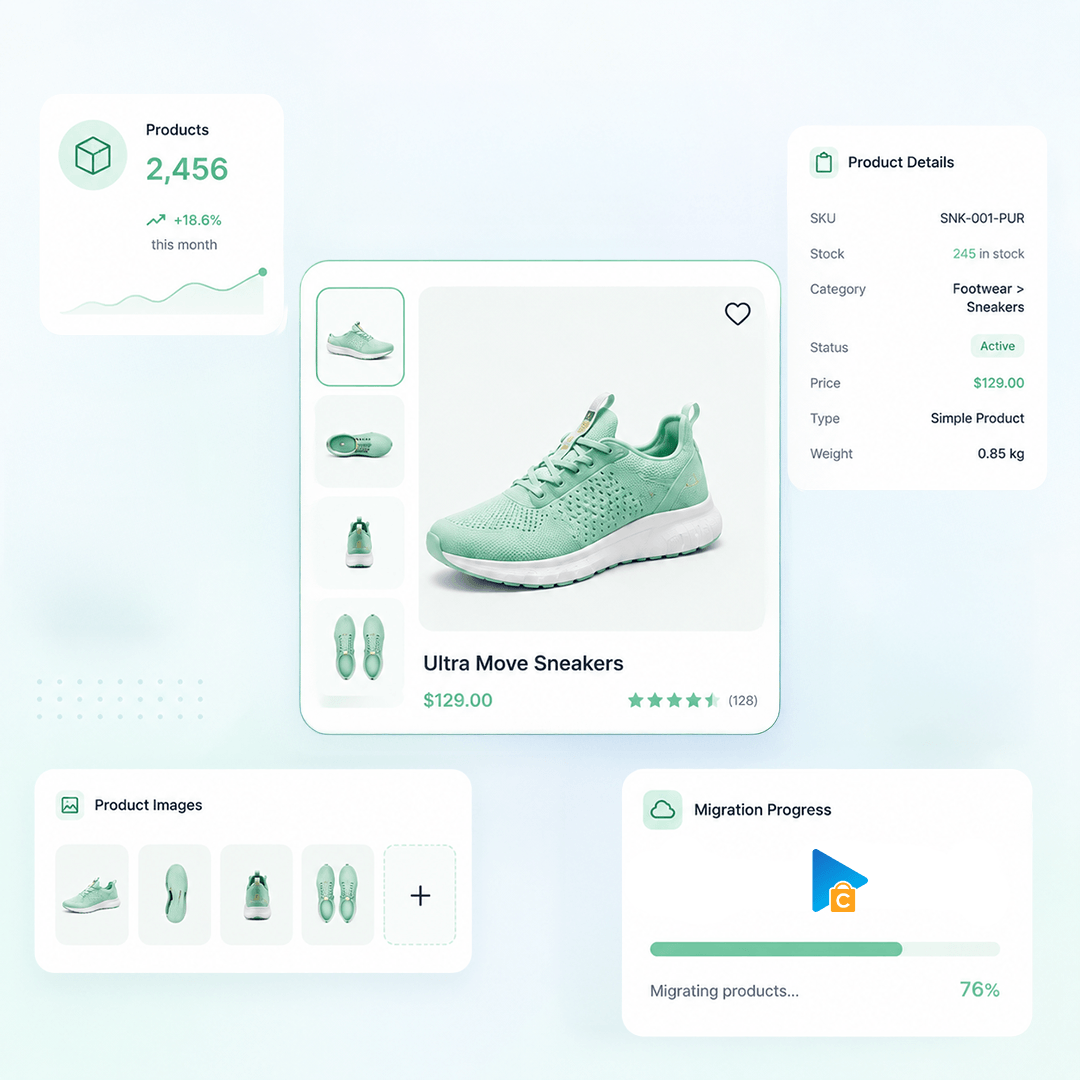
Products
Product Types: Simple Product, Product Variants, Downloadable Product
Product Information: Name, SKU, UPC, Short Description, Description, Weight, Active, Length / Width / Height, Manufacturer
Product Pricing: Price, MSRP, Special Price, Quantity Discounts
Product Options: Option, Option Value, Sort Order, Attribute Stock, Option Type
Product Variants: SKU, Attribute, Weight, Quantity, Active
Product Images: Product Image, Additional Images, Description
Product Inventory: Track Inventory, Quantity, Status, Backorders
External Links / Relationships: Categories, Related Products, Manufacturers
Product Attributes & Custom Fields: Attribute Name , Attribute Value, Display, Field Type
Product Downloads: File name, Download Links, Max Downloads, Expiry, Download Product
Product SEO / Structured Data: Meta Title, Meta Description, Meta Keywords, SEO URL
Product Categories
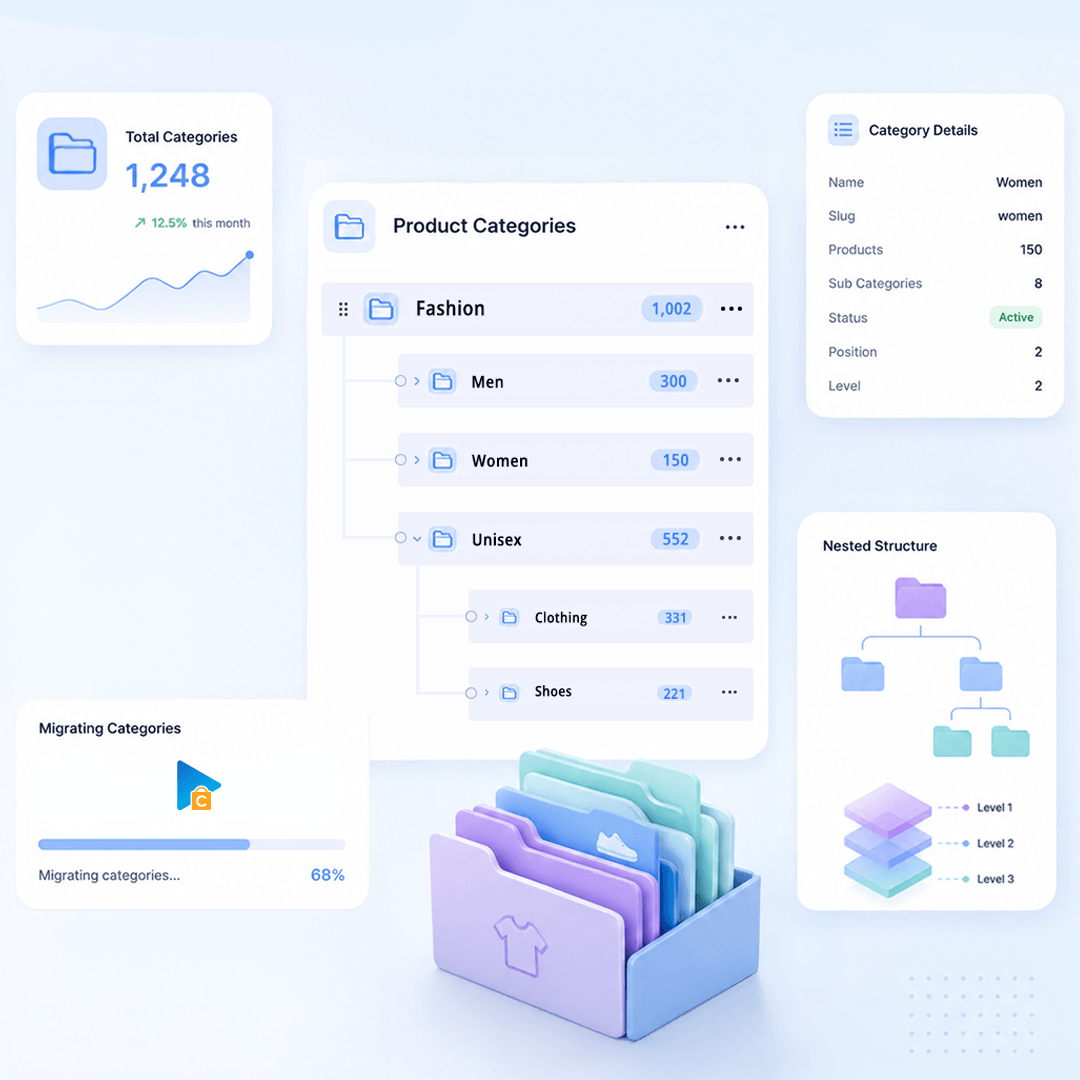
Category Information: Name, SEO URL, Description, Active, Meta Title, Meta Description
Category Images: Image
Category Structure / Hierarchy: Parent Category, Subcategories, Sort Order
Taxes
Tax Rules: Tax Rule, Tax Class, Country, State, Zip Code, Rate, Tax Shipping, Product
Manufacturers
Manufacturer Information: ID, Name, SEO URL, Description
Manufacturer Branding : Image, Alt
Customers
Customer Information: First Name, Last Name, Email, Phone, Status, Date Created, Password, MD5
Customer Addresses: ID, First Name, Last Name, Company, Address, Address 2, City, State, Country, Zip, Phone, Type, Yes / No
Customer Order History: Orders
Orders
Order Information: ID, Order Number, Status, Currency, Subtotal, Discount, Shipping, Tax, Total, Payment, Tracking, Comments, Date Created, Updated
Product Details: Product Name, SKU, Quantity, Price, Total, Tax, Discount, Options
Customer Details: First Name, Last Name, Company, Address, City, State, Country, Zip, Phone
Order Relationships: Customer ID, Products
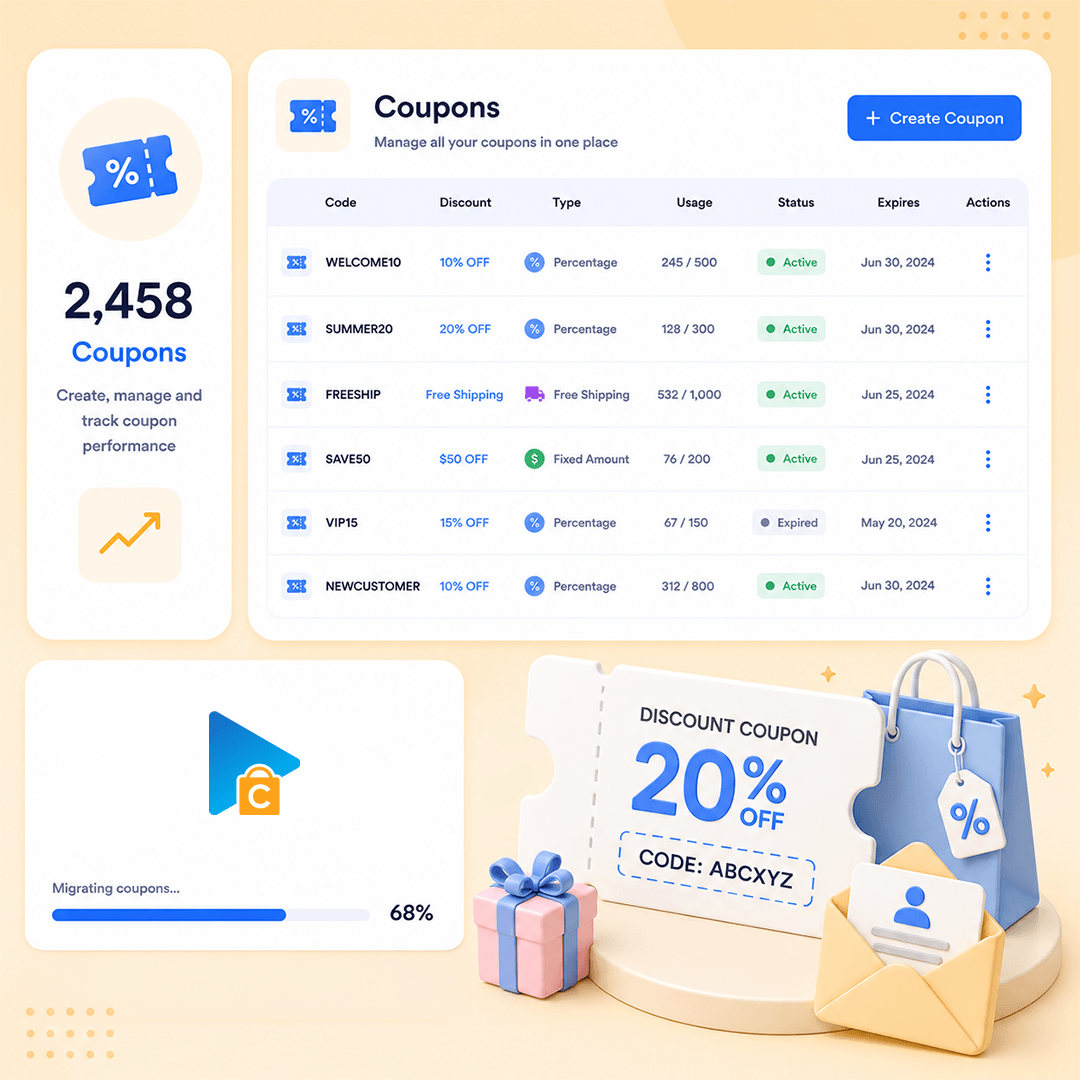
Coupons
Coupon Information: Code, Description, Discount Type, Discount Amount, End Date, Start Date, Status
Usage Restrictions: Min Order, Max Order, Per Customer, Exclude Sale, Products, Excluded Products, Categories, Excluded Categories, Usage Limit, Usage Per Customer
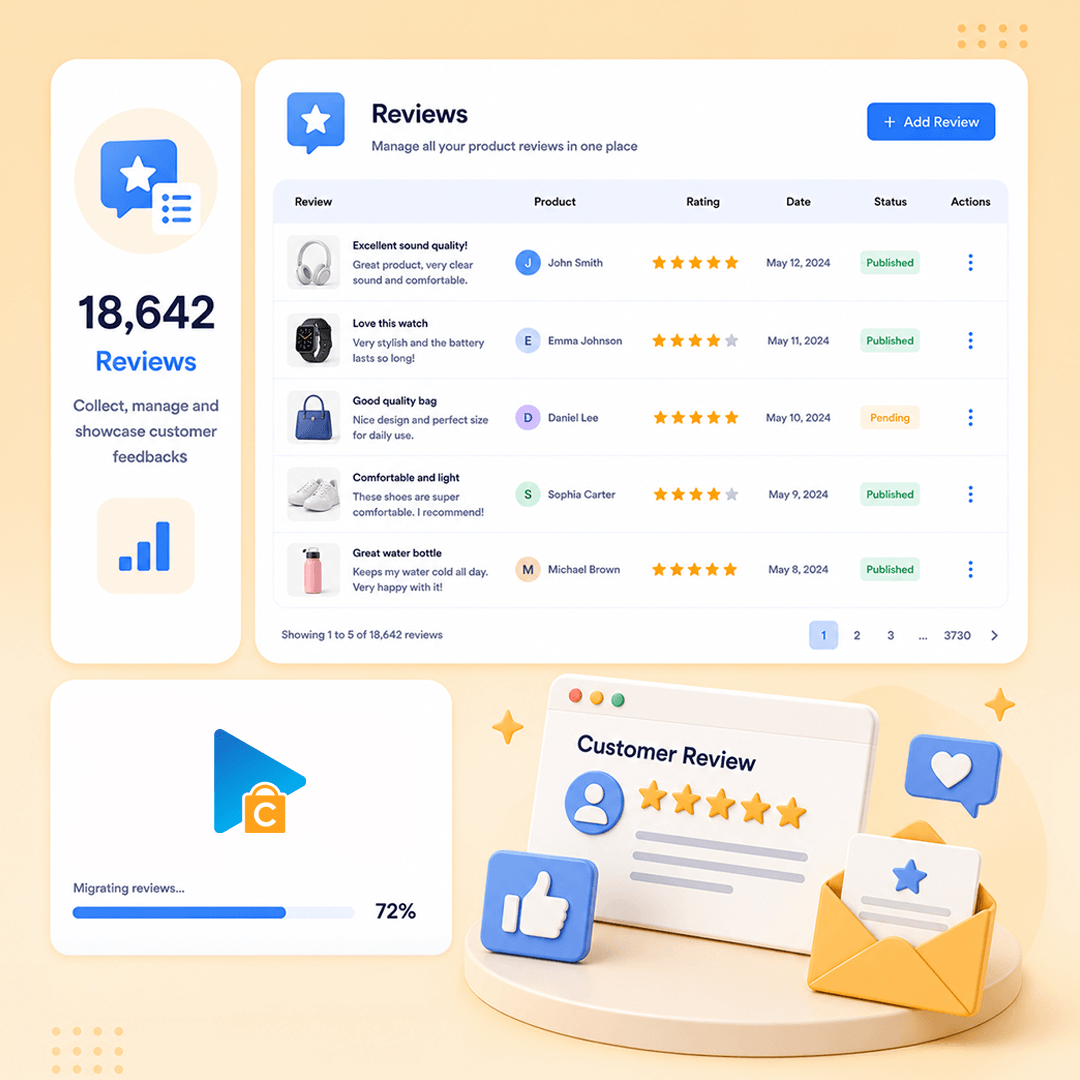
Reviews
Review Information: Title, Review, Rating, Status, Date
Reviewer Information: Customer ID, Email, Name
Product Relationship: Product ID
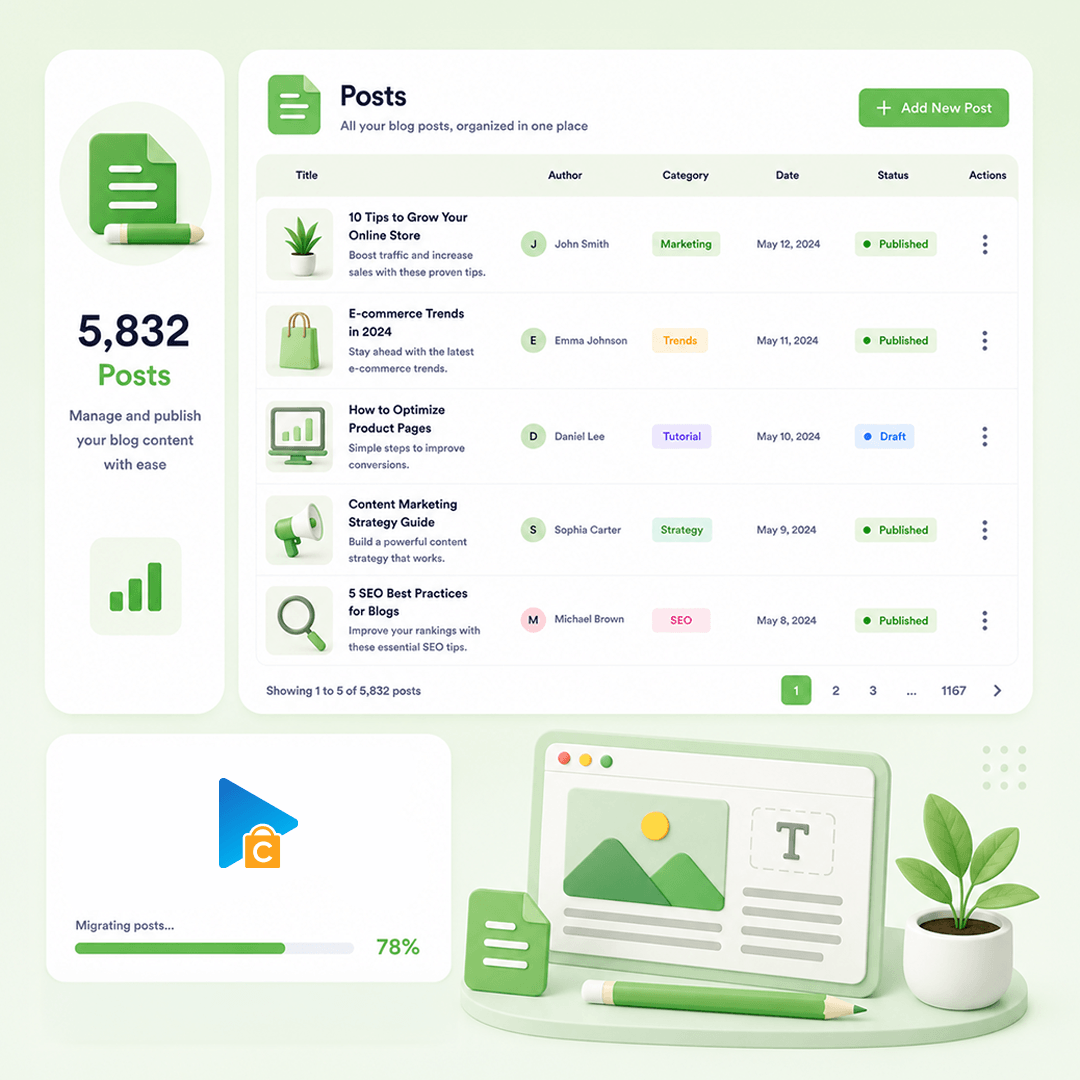
Blog Posts
Post Information: Title, Content, Summary, Tags, SEO URL, Status, Visibility
Post Images: Image, Images In Content, Alt
Post Categories: Category, Parent, Sort
Post SEO / Structure Data: Meta Title, Meta Description
Post Comments: Name, Email, Comment, Date, Status
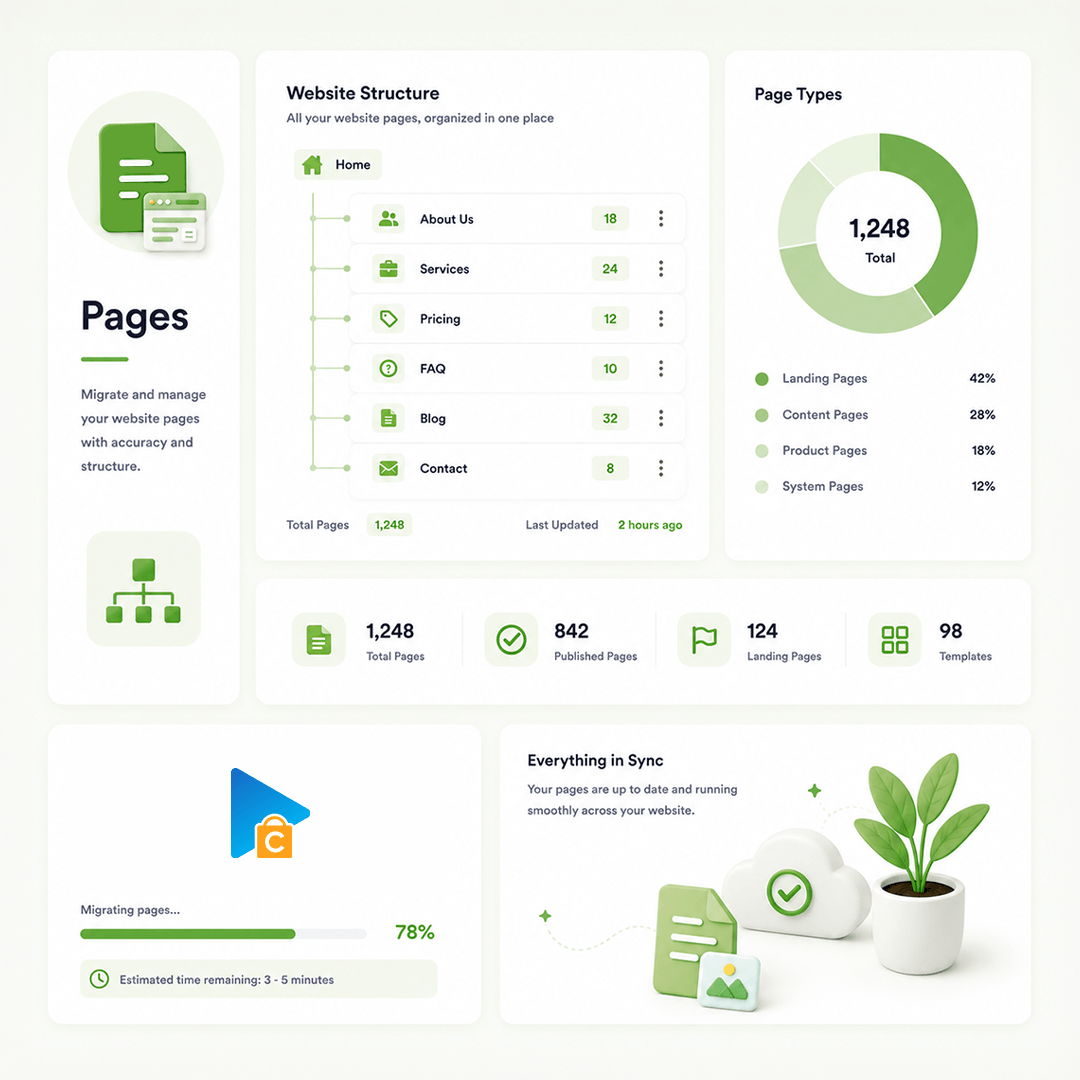
CMS Page
Page Information: ID, Title, Content, Summary, SEO URL, Status, Visibility, Template, Parent, Sort, Created, Updated
Page Images: Image, Images In Content
Page SEO / Structure Data: Meta Title, Meta Description

How Our Migration Process Works

A clear flow from secure connection to Demo and Full Migration.
Run it yourself or get expert help whenever you need it.
STEP1
Connect Your Stores
Connect Source Store and Target Store
STEP2
Configure Your Migration
Choose data, options, and migration mappings
STEP3
Run Full Migration
Migrate selected data to Target Store
Pricing

Pricing for Loaded Commerce Migration

Flexible pricing based on the service you choose
  • Use our migration tool
  • Full documentation & support
  • Unlimited re-migration (12 months)
  • Free demo migration
  • We run the migration for you
  • Dedicated migration expert
  • Unlimited re-migration (12 months)
  • Priority email & chat support
  • Tailored migration plan
  • Custom data mapping & scripts
  • Unlimited re-migration (12 months)
  • 24/7 dedicated support
Testimonials

Loaded Commerce Migration Reviews

Read reviews from customers who chose Next-Cart for their Loaded Commerce migration.
The Team is Awesome.
This is the second time I am working with them and I have to say they are awesome.
Nafiul Hasan

Frequently Asked Questions

Answers to common questions about Loaded Commerce migration.

Will product options and variants be transferred to Loaded Commerce 6?

The default import transfers the main product and descriptive extra fields, but not selectable options or variants. Customers will therefore not automatically get the same choices, variant prices or stock controls. Share representative products before migration so any additional work can be agreed.

Confirm the store version and provide a product containing those fields. The route uses the Loaded Commerce 6 reader, which converts extra product fields into descriptive attributes with a field name and value. Their destination presentation must be checked separately; an attribute value does not recreate an extension's behavior.

The default import transfers the main image and up to six additional gallery images, using the destination’s small and large image slots. If you need more, agree how the extra pictures will be handled before migrating the full catalog. Images inside descriptions are separate: use the description-image copying option where available and verify their links before removing the old hosting.

Do not rely on the built-in Loaded Commerce 6 import to keep original internal order IDs. Migration mappings retain source-to-target references for linking data, but those references are not the original database IDs. Check any integration that depends on the old IDs and confirm its requirements before migration.

Available services depend on your migration path. Standard Migration lets you use the tool yourself with technical support. With Managed Migration, our technicians carry out the agreed migration. Custom Migration covers tailored requirements, with the migration carried out by you or our team as agreed. Data types must be supported by both connections; choosing expert handling does not by itself add unsupported data.

Where a self-service Demo Migration is available for your migration path, you can try it for free before purchasing. It transfers a small sample of supported data so you can check the result. Add-ons and custom work are not included in the self-service demo. For a file-based, custom or technician-assisted evaluation, contact us first to agree the test scope and any applicable cost.

Your data types and quantities determine the Entity Points total and the plan you need. The cost also depends on your chosen service, add-ons, and any custom work. Use the pricing calculator for an estimate; custom work is reviewed and quoted separately.

If you are migrating from a live store, it can normally keep taking orders while Next-Cart copies its data. The migration does not delete or change the source data. Plan the final update and the switch to the new store separately so recent orders and other changes are included. For file-based migrations, changes made after an export require a fresh export; an uploaded file is not a live connection to the store.

Yes. Your license allows repeat runs for the same store and migration path for 12 months from purchase, within your plan’s data limit. Continuing the previous migration can add eligible new records without importing the same mapped records again.

Changing records already migrated is separate: the paid Data Update add-on can update selected fields where your source, target version and those fields are supported. Keep the existing migration links and leave target-data clearing off. It does not automatically update every field or provide continuous synchronization.

Yes. While your license is valid, you can increase your plan’s data limit and upgrade to a higher service where it is available for your migration path. You can move from Standard Migration to Managed Migration or Custom Migration, or from Managed Migration to Custom Migration.

If you already use Custom Migration, you can add custom work after a review and quote. You pay only the additional amount, and your license expiry date stays the same.

Start Your Loaded Commerce Migration Today!

Plan your Loaded Commerce migration with a clear process, secure data transfer, and expert support.