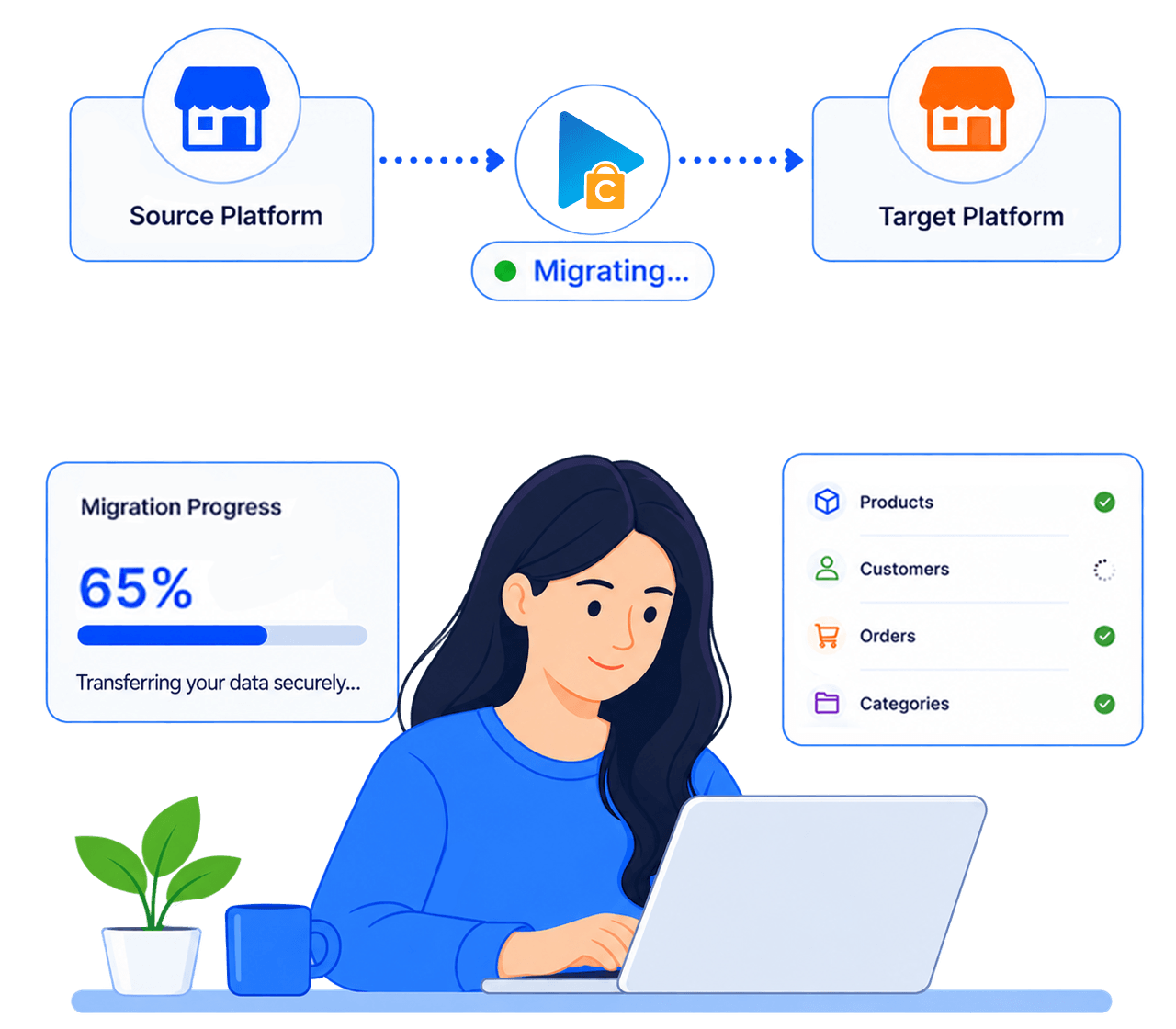

Every eCommerce migration has its own complexities, but some projects go far beyond standard data transfer. The case below is a perfect example of how modern online stores rely on ...
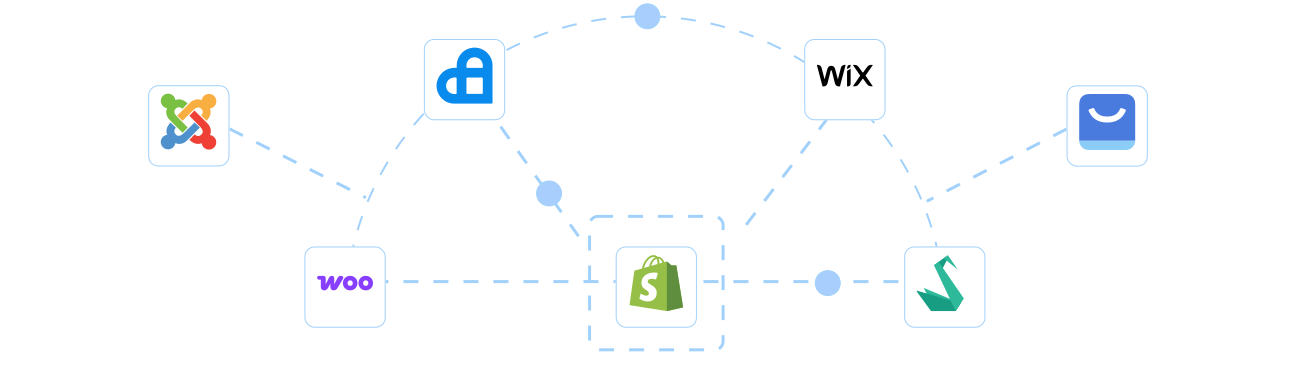








Next-Cart handles two types of data. Standard data is listed on the Product Detail Page for your specific Source Platform → Target Platform pair and is migrated by default. It usually includes products, categories, customers, orders, blog posts, CMS pages, reviews, coupons, images, SEO data, variants, options, attributes, and other supported records.
Extended data outside that listed scope, such as non-standard fields, app or plugin data, custom tables, or special structures, requires Custom Migration.
Yes. Next-Cart copies your data without deleting or changing anything on your current store, so you can keep selling while the migration runs.
To avoid conflicts, we recommend not editing migrated data on your new store while a migration is running.
The process has three simple steps:
Demo Migration moves a sample of up to 10 products, 10 customers, 10 orders, 10 blog posts, and 10 CMS pages. Other supported standard data types are migrated in full during the Demo, except Reviews and Coupons, which are not included.
No. You can start Full Migration whenever you are ready. Demo Migration is simply a free way to see how a small sample of your data will appear on the Target Store before migrating everything.
You can upgrade your service after purchase if your requirements grow.
Think of Entity Points as the size of your migration plan. Next-Cart only counts four data types, and each one has a Weight:
Multiply the number of records in each data type by its Weight, then add the results together.
Example: 100 Products + 100 Customers + 100 Orders + 100 Blog Posts = 100 + 50 + 80 + 60 = 290 Entity Points.
Other supported standard data, such as categories, reviews, coupons, CMS pages, taxes, and manufacturers, is still migrated and does not add Entity Points.
The quantities you enter help you choose a suitable plan; they do not filter or limit the records that can be migrated.
Add-ons give you a simple way to handle basic customization without building a fully custom migration:
Add-ons work within defined limits. More complex requirements may need Custom Migration.
In many cases, yes. For basic needs, Add-ons may be enough to filter records, transform values, or remap fields.
More complex data from apps, plugins, extensions, custom tables, unsupported entities, or special business rules may require Custom Migration.
Additional Migration Options give you three choices for the same migration path:
Choose the option based on the result you want in your new store, then check the migrated data afterward.
Only new Product, Customer, Order, and Blog Post records use Entity Points when they are migrated for the first time.
Records already counted under the same service license do not use Entity Points again, even if you continue the migration or perform a new migration.
Example: 20 new Orders use 16 Entity Points (20 × 0.8); previously counted Orders use 0 additional points.
Make sure your plan has enough remaining capacity for new counted records.






























































































Not sure which platform your store uses? Send us your store URL or tell us what you need to migrate.
Our team will help identify your platform and recommend a solution, including a custom-built migration tool if needed.
Talk to an Expert

Not sure which platform your store uses? Send us your store URL or tell us what you need to migrate.
Our team will help identify your platform and recommend a solution, including a custom-built migration tool if needed.
Talk to an Expert