
- Why we need a Shopify vs. WooCommerce vs. Magento Comparison
- Shopify: The “Verocity King” for modern merchants
- 2026 updates: AI-native commerce and checkout innovation
- Pros: Speed, Stability, and Simplicity
- Cons: The hidden cost of convenience
- Ideal for: Businesses that prioritize speed and growth
- WooCommerce: The “Ownership Play” and SEO edge
- 2026 Updates: Block-based commerce and data flexibility
- Pros: Full control and unlimited customization
- Cons: Maintenance and performance responsibility
- Ideal for: Businesses that value control and SEO
- Magento (Adobe Commerce): The “Enterprise Powerhouse”
- 2026 updates: Headless maturity and AI-driven intelligence
- Pros: Infinite scalability for multi-store, multi-currency, and B2B
- Cons: High investment and operational complexity
- Ideal for: Enterprises with complex ecosystems
- Head-to-head comparison among Shopify vs. WooCommerce vs. Magento: The 2026 scorecard among
- Performance: Speed vs. Flexibility vs. Scale
- Total cost of ownership: Predictability vs. control vs. investment
- Ease of use: Accessibility vs. customization vs. complexity
- The Next-Cart perspective: Why your choice matters today
- Bridging the gap between platforms
- Maintaining data integrity during a move
- Migration readiness checklist
- Final words,
Why we need a Shopify vs. WooCommerce vs. Magento Comparison
The eCommerce landscape in 2026 looks fundamentally different with rising innovative AI factors. They could be AI-powered shopping assistants, predictive personalization, or what many call Agentic Commerce.
These involvements have reshaped how customers discover and purchase. Also, intelligent systems can now anticipate customers’ needs, compare options, and guide them to complete transactions.
In this circumstance, the platform to build your store on becomes your growth engine. Besides being a technical foundation, it directly impacts your ability to integrate AI tools and your Core Web Vitals. A slow-loading store with rigid infrastructure will ultimately lose revenue.
At the same time, choosing the wrong eCommerce platform can lead to technical debt, such as bloated codebases, expensive workarounds, or limited scalability.
However, even in 2026, there is no universally “best” eCommerce platform; there is only the “right” platform for a certain stage, business model, and long-term vision.
In this article, we’ll take the latest updated look at three dominant eCommerce platforms currently – Shopify vs. WooCommerce vs. Magento – and finally help you identify which one is best for your business. Let’s get started!
Shopify: The “Verocity King” for modern merchants
Shopify continues to be the top choice for modern brands looking for the fastest path to market. The platform’s core philosophy has always been simplicity and performance. In 2026, that philosophy was reinforced when the platform had deeply integrated AI and extensibility.
2026 updates: AI-native commerce and checkout innovation
One of the most significant advantages of Shopify is the evolution of Shopify Magic. Beyond a content-generation tool, Shopify Magic becomes an AI operational assistant suite.
With its help, merchants can now automate tasks related to product descriptions, marketing campaigns, and customer segmentation. Moreover, AI-driven recommendations can provide them with valuable insights into pricing strategies and inventory management.
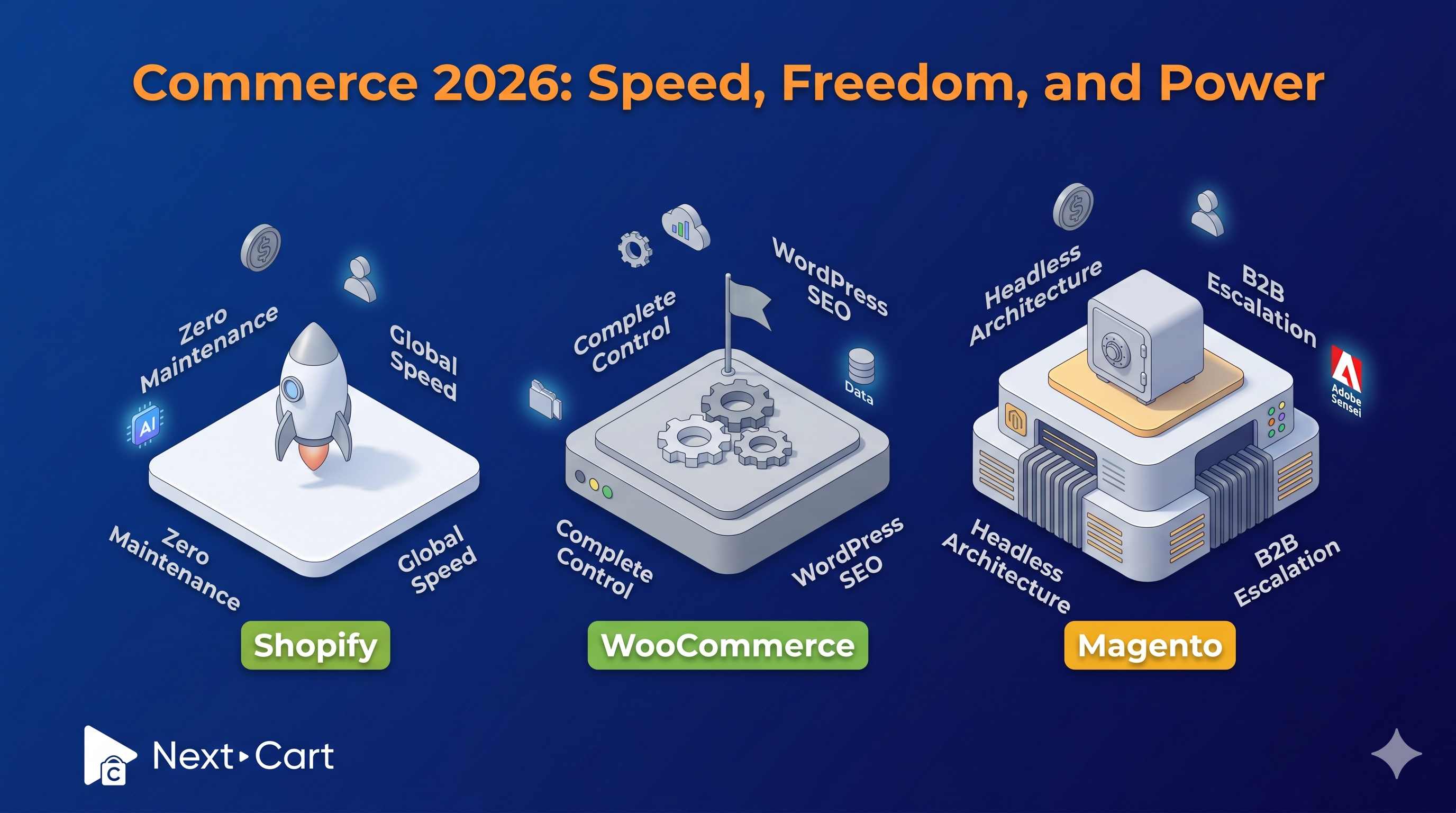
Additionally, its checkout extensibility framework has matured significantly. Previously, the platform limited its customization options to maintain platform stability. Now, it allows developers to extend checkout functionality in a controlled environment. As a result, merchants can set personalized experiences, such as dynamic upsells, localized payment methods, and tailored shipping options.
Importantly, all these functions are obtained without compromising speed or security. Shopify still manages to maintain its flexibility and performance. That is a key reason Shopify remains dominant in high-growth markets.
Pros: Speed, Stability, and Simplicity
Shopify’s SaaS model gives it an advantage over its competitors, which are self-hosted platforms. Shopify automatically manages infrastructure, hosting, security patches, and updates. This automation eliminates the operational burden of running an online store for merchants.
The platform’s performance is another critical strength. Its content delivery network (CDN) ensures fast load times globally, regardless of your geographic location. In 2026, as international commerce and cross-border sales become more common than ever, this feature becomes one of the platform’s core pros.
Shopify also provides excellent AI-powered personalization. Its built-in AI tools help maximize targeted product recommendations, email marketing flows, and customer journey. In particular, you can do that without any advanced technical skills. This accommodates businesses that want to leverage AI but lack in-house expertise.
Also, Shopify has a robust ecosystem of apps and integrations. You can find solutions for any need, including advanced analytics, subscription billing, or omnichannel selling.
Cons: The hidden cost of convenience
Shopify’s cost structure can be complex over time. While its base subscription fee is predictable, many advanced features require third-party apps, each with its own monthly cost. As your store scales, these expenses can accumulate quickly.
Next, transaction fees are counted if you do not use Shopify Payments. Additional fees apply to each transaction. This should be considered for high-volume stores.
Regarding flexibility, the platform does not provide full control over server configurations or database structures. For highly specific use cases, this can limit the ability for advanced customization.
Ideal for: Businesses that prioritize speed and growth
Shopify is the top choice for companies that want to move quickly. These businesses tend to focus on growth rather than infrastructure.
Startups, DTC brands, and scaling companies benefit most from the platform. They can make the most use of the platform’s streamlined setup and powerful marketing tools.
Imagine Shopify as a high-performance racing car optimized for speed, reliability, and efficiency. If you want to launch fast and scale without technical friction, Shopify is a compelling choice.
WooCommerce: The “Ownership Play” and SEO edge
Opposite to Shopify, WooCommerce emphasizes control, ownership, and flexibility. The platform is built as a WordPress plugin, allowing businesses to create fully customized eCommerce experiences.
2026 Updates: Block-based commerce and data flexibility
In 2026, WooCommerce fully embraced WordPress’s block-based editing system. Now, with modular components available, merchants can design entire storefronts. Moreover, the platform provides both visual simplicity and technical flexibility for this process.
Another important development is about decentralized database options. Businesses can now choose how their data is stored – through traditional hosting providers or distributed systems. Their choice depends on their specific concerns about data ownership, privacy, and compliance.
Pros: Full control and unlimited customization
WooCommerce’s defining feature is ownership. Merchants have complete control over the hosting environment, database, and codebase. They can customize every aspect of their online store, from design to functionality.
From a financial perspective, WooCommerce does not charge transaction fees at the platform level. This means significant savings for businesses with high sales volumes.
WooCommerce also excels at SEO. Integrating with WordPress – the world’s biggest content management system – WooCommerce provides unmatched flexibility for content marketing. What you can do is massive, including optimizing URLs, creating advanced blog strategies, and implementing technical SEO improvements.
The platform is a powerful choice to win organic traffic and content growth.
Cons: Maintenance and performance responsibility
The level of control you get comes with corresponding responsibility. WooCommerce requires merchants to do regular maintenance. This includes updating the plugin, monitoring security, and optimizing performance.
In addition, performance depends heavily on hosting quality, while a poorly configured server can lead to slow load times or even downtime. As a result, if store owners fail to ensure hosting quality, the user experience and SEO rankings can be negatively impacted.
Ideal for: Businesses that value control and SEO
WooCommerce is ideal for businesses that want full control over their digital assets. It is especially well-suited for content-driven businesses and those with unique customization needs. And these businesses are willing to invest in managing their infrastructure.
Just think of WooCommerce as a fully equipped workshop that provides you with all the tools you need, but it depends on your expertise and resources to use them effectively.
Magento (Adobe Commerce): The “Enterprise Powerhouse”
When businesses grow to a level where they must handle complex operations, global expansion, and high transaction volumes – among Shopify vs. WooCommerce vs. Magento – no one can beat Magento. In 2026, Magento has established itself not just as an eCommerce platform but as a comprehensive digital commerce infrastructure for enterprise organizations.
2026 updates: Headless maturity and AI-driven intelligence
Magento has evolved toward a fully headless architecture. Its model allows businesses to decouple the frontend experience from the backend engine. Brands can deliver a consistent experience across websites, mobile apps, kiosks, voice commerce, and IoT devices.
At the same time, Adobe’s AI system – powered by Adobe Sensei – provides deep data analytics. It allows merchants to leverage predictive analytics and forecast demand, automate merchandising decisions, and personalize customer journeys at scale. These capabilities are essential in the competitive AI-driven commerce environments.
Pros: Infinite scalability for multi-store, multi-currency, and B2B
Magento’s greatest strength is the ability to handle complexity. It is designed to support multi-store architectures, allowing enterprises to manage multiple brands and storefronts across different regions from a single backend.
This ability is particularly useful for global companies that operate in different currencies, tax rules, and customer expectations.
Additionally, the platform’s product management system is powerful, especially for highly configurable products. Businesses can manage intricate pricing structures and handle massive catalogs with up to millions of SKUs. This level of flexibility is unmatched by most current platforms.
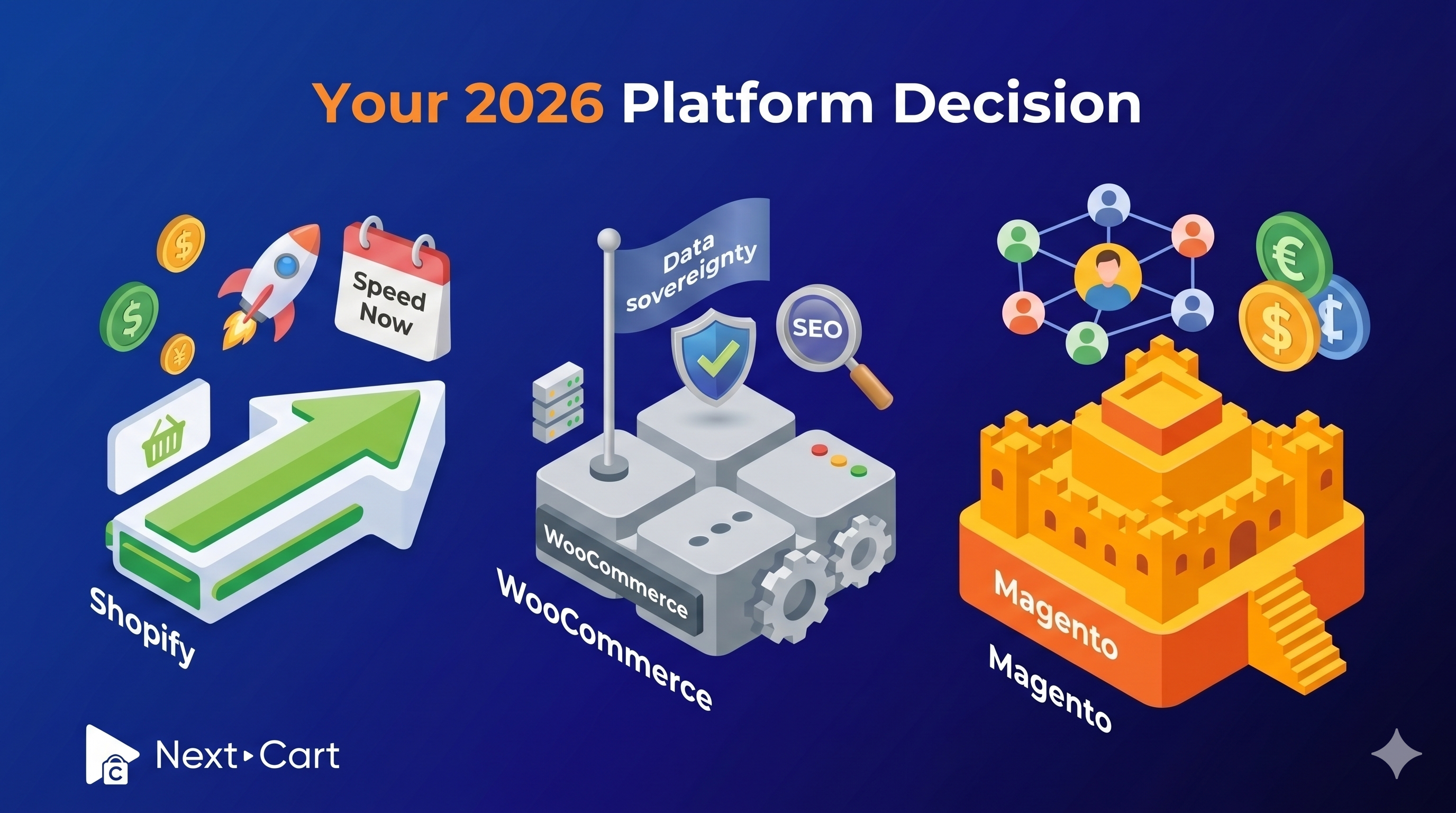
Magento also excels in B2B functionality, thanks to its built-in custom pricing tiers, company accounts, and bulk ordering workflows. These features are integral for wholesalers and enterprise suppliers.
From a security standpoint, Magento offers robust security features for large-scale operations. Businesses handling sensitive customer data and high transaction volumes can benefit from Magento’s advanced access controls and compliance-ready infrastructure.
Cons: High investment and operational complexity
The power of the platform comes at a cost. Magento has the highest Total Cost of Ownership (TCO) among the three platforms. Higher expenses are required for licensing for Adobe Commerce, development, hosting, and ongoing maintenance.
Also, its implementation is not straightforward. To build and maintain a Magento store, businesses need a dedicated development team and DevOps that can manage complex infrastructure and performance.
Ideal for: Enterprises with complex ecosystems
Magento is best suited for large enterprises that operate at scale and require deep infrastructure customization. It is the best platform for complex supply chains, large catalogs, multiple sales channels, and high-volume transactions.
In essence, Magento is like a digital fortress, which is resilient but requires significant resources to build and maintain.
Head-to-head comparison among Shopify vs. WooCommerce vs. Magento: The 2026 scorecard among
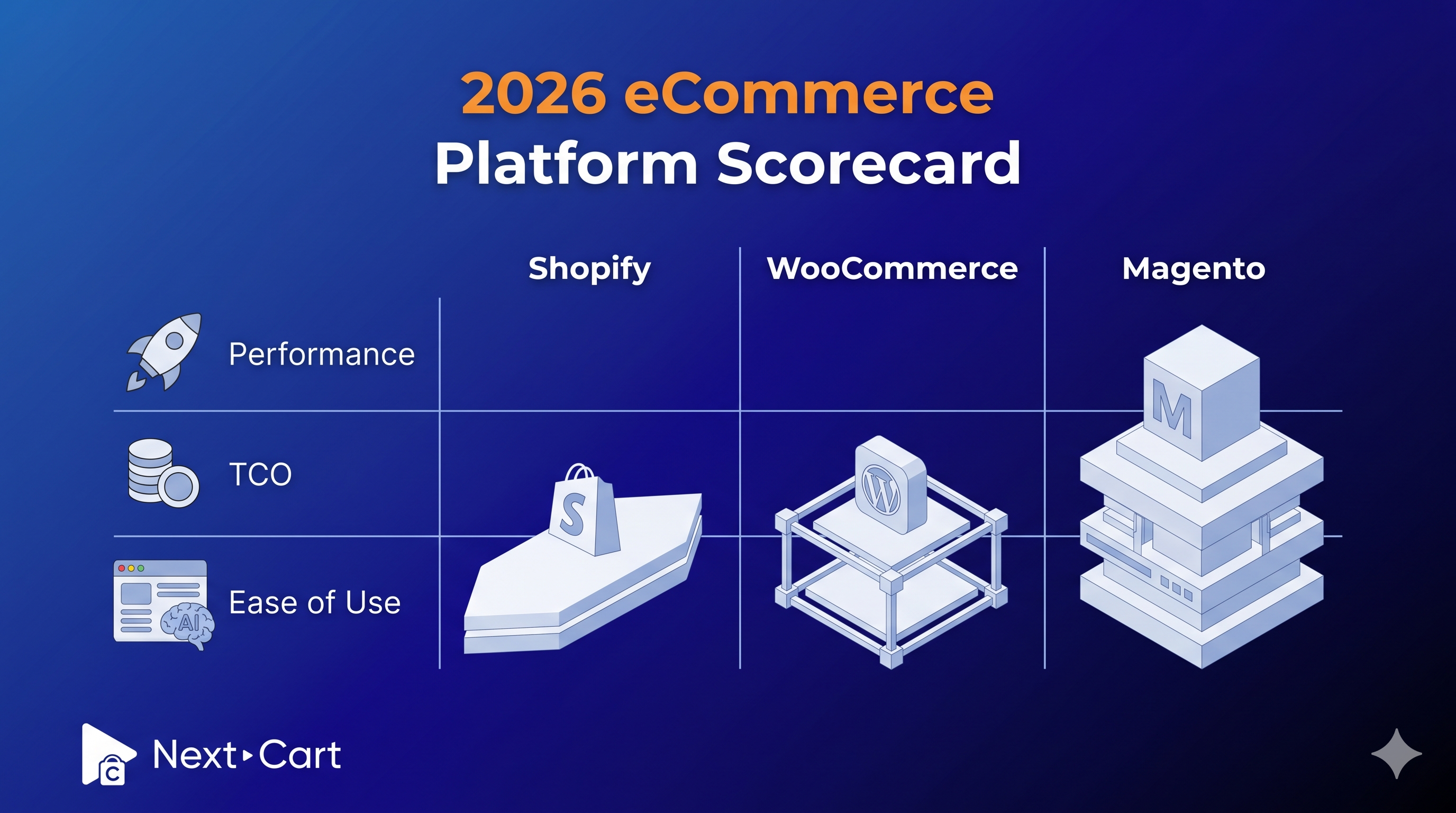
When each platform has its own strengths and drawbacks, the final decision comes down to how they perform across key business dimensions. In an AI-driven environment, the most important factors to consider are performance, cost efficiency, and usability.
Performance: Speed vs. Flexibility vs. Scale
In terms of speed and consistency, Shopify is the leader thanks to its fully managed infrastructure. It ensures fast load times and stable performance across global markets. That’s why Shopify is ideal for brands that prioritize user experience and conversion rates.
WooCommerce offers a different performance advantage – flexibility. Store owners have ample space to develop their own optimization strategies. With the right setup, the stores can achieve exceptional speed. However, performance depends heavily on how the store is configured.
Magento, on the other hand, is a platform for performance at scale with massive traffic and transaction volumes. To achieve optimal speed in this platform, enterprises need to invest in significant infrastructure and technical expertise.
Total cost of ownership: Predictability vs. control vs. investment
Shopify provides predictable pricing. However, as stores grow and require more advanced features than the platform offers, there is a need for app subscriptions and transaction fees, resulting in additional costs for merchants.
WooCommerce offers the most control over its cost. There are no platform-level transaction fees. Also, businesses can choose hosting providers based on their budget. That said, costs vary depending on development needs and maintenance efforts.
Among Shopify vs. WooCommerce vs. Magento, Magento requires the highest level of investment. It is only justified when businesses fully utilize the platform’s enterprise capabilities. Otherwise, the financial burden can outweigh the benefits in smaller operations.
Ease of use: Accessibility vs. customization vs. complexity
Shopify remains the most user-friendly platform compared to the others. Its intuitive interface integrates AI tools, making it more accessible even to non-technical users.
WooCommerce strikes a balance between usability and flexibility. It requires users to have some technical knowledge. But for those who have already used WordPress, the comprehensive integration between the two systems offers users a familiar environment.
Magento is the most complex of the three platforms. It is not designed for beginners. But for organizations with dedicated technical teams capable of managing advanced features, Magento is a robust system to rely on for their complex needs.
The Next-Cart perspective: Why your choice matters today
Businesses rarely stay on one platform forever. With continuous growth, market shifts, and new technologies, change is necessary.
But it doesn’t mean choosing a platform is just for immediate needs. It should be adapted for long-term growth.
This is why Next-Cart is not just an eCommerce platform migration service provider.
Bridging the gap between platforms
Next-Cart specializes in seamlessly migrating websites between platforms, including Shopify, WooCommerce, and Magento. We make migration an opportunity for companies rather than a risk, whether it is scaling up, optimizing costs, or becoming more flexible.
With our deep industry expertise and years of experience, we help businesses migrate their websites between ecosystems without disrupting operations or losing data.
Maintaining data integrity during a move
One of the most critical aspects of any eCommerce migration is data integrity. eCommerce data often involves interconnected structures, such as products, categories, customer profiles, and order histories.
Being aware of the importance of data integrity, Next-Cart always accurately maps data between source and target platforms, preserves SEO URLs, maintains product variants, attributes, and custom fields, and securely transfers customer and order data.
We know that even small data inconsistencies can lead to serious issues, such as broken links or lost SEO value. That’s why a well-structured process is in the priority list every one of our works.
Migration readiness checklist
Before initiating a migration, we always ask businesses to carefully evaluate their readiness. The main goal is to make the migration a strategic upgrade aligned with their long-term goals.
The checklist covers essential aspects of their readiness:
- Current platform limitations and pain points
- The complexity of product and customer data
- SEO dependencies, including URL structures and backlinks
- Integration requirements with third-party systems
- Growth objectives for the next phase of the business
Final words,
In 2026, the decision between Shopify vs. WooCommerce vs. Magento is not just about looking at the key features of each platform. But it is the process of reviewing how your business operates, grows, and competes in an AI era, and choosing a platform that aligns with that.
Shopify stands out for its speed and simplicity, which help brands scale quickly.
WooCommerce offers unmatched control and SEO flexibility for businesses that value ownership.
Magento provides the power and scalability required for enterprise-level operations.
Each platform represents its own philosophy that works best for specific business models, resources, and their ambitions.
What matters most is matching your business goals to the platform’s strengths; then the platform will support your current business status and enable growth over time.
Shopify vs. WooCommerce vs. Magento – Not sure where to go? Run a Free Demo Migration with Next-Cart today to see your store on a new platform in minutes!