
- “We need more traffic” (but do you?)
- The big misunderstanding: blaming marketing
- What “friction” really means
- The hidden blockers we often find
- Why merchants don’t notice the friction
- When the platform becomes the bottleneck
- The ROI truth: conversion beats traffic
- Conclusion: the cart is where revenue is protected
“We need more traffic” (but do you?)
“Our traffic is stable. Maybe we need more ads.”
This is one of the most common conclusions merchants draw when they notice their revenue slowing. It feels logical, though.
In the case of flat sales, the regular assumption is that not enough people visit the store. As a result, the go-to solution is more ads and bigger budgets for new acquisition channels to achieve more targeting.
On the surface, it makes sense.
However, when working with eCommerce businesses like this, we observe a recurring pattern: traffic increases, campaign metrics look healthy, add-to-cart numbers remain stable, yet revenue barely moves as cart abandonment stays high.
Then, frustration starts to build. Marketing teams push harder, and budgets stretch further. But the final revenue result remains nearly the same.
In fact, when a customer adds a product to the cart, the matter is no longer attraction, or awareness, or traffic. But it is about hesitation.
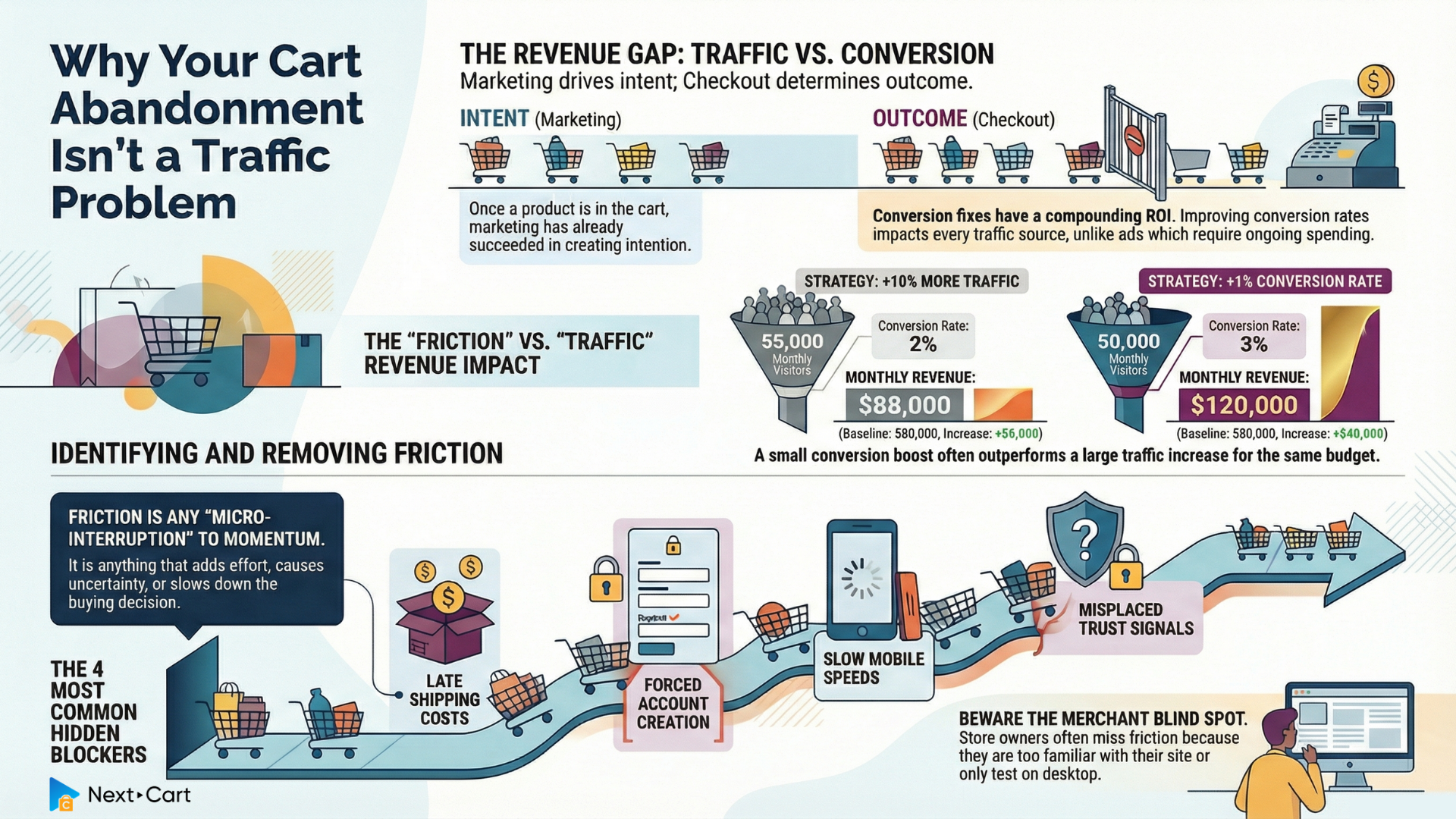
At the moment, once a customer places a product in the cart, the marketing work has already done its job. Then, interest has turned into intention. The customer has moved from browsing only to already considering a purchase.
From that point forward, your role is no longer convincing them to want the product, but to minimize any reason that could change their mind.
That is where friction quietly takes control.
The big misunderstanding: blaming marketing
Marketing is visible. But UX friction is not.
Merchants can easily access campaign dashboards, view traffic graphs, measure cost-per-click, return on ad spend, impressions, and click-through rates, and continuously update them.
That’s why when sales performance stalls, marketing becomes the easiest target to resolve. It’s logical to look at the most visible lever and assume it needs adjustment.
The typical reactions are refining targeting, testing new creatives, increasing the budget, and exploring another channel to reach out. Then, if traffic dips, it confirms the suspicion. If traffic rises but revenue does not, the assumption is that the traffic must be “low quality.”
But the overlooked reality is actually: Once customers reach the cart, marketing is already successful.
That sequence signals readiness and represents a meaningful buying behavior, not just casual browsing.
Therefore, blaming marketing in this stage misdiagnoses the real problem. It assumes customers lack interest when, in fact, they already demonstrated clear purchase intent.
The main issue is not attraction, but rather an interruption.
Cart abandonment often indicates weak campaigns. In reality, it is frequently evident that the buying journey introduces friction.
This misunderstanding, unfortunately, often leads to a costly cycle: rising acquisition costs, pressured marketing teams, yet the same structural friction in the cart and checkout experience, as a result, undermines every new visitor.
Marketing drives opportunity. But checkout determines the outcome.
When abandonment is high, the question should not be “How do we get more people in?”, but rather “What is making ready-to-buy customers hesitate?”
The perspective shift will change everything.
What “friction” really means
Friction is not a technical failure. It is neither necessarily a broken page nor a system error.
Friction is anything that makes a customer pause before finishing their purchases, such as:
- Uncertainty
- Check out odds
- Slow the natural momentum of a buying decision
In fact, the most dangerous friction is subtle, which does not scream for attention, does not produce error messages, yet simply creates hesitation.
For example, friction could be shipping costs appearing late in the process, which can disrupt customer expectations. Then, the customer might have to mentally calculate a total only to see additional fees at checkout. Finally, even if the cost is reasonable, the gap can trigger resistance.
In addition, extra checkout steps create cognitive fatigue. For instance, each additional field asks for customer attention and time. When a checkout takes longer than their expectation, customers begin to question whether the effort is worth it.
Another common source of friction is the requirement to create an account to make a purchase. Many customers are willing to buy but not to commit to registration before completing a purchase.
Poor mobile performance is another frequent source of friction. A smooth checkout on a desktop may feel slow on a mobile device. Delays in loading or recalculating totals can erode customer trust.
Payment options that are not visible can lead to friction. Customers tend to feel uncertain when they cannot see accepted payment methods early in the checkout process. When they begin to wonder whether their preferred method is supported or whether the transaction is secured, the risk of cart abandonment is high.
All of these friction signals are not dramatic failures. They are just considered small interruptions.
But in eCommerce, small interruptions at scale can lead to significant revenue losses.
Read more:
What We See During Store Migrations: AI Has Changed What Customers Expect
The hidden blockers we often find
When auditing migrations and evaluating platforms, we often identify friction points that merchants rarely notice. Not because they are careless, but because familiarity makes it hard to see.
One common point is the visible coupon field in the cart. This field is created to support promotion campaigns, but it also often triggers unintended behavior. When customers see the coupon box and do not have a code, they assume they are missing out on a discount. They might leave the checkout to search for one. Then some return, while many do not.
Another blocker is lag in quantity updates. When a customer adjusts the number of items, and the cart takes a few seconds to recalculate, it creates uncertainty. In a buying moment, a short delay can turn into a longer one, leaving space for inconfidence and cart abandonment.
Slow cart recalculation can also interrupt customer experience. Shipping estimations, tax calculations, and promotional logic are all useful features. But if the cart refreshes slowly for each of their changes, the overall experience will feel heavy.
Unexpected taxes appearing only at the final step are another hidden blocker. As transparency early in the process builds customer trust, any surprises near the payment stage will, by contrast, create resistance.
Trust signals are misplaced. Many stores display security badges and reassurance elements on their homepages. But these signals are missing when customers enter payment information, when reassurance matters most.
Customers rarely articulate these issues. They do not send feedback saying the UX feels heavy or uncertain. They simply leave the cart abandoned.
Why merchants don’t notice the friction
Friction can go unnoticed due to familiarity.
As a store owner, you know your website deeply. You understand every step and know what happens when each button is clicked. You are not confused by your own flow.
But your customers are seeing it for the first time.
Another reason merchants may not notice friction is that they test only on a desktop. Many internal reviews happen on desktop devices with strong internal connections. But customers shopping on mobile devices often experience much less ideal conditions. If you miss testing on these mobile devices, you are more likely to miss a large percentage of customers.
Analytics dashboards also contribute to this blind spot. Merchants often rely on high-level metrics, such as traffic, conversion rate, and revenue, to monitor their store performance. But these numbers normally do not reveal micro-interactions. They do not show existing customer behavior, including hesitation, repeated clicks, or moments of confusion.
In short, comfort with a platform, regardless of its limitations, mainly leads to hidden friction. Over time, merchants often adapt to what their platform allows, missing the opportunity to remove unnecessary fields and simplify certain steps and customizations.
Eventually, limitations become normalized.
But customers still compare your checkout experience to the smoother one and may leave if their expectations are not satisfied.
When the platform becomes the bottleneck
When looking into the root sources, friction is not simply a UX oversight. It is actually structural.
Some platforms restrict how merchants can customize the checkout. For example, fields cannot be removed, steps cannot be reordered, or the flow cannot be simplified beyond a template.
When stores grow, they often rely on additional apps and plugins to extend their website’s functionality. These add-ons each add certain value to upsells, loyalty programs, shipping calculators, analytics, or promotion campaigns. But at the same time, they add scripts and complexity.
Over time, the checkout becomes layered, and the extensions conflict with each other. As a consequence, stability decreases, and performance slows.
In these situations, the cart is not poorly designed, but is constrained by the underlying platform architecture.
The ROI truth: conversion beats traffic
Growth strategies often prioritize acquisition because it feels active and measurable. Many merchants think that more traffic equals more opportunity.
But the reality tells a different story. Take a look at the following example!
A store has 50,000 monthly visitors, a conversion rate at 2%, and an average order value os $80. It generates 1,000 orders and $80,000 in revenue.
When traffic increases by 10% to 55,000 visitors per month, with the same conversion rate, revenue increases to $88,000. This increase depends on sustained advertising investment.
Now, if the conversion rate increases from 2% to 3%, without changing traffic, orders rise to 1,500, and revenue increases to $120,000.
As you can see, the impact is dramatically larger.
Improving conversion can affect every source of traffic, including organic search, paid ads, email campaigns, direct visitors, and returning customers, compounding across the entire ecosystem.
In addition, while traffic acquisition requires ongoing costs, friction reduction is a one-time investment that benefits every future visitor.
That’s why reducing friction often produces a stronger long-term ROI than continuously increasing ad spend.
Conclusion: the cart is where revenue is protected
The cart is the moment where intention either becomes revenue or disappears.
The best-performing stores prioritize simple checkout. They remove unnecessary steps, minimize required fields, optimize mobile speed, and reinforce trust at the moment of payment.
Also, these stores understand that when customers abandon carts, they are not rejecting your product. Instead, they are rejecting the friction.
Marketing creates desire. Products create interest. But revenue is protected by the cart.
If your traffic increases while revenue remains stagnant, the matter may not be more visitors, but fewer obstacles.
Before deciding to increase your ad budget, ask: Is your cart helping customers decide, or giving them reasons to hesitate?
Because once a product is in the cart, you do not need to convince the customer to want it.
You simply need to make saying “yes” effortless.