
The fear of upselling (Increase AOV)
“We don’t want to annoy our customers with too many offers.”
This concern is very common among eCommerce merchants when they discuss upselling strategies.
For many merchants, especially those who have worked hard to build trust with their customers, the idea of adding promotional activities feels quite risky. They often worry whether these upselling programs to increase revenue will appear desperate, look “spammy”, or even drive customers away.
And to be fair, that fear is understandable.
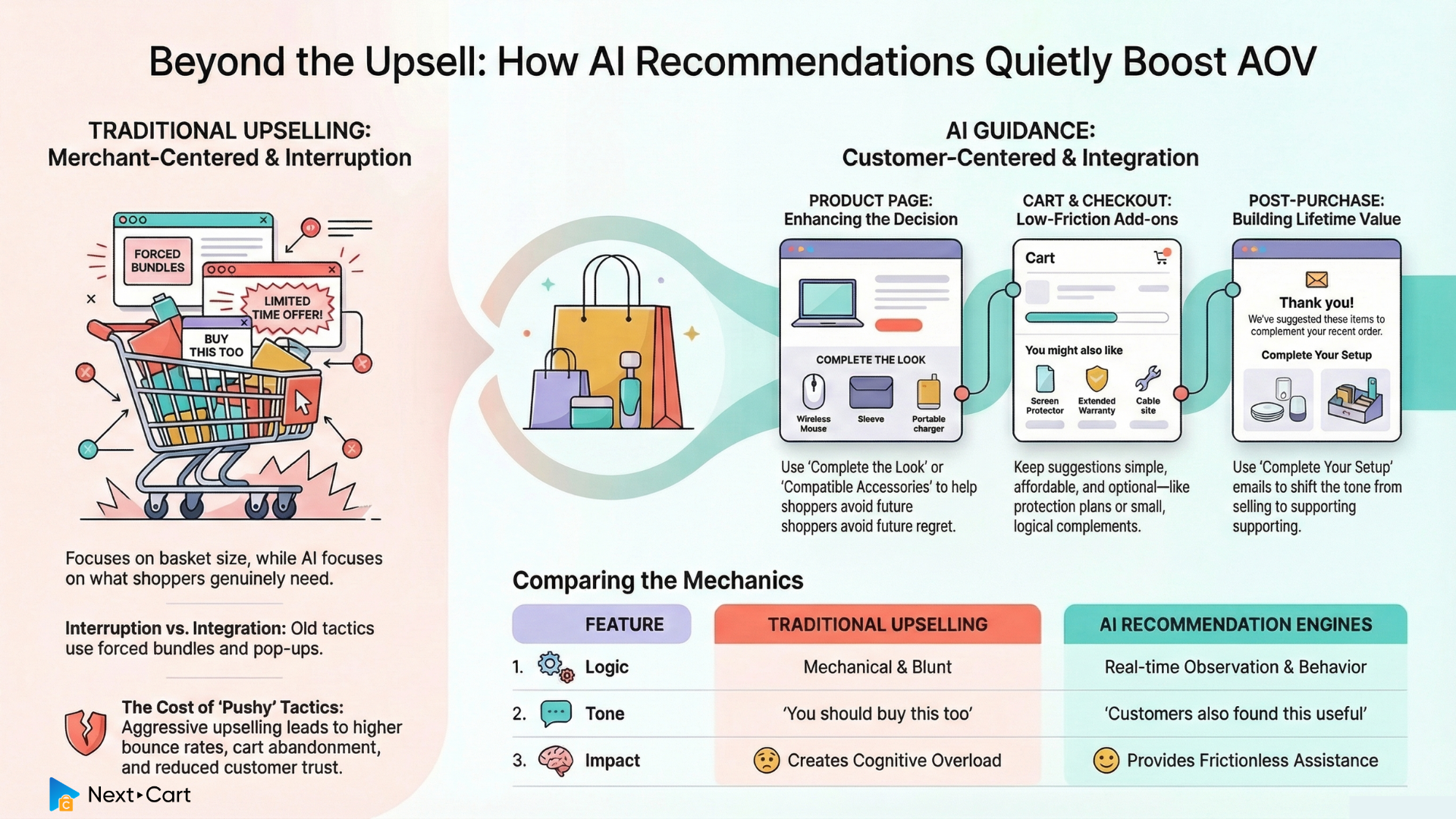
In the past, traditional upselling was often seen as interruptions of the buying journey. It used to show pop-ups to customers, force unfit bundles, or even aggressively push upgrades before the shopper had decided on the original product. As a result, it often created friction.
But a significant difference lies in guiding rather than pushing.
Now, AI recommendation engines are being applied to upselling strategies to avoid forcing customers to buy more. Instead, they are designed to help customers discover what they truly need.
With natural, relevant, and timely recommendations, Average Order Value (AOV) increases quietly. Then customers add more items not because they feel pressured, but because the suggestions make sense to them.
The real shift is that AI recommendations don’t try to sell more; they’re about helping shoppers better.
The problem with old-school upselling
Let’s take a closer look at what really went wrong with traditional upselling methods.
The old approach was often blunt and mechanical:
- Stores would install pop-ups to appear seconds after shoppers landed on a product page.
- “Buy 3, get 1 free” banners would be displayed across every page, regardless of context.
- Bundles would automatically add items to the cart, and customers had to manually remove them.
- Cross-sell sections would recommend products that are not relevant at all.
These forcing tactics were common due to a simple assumption: more visibility equals more sales.
But customers actually experience a website as a journey, not a series of sales tactics. So, when the journey is interrupted with all types of sales tactics, customer trust erodes.
As a result, beyond an ineffective AOV increase, aggressive upselling often leads to other negative consequences, including:
- Higher bounce rates
- Cart abandonment
- Reduced trust
- Lower overall conversion
This happens because customers feel pressured and unsatisfied.
- When someone is still evaluating a product, a sudden “Upgrade Now!” pop-up appearing will feel premature.
- When unrelated products are suggested, it signals that the store does not truly understand the shoppers’ needs.
- When there are too many offers in the store, competing for shoppers’ attention, cognitive overload occurs.
The final result is often under expectations. The more you push additional products, the less customers want to engage with them.
What AI recommendation really does
AI recommendation engines do not operate on such a force logic. Instead, they are based on real observation and understanding.
Unlike traditional upselling, which randomly shows products, AI systems first analyze customers’ browsing behavior, past purchase history, product relationships, similar customer patterns, and real-time interaction signals.
Rather than saying, “You should buy this too,” the system suggests, “Customers who viewed this item also found this useful.”
The tone is subtle, and the suggestion feels much more contextual.
The difference here lies in intent. Traditional upselling is merchant-centered: How to increase the basket size? Meanwhile, AI recommendations are customer-centered: What customers genuinely need?
For instance, for a shopper viewing a professional camera, AI may recommend a compatible memory card, a protective carrying bag, or an extra battery.
These suggestions are not random. They are actually logical complements, as the system has understood product compatibility and usage content. Then, recommendations are provided to solve real problems the customer may not yet have even considered.
Instead of pressure, these suggestions feel like assistance that improves customers’ experiences.
It resembles a knowledgeable in-store sales associate who says, “If you’re buying this camera, you’ll probably want a memory card as well.”
The upselling suggestions are now more relevant and frictionless. And when customers feel supported, they are far more open to adding items.
Where smart recommendations increase AOV naturally
AI recommendations can present throughout the customer journey to improve shopping experiences. Each stage in this journey is an opportunity to increase AOV without creating friction.
Product page
The product page is the most natural place to introduce complementary items. At this stage, when customers click to discover a product, they are already engaged with it. The key is to keep recommendations tightly related.
In the product page, effective placements include:
“Frequently bought together”
“Complete the look”
“Compatible accessories”
“Customers also bought”
Then, the relevance must be clear. For example, if someone is viewing running shoes, suggesting matching socks or a sports watch makes sense.
The goal here is to enhance the primary purchase decision.
When done well, these suggestions help reduce future regret. Instead of later realizing they forgot an essential accessory, the customer can complete their purchase with confidence.
And that confidence naturally increases order value with customer satisfaction.
Cart page
AI recommendations should be a beneficial factor that maximizes AOV growth.
At this stage, the customer has already committed to certain items. Therefore, the suggestions should be low-friction and highly relevant.
For example, the suggestions could be protection plans, small add-ons, extended warranties, or low-cost complementary items.
The key rule is to keep the suggestions simple and optional. Avoid forced additions or intrusive pop-ups; instead, place subtle recommendations below the cart items.
In addition, the suggestions should be logical and affordable relative to the cart value. Then, customers are more likely to accept them.
Checkout page
Checkout is one of the most sensitive stages for upselling. Any interruptions here can damage conversion rates.
In particular, overloading this stage with additional offers is totally not recommended. Instead, suggestions must be minimal and highly relevant.
In most cases, a single selective suggestion works better than multiple blocks.
Also, site speed is critical here. Slow-loading widgets create frustration for shoppers.
In short, at this stage, less is more.
Post-purchase
After checkout, there is still a powerful opportunity to increase value through post-purchase emails
“Complete your setup”
“Customers who bought this later upgraded to…”
“Accessories that enhance your experience”
As the original purchase is already complete, the tone shifts from selling to supporting, no pressure.
This approach helps increase not only AOV but also lifetime value (LTV), as customers perceive the brand as helpful and knowledgeable.
When AI becomes pushy (and fails)
Even with AI-powered systems, failure is still possible if they are implemented poorly. They do not automatically guarantee a good experience.
Below are common mistakes that can turn intelligent recommendations into noise during the purchase journey.
- First, too many recommendation blocks
Imagine every page contains multiple carousels, such as: “You may also like,” “Recommended for you,” “Trending now,” or “Customers also viewed.” Then, the suggestion effect becomes overwhelming. And the system becomes confusing rather than guiding.
- Second, irrelevant suggestions.
AI systems operate depending on data quality. If the data is unqualified, fragmented or outdated, the suggestions would not match customer intent, recommending irrelevant products.
- Third, slow loading times.
External apps or poorly integrated recommendation engines can slow down page load times. Widgets load seconds after the main content. Then, shoppers may feel disconnected and intrusive.
- Fourth, repetition.
Showing the same recommended products across all pages, including product pages, cart pages, and emails, can create fatigue. Customers can easily notice the repetition and find it untrustworthy.
Overall, the core principles when using AI recommendations are: relevance builds trust, and overexposure destroys it.
The most efficient AI recommendations often feel almost invisible and highly relevant. If customers notice how often they appear, something might go wrong.
Why platform and data matter
Behind every effective AI recommendation system is a strong data architecture.
From hundreds of migration projects across platforms like Shopify, WooCommerce, Magento, and BigCommerce, Next-Cart teams have observed one consistent pattern: the quality of recommendations depends on how centralized and accessible the data is.
Many stores struggle with:
- Fragmented customer data
- Separate databases for products and orders
- Heavy reliance on third-party plugins
- Lack of real-time processing
In these situations, when AI tools act as external layers, there are several common issues emerging, such as slower page speed, inconsistent personalization, delayed recommendation updates, and data synchronization errors
If a platform cannot process behavior in real time, AI recommendations lag. Customers continue to see suggestions based on a previous browsing session rather than their current intent.
To help AI work properly, platforms need to provide it with a clean product taxonomy, accurate customer data, real-time behavioral tracking, and fast server response times.
A store built on fragmented systems will struggle to implement intelligent recommendations. On the other hand, a well-structured architecture accommodates AT to operate smoothly.
This is why platform decisions and migration strategies matter for integrating AI-powered tools.
The real secret: increase value, not pressure
Ultimately, increasing AOV is not about pushing shoppers to add more products to a cart. It is about increasing perceived value.
When customers add a complementary item that makes sense, they do not feel sold to, but feel prepared.
The shift in mindset is critical. Instead of asking, “How can we push customers to spend more?” merchants should ask, “How can we help customers make better decisions?”
AI recommendations support this approach by:
- Reducing search effort
- Highlighting compatible items
- Anticipating needs
- Saving time
Imagine walking into a physical store and meeting a skilled sales associate who listens carefully, understands your intent, and suggests exactly what you need. They do not overwhelm you with unrelated products and put pressure on you.
That is what a good AI recommendation does. It acts as an elegant assistant.
When customers feel understood, they trust the brand more and are comfortable spending more. Then, the increase in AOV becomes better service, not aggressive selling.
How AI Recommendation Engines Increase AOV Without Being Pushy
Helpful sells more than aggressive
When implementing AI recommendation engines thoughtfully, merchants can achieve two goals simultaneously: higher revenue and better customer satisfaction.
The key to achieving the optimal result lies not in the technology itself, but in the philosophy behind it:
- Relevant
- Timely
- Simple
- Fast
The recommendations then are no longer pressure or interruption. Instead, customers will feel understood and supported. In that environment, AOV naturally increases, while stores can improve customer satisfaction.
The future of eCommerce does not lean on louder selling, but on smarter guidance.
AI recommendations, when done right, prove that: helping customers buy better outperforms trying to make them buy more.