
Search is no longer about links.
For years, search engines have acted as a process of discovery, comparison, and evaluation. Users type a query into Google, scroll through links, click on one or two results, browse multiple pages, and make a decision.
That behavior is changing.
Today, users are turning to AI-powered interfaces, including chatbots, assistants, and generative search experiences.
- Instead of typing keywords, they ask full questions.
- Rather than browsing ten tabs, they expect a single, clear answer.
- Instead of comparing options themselves, they rely on AI to guide their decisions.
In other words, search is no longer about finding pages. It is about getting answers and receiving recommendations.
AI introduces a new layer between users and websites. It is now a gatekeeper. It could act as a search engine summarizing results, a chatbot answering questions, or a recommendation engine suggesting products.
In short, you are no longer just competing to rank on Google. You are competing to be understood, selected, and recommended by AI.
Therefore, traditional SEO is no longer enough. Businesses must expand their marketing strategies with Answer Engine Optimization (AEO) and Generative Engine Optimization (GEO).
These strategies form the new search optimization stack for 2026. SEO vs AEO vs GEO.
- SEO: Still foundation, but not the full picture
- AEO: Winning the answer, not the click
- GEO: When AI recommends products
- SEO vs AEO vs GEO – A simple comparison
- Why this matters for merchants right now
- How to prepare for the new optimization stack
- Content layer: Answer real questions clearly
- Data layer: Build structured, consistent information
- Platform layer: Ensure flexibility and performance.
- The future: From ranking to understanding
- A new game requires a new stack
SEO: Still foundation, but not the full picture
Search Engine Optimization (SEO) has been by far the backbone of online visibility. It is about optimizing your website for search engines so they can understand and rank it for relevant queries. It focuses on keywords, backlinks, technical performance, and content relevance.
When done well, SEO helps your website appear higher in search results. It helps drive organic traffic and increase brand visibility.
SEO still plays a crucial role today in 2026, in many ways:
- Ensures your site is discoverable.
- Helps search engines index your pages correctly.
- Builds authority over time.
- Remains a cost-effective way to generate consistent traffic.
However, in the AI era, SEO appears to have its limitations.
First, SEO depends on clicks, getting users to click on your link. Meanwhile, in AI-driven search, users often get direct answers without clicking anything.
Second, competition is more intense as ranking on the first page is no longer enough. Now, the top few results or AI-generated answers get attention.
Third, AI systems are summarizing content. They condense your carefully crafted article into a few sentences. As a result, it tends to strip away branding, context, and conversions.
In other words, SEO can still bring traffic, but it no longer guarantees visibility.
This is why eCommerce businesses must look beyond SEO. It is time to optimize not just for search engines, but also for answer engines.
AEO: Winning the answer, not the click
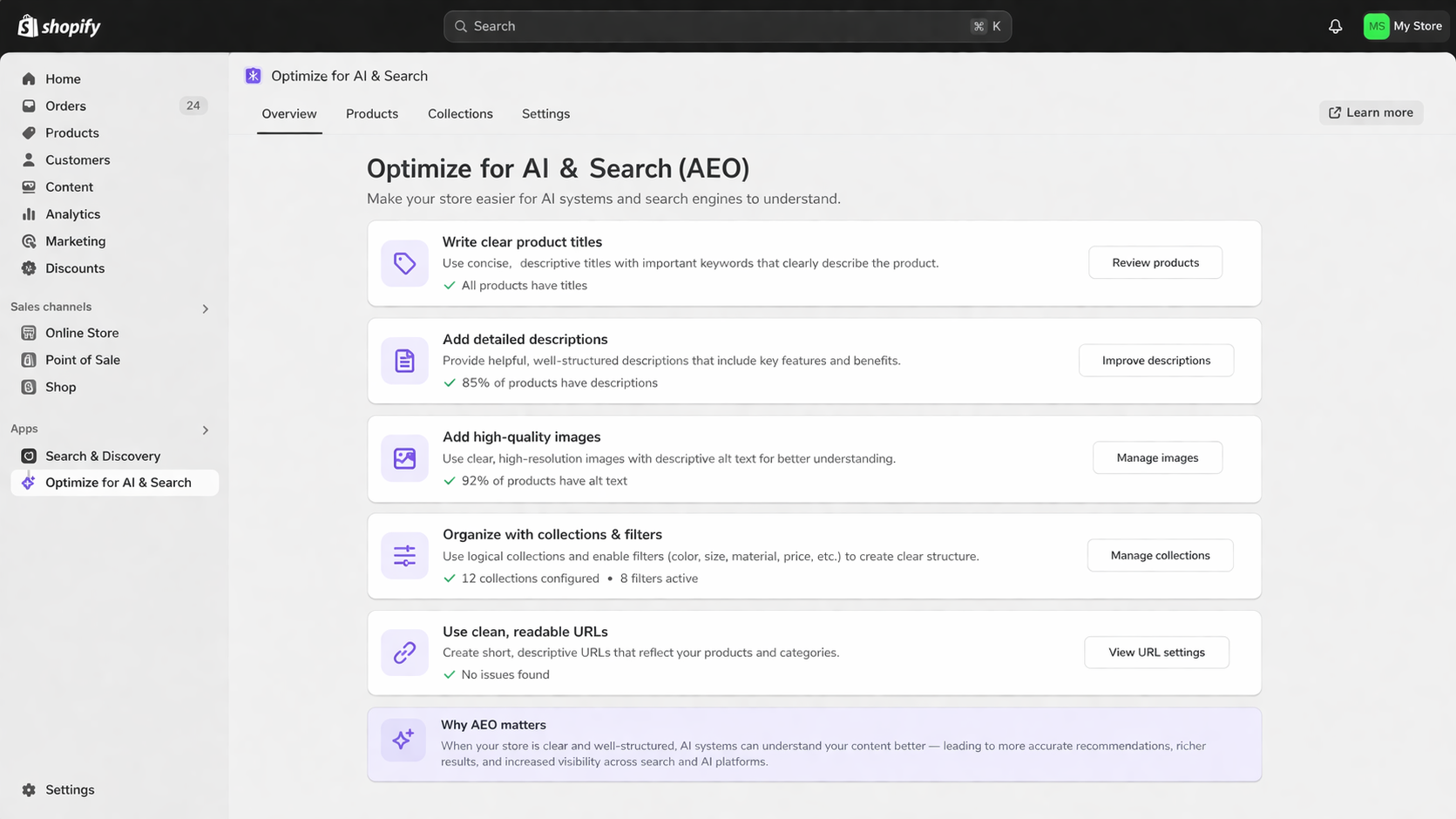
Answer Engine Optimization (AEO) is the next evolution of search strategy. Instead of focusing on ranking, AEO ensures your content is selected as the answer for users’ questions.
For example, a student might ask, “What’s the best laptop for college?” A business owner might ask, “How do I migrate my online store?” A shopper might ask, “What should I buy for a home office setup?”
In the AI era, these users tend to prefer a direct answer over a list of links.
AEO is about structuring your content to help AI extract, understand, and present it as a response. This requires a different approach to content creation.
- Instead of long, unfocused articles, AEO favors clarity.
- Rather than burying key points deep in paragraphs, AEO focuses on giving direct answers.
- Instead of vague explanations, it prioritizes specificity.
With each user’s question and concern, AI systems look for content that clearly defines options and provides a clear conclusion. If your content is well-structured, with clear headings and concise explanations, it is more likely to be selected for presentation in user answers.
The key here is simple but powerful. If AI answers the question without you included, you lose visibility. AEO ensures that your content is not just indexed, but used.
But as AI evolves further, answering questions is only part of the journey. It is recommended.
GEO: When AI recommends products
Generative Engine Optimization (GEO) makes the shift more impactful for merchants.
While AEO focuses on informational queries, GEO focuses on decision-making ones. This is the moment when users are ready to choose a product or service.
For example, users might ask queries, like “What should I buy for a beginner home gym?” “Best skincare routine for teenagers” or “Which platform should I use for my online store?”
In these cases, they are not just looking for information – they are looking for recommendations.
And AI is stepping in to provide those recommendations directly.
GEO is about including your products and services in those AI-generated suggestions. This requires more than good content, yet it requires high-quality data.
AI systems rely on product structure, including attributes, categories, relationships, and context, to determine what to recommend. If your data is incomplete, inconsistent, or poorly structured, your products may be invisible to AI.
For example, if you sell running shoes, AI needs to understand:
- Who the product is for (beginners, professionals)
- What it is best used for (road running, trail running)
- Key features (cushioning, durability, weight)
- How it compares to alternatives
Without this complete context, AI cannot recommend your product.
In addition, the key difference between AEO and GEO is intent:
- AEO is about answering questions. GEO is about influencing decisions.
- AEO helps users understand. GEO helps users choose.
As AI increasingly makes choices on behalf of users, GEO becomes critical.
SEO vs AEO vs GEO – A simple comparison
Let’s look at these three approaches side by side.
SEO focuses on search engine rankings. Its goal is to appear in relevant queries and drive traffic. Though it is mediated by search engine algorithms, SEO primarily targets human users. The performance is measured by clicks, sessions, and page views.
AEO focuses on being selected as the AI answer. Its output is a direct response through AI interfaces. Users may never see the original source. The impact is authority and presence in the decision-making moment.
GEO focuses on being recommended. Its output is a suggestion for a product or service. It is deeply integrated into AI-driven experiences. The line between search and recommendations disappears. It directly impacts businesses’ conversion and revenue.
More importantly, SEO, AEO, and GEO do not replace one another; they are layers of a single strategy.
SEO gets you indexed.
AEO gets you quoted.
GEO gets you chosen.
Why this matters for merchants right now
This shift is already happening, not in the distant future. Users are increasingly relying on AI to guide their decisions. Search engines are integrating generative answers into result pages.
AI is becoming a “middle layer” between users and only stores.
In the past, users interacted directly with search results. Today, they interact with AI-generated summaries and recommendations. Your website is no longer the first point of contact.
If you keep doing it the same way you have so far, the risk is high. Your product might exist, your content might be well-written, and your SEO might be strong. But if AI does not select or recommend you, you disappear from the user’s journey.
Then, you need to be included in AI responses. And it comes to how AI can understand, trust, and use your data.
For merchants, at this changing moment, you are not just optimizing for search engines anymore. You are optimizing for systems that summarize and decide.
How to prepare for the new optimization stack
To adapt to this new reality, businesses need to change how they approach their digital presence.
It’s no longer just about content or keywords – it is about building a system that AI can understand and utilize.
There are three key layers: content, data, and platform
Content layer: Answer real questions clearly
Content must be answer-focused instead of keyword-focused. In other words, write for questions instead of for search engines. You should think about what your customers are actually asking, then provide clear, direct responses.
Structure is critical. Headings should reflect real queries. Provide concise answers early in the content. And try to break down complex topics into smaller sections.
Clarity is more important than length. An 800-word article that is well-structured and directly answers a question is better than a 3,000-word article without a clear answer.
The most important goal is to make it easy for AI to extract and present your content.
Data layer: Build structured, consistent information
To make GEO work well, data is everything.
Your product information must be clean, consistent, and structured. This includes product attributes such as size, color, material, use case, and target audience.
Here, schema markup and metadata play a crucial role. They provide explicit signals that help AI systems understand what your data means.
At the same time, ensure consistency throughout your website. It is harder for AI to interpret if your product categories, naming conventions, and attributes vary across your site.
Data is the language to communicate with AI. The clearer it is, the better AI can represent your products.
Platform layer: Ensure flexibility and performance.
Finally, your platform should support this new optimization model.
A rigid or outdated system can limit how you can structure data and optimize performance.
The eCommerce platform you choose needs to be flexible, fast, and API-driven. Then, it allows you to easily manage content and data to align with how AI consumes them.
The future: From ranking to understanding
The biggest shift in this new era of eCommerce is not technological but conceptual.
For years, all businesses have focused on ranking pages, and success was measured by positions, clicks, and traffic.
But in an AI-driven world, what matters more is understanding.
AI systems enhance the relationship between users and websites by recommending products and services. AI needs to understand your content, products, customers, and value to give its recommendations.
This changes how we implement optimization.
What We See During Store Migrations: AI Has Changed What Customers Expect
It is no longer about algorithms or keywords alone. It is about building clarity and consistency in every layer of your digital presence.
When AI understands your business, it becomes your advocate. It will surface your products in the right context, answer questions, and guide users toward your offerings.
And that is far more powerful than a single search ranking.
A new game requires a new stack
SEO is not dead. It remains a critical foundation for visibility. But it is no longer sufficient on its own. AEO and GEO represent the next phase where answers and recommendations matter more than links and rankings.
Together, they form a new optimization stack. They reflect a circumstance in which users ask instead of searching, AI answers instead of lists, and systems recommend instead of users comparing.
For merchants, this brings both challenge and opportunity. That’s why it’s important to acknowledge SEO vs AEO vs GEO.
The challenge is to adapt to a more complex landscape where there is more than just SEO. The opportunity is a competitive advantage by moving early: structuring content, data, and platform to align with how AI works.
In the future, success is not just about being found. It is about being chosen.