

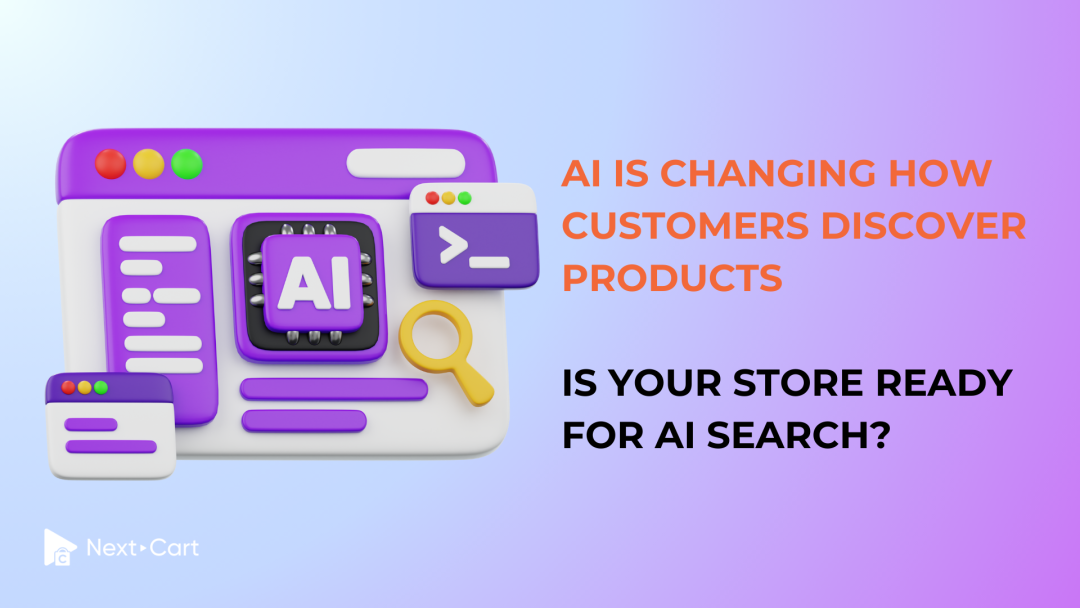
Customers are not searching like before
Not long ago, online shopping followed a predictable path: On their browser, customers typed keywords into a search box, scanned through resulting pages, clicked product listings, compared options, and made a final decision.
Then, eCommerce platforms and SEO strategies were designed around this behavior. Business success was measured by how well the pages ranked in search engines for the “right” keywords and by how attractive the pages were to customers.
However, this model is gradually disappearing.
Currently, instead of searching the web, customers are asking questions. Instead of manually comparing dozens of products, they rely on AI-generated options. Customers no longer click through multiple websites; they receive shortlists and AI recommendations before visiting a store.
In other words, AI now sits between customers and products: Customers ask questions > Search engines summarize answers > Shopping apps recommend products > Chat-based tools suggest “the best products” based on customers’ preferences and past behaviors.
This shift raises a new urgent question for online merchants:
Is your store visible in this new AI-driven discovery flow? Is it filtered out before customers even see it?
What does “AI search” really mean for shoppers?
AI search is often understood as a more advanced search engine. In reality, it contains a fundamental shift in how engines discover information and products.
Traditional search tended to match keywords to sites. Meanwhile, AI search focuses on understanding customer intent and delivering decisions.

For example, when a shopper asked, “What are the best running shoes for flat feet?” AI will not only provide a list of sites but also offer guidance. AI can interpret the problem, evaluate available options, and surface products to fit their needs.
AI-powered systems tend to provide more direct answers instead of links. They summarize product features and recommend items for shoppers. Sometimes, they even rank products by suitability.
At the moment, these experiences already exist across many online channels:
- AI summaries appear at the top of search results.
- Recommendation engines personalize product visibility within marketplaces.
- AI tools suggest products directly within chats and apps.
In all of these cases, customers place great trust in AI to help them make buying decisions. Therefore, the flow shifts from customers discovering themselves to AI qualifying and recommending.
Products can be either included in the AI’s shortlists or excluded entirely.
How are products discovered without clicking your store?
In modern eCommerce, “zero-click discovery” is popular.
This does not mean customers never visit an online store, but many purchasing decisions are influenced or even made before a store-visiting click.
As customers easily see products through AI summaries and recommendation lists in search results, shopping apps, or conversational interfaces, they may already have a preferred option before visiting a product page.

From the merchants’ perspective, this introduces a hidden risk.
You have already indexed the products, set competitive prices, and made them technically available online, but they remain invisible. In fact, if AI systems cannot understand what a product is, they may simply not show it.
In this new online business landscape, visibility is no longer guaranteed by presence alone. Instead, it depends on whether AI can interpret your catalog clearly to recommend it to users.
Only traditional SEO is no longer enough
Search engine optimization is still important. Keywords, page structures, and technical performance should continue to matter.
However, traditional SEO was originally built for human readers, so AI systems cannot evaluate their meaning at scale.
Normally, traditional SEO strategies prioritize keyword density, long-form content, and backlinks. Among others, these elements help pages rank well.
On the other hand, AI systems understand a product by analyzing its structure, consistency, and relationships between data. The systems evaluate a product based on how clearly its information is defined and whether it aligns across the whole catalog.
Therefore, a page that looks persuasive to a human reader may still be ambiguous to an AI, just because the underlying data is unclear or inconsistent.
Let’s consider two product listings as an illustration.
One is optimized with marketing language and repeated keywords. The other focuses on using clear titles, structured attributes, and consistent descriptions.
The results of both strategies may be acceptable to humans. But to an AI, the latter one is easier to interpret and classify.
In short, clarity becomes as important as optimization. SEO helps customers find your pages, and AI readiness helps your products be selected before the pages are opened.
Read more:
https://next-cart.com/blog/ai-changes-what-customers-expect-that-we-see-during-migrations/
What AI looks at when choosing products to show
AI does not evaluate products emotionally; it evaluates them logically. Its goal is to reduce uncertainty.
- Product titles and descriptions
When deciding which products to surface, AI systems look at product titles and descriptions as a starting point. The systems need to immediately understand what the product is, what problem it solves, and who it is for.
Titles with internal codes or branding alone provide little meaning to AI systems, whereas clear, descriptive titles help AI systems classify products more easily.
- Categories and attributes
Category structure and product attributes are also important to help AI understand your products. AI looks for logical hierarchies and standardized data.
For products sharing consistent attributes, such as size, material, compatibility, or use cases, AI is more confident. Meanwhile, when attributes are missing, duplicated, or labeled differently across listings, its confidence is lower.
- Reviews and consistency
Customer reviews help AI validate whether product descriptions align with real-world usage. Also, consistent feedback reinforces its validation. Conflicting signals create doubt and less confidence in showing a product.
Signs your store is not ready for AI search yet
Many online stores ask: If their site is indexed, loads quickly, and ranks well, are they already “AI-ready”?
In practice, AI-driven discovery exposes weaknesses that traditional search often overlooks: AI cannot clearly understand what your store offers.
Common warning signs of your store not being ready for AI search include:
- Product data is inconsistent
Over time, as catalogs grow and teams change, attributes may be named differently across similar products, specifications may be missed, and different labels appear in the same feature.
To AI, these signs raise uncertainty. When AI cannot compare products within the same category, it hardly recommends any of them.
- Categories overlap or confuse
This happens when stores organize categories based on internal logic, legacy decisions, or marketing campaigns, without considering clear product meaning. Then, categories may overlap, with mixed product types and unclear hierarchy.
This structure often confuses AI systems, making it hard to determine clear relationships between products and categories.
- Important information lives in images only
Another sign is essential product information appearing only in images. For example, size charts are embedded in banners, technical specifications are presented as infographics, or key features are listed within promotional images.
This presentation may appeal to customers, but it is largely invisible to AI systems. Without structured, readable text, AI cannot understand product details to evaluate them.
Rest assured that these issues do not indicate poor management or bad intent. They are just a natural consequence of the growth path with years of adapting to practical customer shopping behaviors. Almost every established store has this technical “messiness”, but it is totally fixable.
How smart merchants prepare for AI discovery
Instead of chasing every new algorithm update or tool, smart merchants focus on fundamental actions.
- Clean product data
They invest time in cleaning product data. This does not mean rewriting every description or all content. It is about making core product information accurate, complete, and consistent across the entire catalog.
Smart merchants set a standard for attributes, including size, material, compatibility, usage, and variations, so that similar products speak the same “language.” Then, when evaluating the category, AI can compare products with confidence.
- Clear structure
To prepare for AI discovery, merchants revisit their category hierarchies with a simple question: Does the current structure clearly explain products?
Well-prepared stores define clear parent-child relationships and ensure each product belongs in the right category. This clarity helps AI understand how products relate to one another and which is relevant for specific use cases.
- Fewer workarounds
During operations, many stores have accumulated custom fields, plugins, duplicate attributes, and manual overrides to address short-term problems. But these often fragment product data behind the scenes.
Smart merchants gradually replace these patches with cleaner and more unified data models. With fewer exceptions and special cases, the entire catalog becomes easier for AI to interpret.
A key mindset change is that AI evaluates patterns across the entire store, not individual pages. Therefore, it is vital to ensure consistency across products, categories, and attributes. Smart merchants tend to think holistically about their catalogs.
To illustrate this, consider a retailer that migrated its online store from an older eCommerce platform to a modern one. They didn’t launch a new brand campaign or increase ad spend. Instead, they standardize product attributes, simplify categories, and remove duplicate data.
As a result, after the migration, their catalog became easier for AI systems to read and classify. Over time, their products appeared more frequently in AI-generated recommendations and summaries.
What sets these merchants apart is not advanced technology or optimization. It is discipline. They invest in clarity, structure, and consistency.
Product visibility now depends on AI understanding
Product discovery has changed significantly.
Customers are no longer navigating the web alone. AI now guides them, filters options, and determines which products are seen.
In many cases, AI acts as the first and most influential decision-maker.
This shift redefines what it means to be visible online.
It is not about gaming systems or chasing trends. It is about making your store easy to understand based on AI readiness. Clear, structured, and consistent product data helps AI confidently recommend it.
In other words, the future of eCommerce visibility depends less on rankings and more on AI understanding.
The most important question for merchants today is not, “Is my SEO good enough?” It is:
“If AI were your customer, could it understand your products?”
If the answer is uncertain, now is the time to prepare!