

For many eCommerce businesses, global storefronts begin with translating the website and enabling currency switching, and then expecting customers from new markets to start buying. Yet in practice, many businesses discover that sales don’t move.
This situation is more common than merchants expect.
A store launches in new markets across Europe and Asia. It has product descriptions translated, navigation menus appearing in multiple languages, currency converters installed, and international marketing campaigns beginning. Then, traffic grows, but conversion rates remain low.
At first glance, the content is readable, the checkout works, and products are available globally.
Why? Because translation alone does not create localization.
A translated website may display understandable words, but it does not create a trustworthy shopping experience. Meanwhile, customers evaluate far more than language.
The entire shopping experience should be adapted to the expectations of each region.
Global storefronts: Multilingual is just the first layer
When first approaching global expansion, merchants often center on translation:
- Product descriptions are converted into multiple languages.
- Navigation menus are duplicated across language versions.
- Checkout pages and policy documents are translated to ensure customers understand the purchasing process.
These steps are essential for international customers to navigate the store and understand product details. However, translation alone addresses only the surface of localization.
In fact, a truly multi-lingual store must manage a wide range of content elements. This includes product titles, detailed descriptions, category names, navigation menus, blog content, marketing banners, and promotional messages.
Beyond the storefront interface, transactional communication must also be localized. Order confirmation emails, shipping notifications, return instructions, and support responses must all reflect the customer’s language.
Policy pages are a critical component that customers need to understand clearly before making a purchase. They include return policies, shipping guidelines, privacy statements, and warranty information. Inconsistent or poorly translated policies can reduce confidence in the brand.
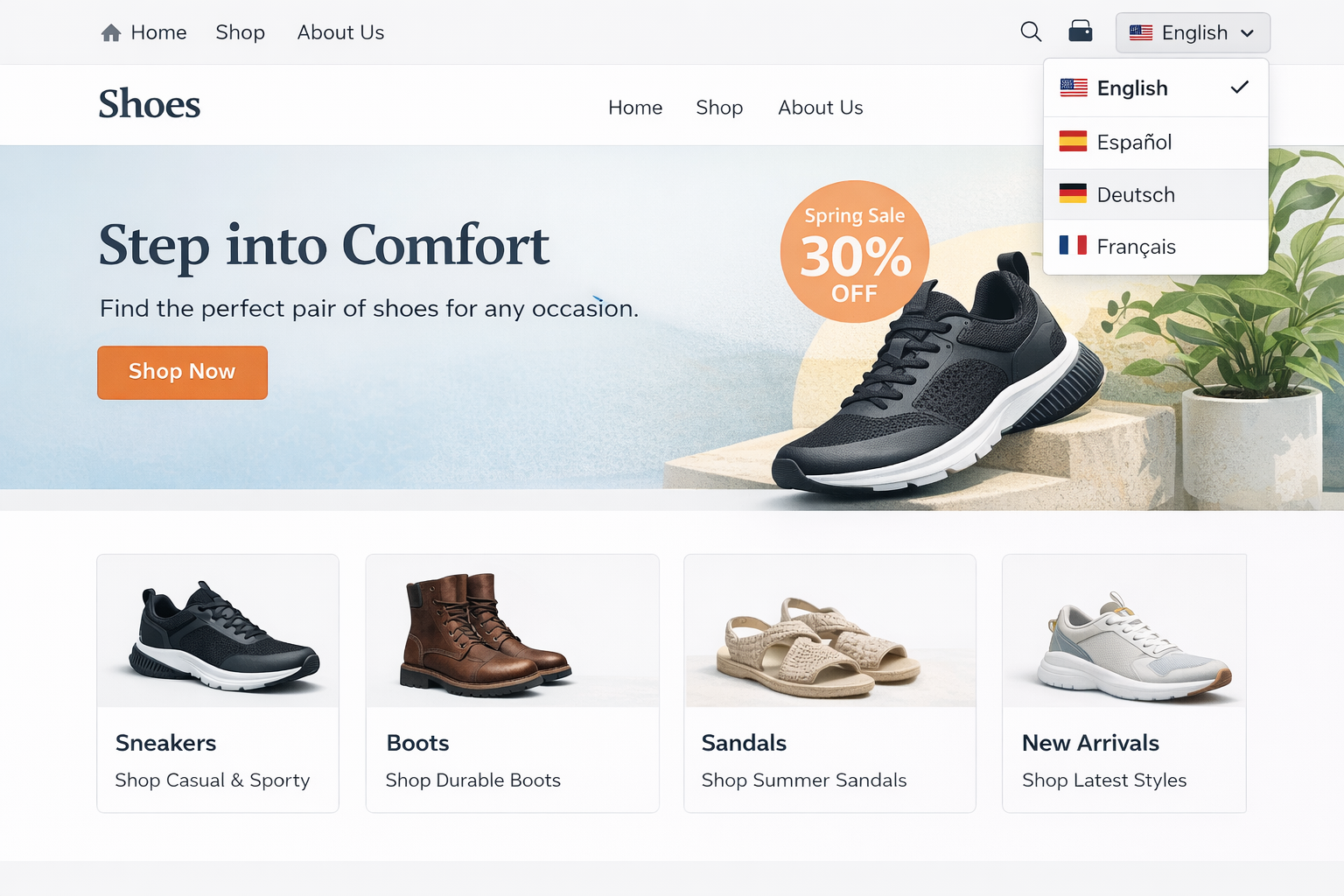
In addition, managing across several languages introduces more layers of operations. Any update in one language must be synchronized with all others. For example, an updated product specification in English should also be translated into German or Spanish. Or promotions launched in one region must appear in the corresponding language version.
The challenges grow as product catalogs expand. A store with hundreds or thousands of products will require translations for the corresponding number of individual content elements. A structured system is needed to manage these translations and maintain consistency across languages.
Moreover, customers expect more than readable text; they expect relevance. Product details, measurements, regulations, and messaging must be aligned with the norms of their local market.
This is where global storefront optimization becomes critical. It is about managing custom data that adapts the store experience for each region.
The hidden layer: Custom data per market
While multilingual makes a storefront readable, custom data makes it meaningful for a certain market. It plays a crucial role in how a store serves international audiences.
Custom data refers to product information and attributes varying by region, regulation, or local consumer expectations. Rather than a single universal dataset, global storefronts require different data structures for different regions.
One of the most common examples is product sizing. With apparel brands, different countries require different size charts. For instance, a size “M” in the United States may correspond to a different measurement range in Europe or Asia. Without their familiar region-specific size, customers may hesitate to purchase.
Measurement units are another challenge. Some markets use centimeters, kilograms, and liters, while others use inches, pounds, and ounces. When displaying the wrong unit system, stores create friction during the buying process as customers must mentally convert information themselves.
Regulatory compliance is also essential for custom data. Certain special industries, such as cosmetics, electronics, and food products, must display specific information by region. Ingredients, safety warnings, certification labels, and packaging details may differ across countries.
For example, for a skincare product, European Union regulations may require detailed ingredient disclosures, while other markets may have different labeling standards. If the product page cannot accommodate compliance data, merchants may face both legal and operational challenges.
Pricing logic can also vary between markets. Taxes, import duties, shipping costs, and local purchasing power vary across regions, influencing product pricing. Therefore, it is not optimal to simply convert currency using exchange rates. Many merchants implement market-specific pricing structures that reflect local conditions.
Marketing content also helps custom data become valuable. For different cultural contexts or regional shopping trends, there is a need for custom promotional messages, seasonal campaigns, and product highlights.
In this circumstance, if a platform does not support flexible product attributes or region-specific data fields, merchants will encounter limitations. They might be duplicate product listings, manual adjustments, or external systems that require storing additional information.
For this reason, to obtain successful global storefronts, data structures need to allow merchants to define and manage custom data for each region without disrupting the product catalog.
https://next-cart.com/blog/the-new-commerce-standard/
Common mistakes we see during migration
When we work with merchants to migrate their online stores to new platforms, the challenges associated with global storefronts become more apparent. The migration process often reveals hidden structural limitations.
Using automatic translation without review
Current automatic translation tools rarely capture the nuance of product descriptions, marketing messages, or policy content. Literal translations can sound unnatural or confusing. This often happens in languages with different grammatical structures.
Unfortunately, customers can quickly notice awkward phrasing or inconsistent terminology. That makes a store appear unprofessional and unreliable, reducing customer confidence during the purchasing process.
One global product database with no regional customization
With a single global product database for all regions, every product attribute is shared across all markets. This makes it hard to adapt content for specific countries. Merchants may struggle to display measurements, regulatory information, or product variations.
Currency conversion without a local pricing strategy
This is an area where merchants often underestimate complexity. Many stores simply apply real-time exchange rates to convert prices. This is actually not an optimal pricing strategy because local taxes, shipping costs, and market expectations may require entirely different pricing models.
Ignoring local SEO structure (URLs, metadata)
Each language version of a site should have its own structured URLs, localized metadata, and keyword targeting. Otherwise, search engines may struggle to index the site across different markets.
Slow performance in certain regions
If a storefront’s infrastructure is optimized only for one region, customers in distant locations may experience slower load times. Even small delays can significantly affect conversion rates.
These issues accumulating make the global store still feel foreign to international visitors. Customers may understand the language, but their experience lacks familiarity and trust.
Why platform architecture matters
Every store experience is built on a technical foundation that can vary in flexibility and scalability. For global commerce, this architectural layer can determine the performance of localization efforts.
Some eCommerce platforms support native multi-language, allowing merchants to manage translations and localized content directly within the system. Yet others rely on third-party extensions to provide similar functionality. These extensions can introduce challenges with compatibility and maintenance.
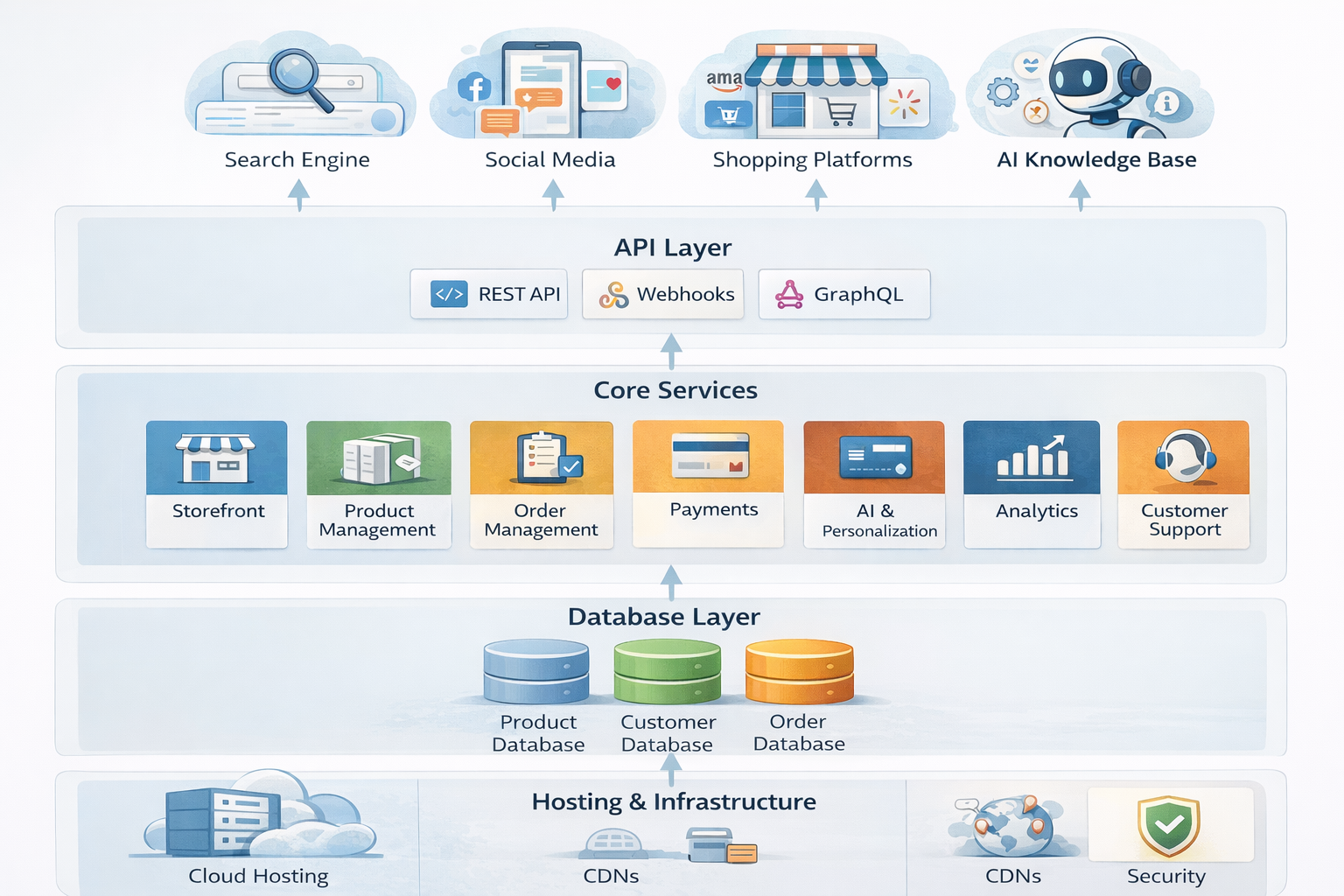
When the platform limits how product data can be structured, localization becomes more complex. Merchants cannot easily create custom attributes or region-specific fields. Then, they may resort to workarounds that can make the product catalog even more complicated.
For example, duplicating products across regions might initially help with localized attributes. However, it also multiplies the effort to update inventory, pricing, and descriptions. Managing multiple versions of the same product quickly becomes a burden for merchants.
Regarding regional pricing, platforms with flexible pricing rules for different markets enable merchants to implement more sophisticated strategies. Otherwise, any pricing adjustment will require manual changes or additional plugins.
Platform infrastructure plays an important role in website performance. Global storefronts must serve customers across continents, so site speed and reliability depend on distributed server environments and delivery networks.
Over time, merchants add multiple extensions or patches to compensate for missing functionality. Each addition solves a short-term problem, but increases the overall complexity of operating the system. Eventually, the platform becomes difficult to manage.
On the other hand, with a flexible platform architecture, localization becomes far easier to manage. Merchants can adapt their storefronts to new markets without restructuring the entire system.
The business impact of doing it right
When global storefronts are optimized properly, the impact extends beyond aesthetics or technical organization. Localization influences how customers perceive a brand before deciding to make a purchase.
- Conversion increases in local markets.
When product information, including measurements, pricing, and regulatory details, aligns with local expectations, customers feel more confident during the buying process. The clarity will encourage faster purchasing decisions.
- Customers trust the brand faster.
When a storefront reflects the norms of a customer’s region, it signals that the brand understands and respects its international audience. For first-time buyers who are still cautious about purchasing overseas, this perception is particularly important.
- Support tickets decrease.
Customer support teams also benefit from proper localization. When product details, policies, and shipping information are clear in each market, customers ask fewer clarification questions. They will not have to handle a load of support tickets related to sizing, pricing, or regulatory concerns.
- Marketing campaigns perform better.
Campaigns in specific regions become more effective when landing pages and product information align with local expectations. At the same time, promotions that reflect cultural context or seasonal trends will make a better impression on customers.
- SEO visibility improves in each region.
Localization creates measurable results for search engine visibility. With properly structured language versions, search engines can effectively index the site for different markets. As a result, organic traffic increases in region-specific searches.
Over time, the improvements compound: higher conversion rates, stronger trust, reduced support workload, and better marketing performance. They will all contribute to long-term growth.
Localization is therefore not just about user experience, but also an investment in sustainable global revenue.
Beyond language: Cultural context
Language and product data form the foundation of localization. Yet cultural context is the next level to consider.
Shopping behaviors vary widely across regions. Payment preferences, delivery expectations, and promotional strategies often differ between markets.
A payment method popular in one country may be rarely used in another. For example, cash on delivery is a preferred payment option in markets where customers are not comfortable with online payments. In contrast, buy-now-pay-later services are more popular in regions with flexible payment plans.
Shipping expectations can also vary. In certain regions, customers expect fast delivery. Meanwhile, others prioritize lower shipping costs even if delivery takes longer.
Marketing tone is also vital in a cultural context. Some markets respond well to direct promotional messaging, while others prefer informational or educational content. In addition, seasonal campaigns, holidays, and promotional events also differ across cultures.
To meet these expectations, storefronts need to evolve to reflect regional behaviors, ensuring that promotional banners, payment options, and marketing messages align with local trends.
A truly optimized global storefront does not simply translate its content; yet it must adapt to reflect the cultural environment of each market.
Global growth requires data flexibility
Expanding into international markets is a milestone for any eCommerce business. However, growing globally introduces operational challenges that extend beyond translation.
A global storefront requires a flexible data structure to support regional differences. Multi-language support is just the beginning. Then, merchants must also manage custom product attributes, localized compliance, pricing strategies, and marketing content.
If platforms restrict how data can be structured or localized, merchants often have to rely on temporary solutions that grow complex over time. This complexity can slow expansion and increase operational stress.
By contrast, flexible platforms allow businesses to adapt quickly to new markets. Merchants can introduce new languages, regional attributes, and localized pricing models without restructuring the entire catalog.
Going beyond a translation project, global expansion is the process of building a storefront architecture that can evolve to meet international markets.
When language and data structure align, merchants can deliver native experiences to customers everywhere, and global expansion becomes sustainable.