
- Why are you waiting too long to migrate – “We usually get the call late”
- Revenue leakage: The money you don’t see disappearing
- Conversion loss: When growth stops responding
- Staff burnout: The cost no one calculates
- Why merchants wait anyway
- The turning point: When waiting becomes more expensive
- Migration is not a reaction – it’s protection
Why are you waiting too long to migrate – “We usually get the call late”
After years of working with merchants across different platforms and industries, we notice a consistent pattern.
Most store owners do not reach out to us when things are smooth. They do not call when revenue is rising or when the platform supports every growth initiative. They call when something unstable appears.
In most cases, they reach out when traffic dips, checkout errors surface during important campaigns, site speed becomes inconsistent, or the internal team begins expressing frustration.
By the time migration is discussed, the business has already been under strain for a long time.
In that way, an eCommerce store rarely fails in a dramatic, single-day collapse. Instead, store performance weakens gradually. Performance drops by small margins, and conversion rates decline slightly.
In addition, more budget is required for marketing efforts to produce the same results. Development cycles become slower and more complex.
The danger lies in how normal this process is. When issues are incremental, they are easier to ignore. They routinely make adjustments for any slight slowdown, a small dip in conversions, or a delayed feature launch.
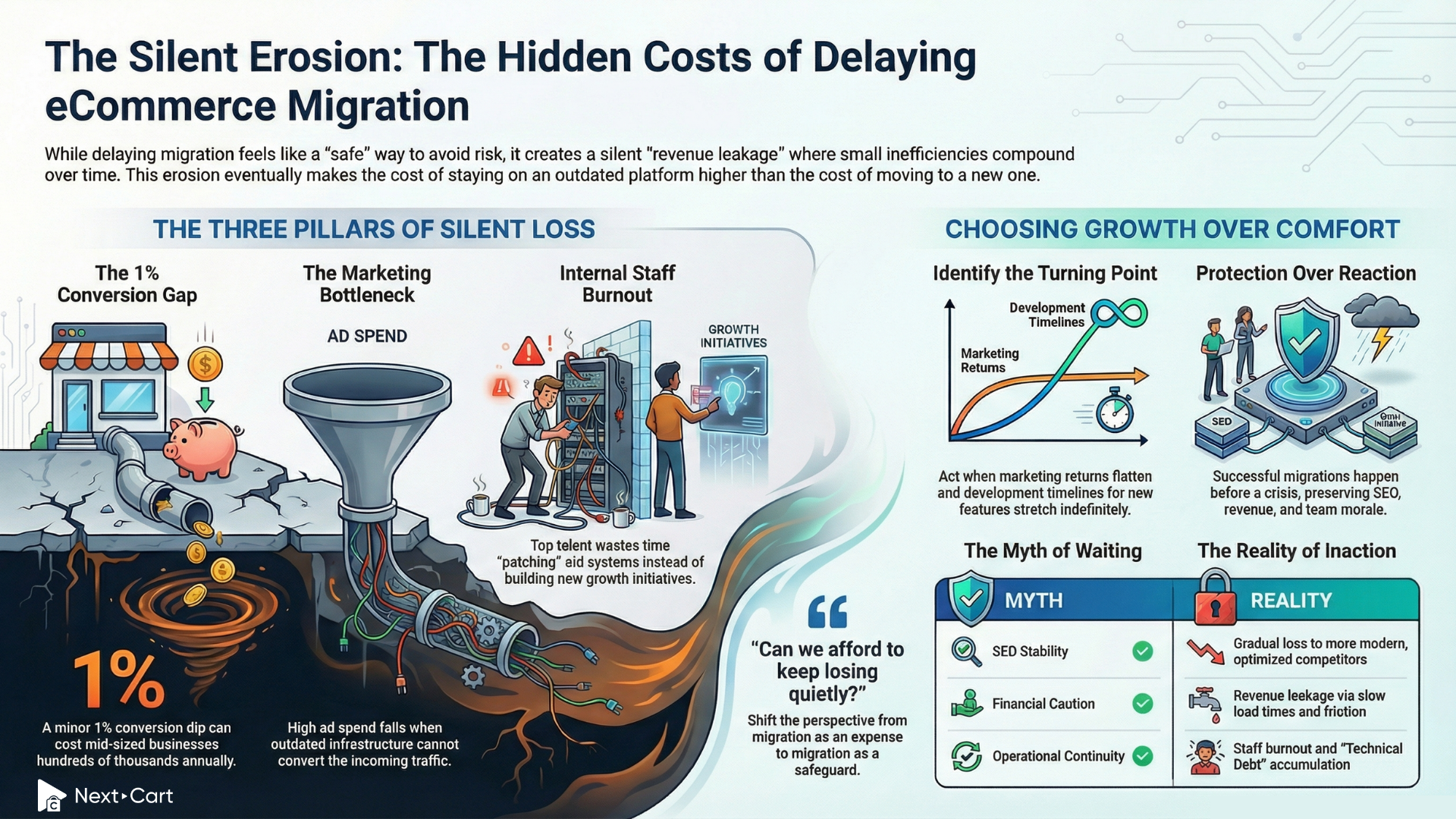
As a result, the hidden cost of waiting too long to migrate is the accumulation of minor losses repeating every day.
Each loss seems insignificant. But together, they reshape the business’s trajectory.
However, waiting often feels safe and cautious. But the longer a merchant postpones a necessary platform change, the more expensive that caution becomes.
This article is about understanding the real cost of inaction and recognizing when waiting will quietly drain more value from your business.
Revenue leakage: The money you don’t see disappearing
Imagine a store that appears stable on the surface, with consistent traffic levels, customers still placing orders, no visible crisis, and steady revenue on financial reports.
Yet something feels stagnant in the meantime.
- Sales have remained flat for more than a year.
- Growth now requires aggressive promotion.
- Marketing budgets increase, but total revenue barely shifts.
Then, business meetings revolve around efficiency rather than expansion.
This is where revenue leakage begins.
However, revenue leakage does not show up as a sudden drop that easily draws attention. Instead, it appears as underperformance relative to potential, such as:
- A product page that loads 2 seconds slower than competitors can reduce conversion.
- A checkout process with unnecessary fields can increase abandonment rates.
- Limited payment options discourage customer segments.
- Mobile responsiveness may not be fully optimized.
No single issue seems urgent enough to justify a major platform decision. However, eCommerce operates at scale. When thousands of customers experience small friction every day, the cumulative impact becomes significant.
For only 1% difference in conversion rate, a large financial gap can be made over a year. In mid-sized and enterprise businesses, that 1% can translate into hundreds of thousands of dollars.
Unfortunately, as the gap develops slowly, it is rarely recognized.
Additionally, platform limitations can restrict revenue growth in less visible ways:
- The current system might make it difficult to implement dynamic product bundles, subscription models, or advanced upselling techniques.
- The rigid promotional rules could prevent flexible campaigns.
- Optimization requires constant manual adjustments.
In particular, when your competitors adopt more advanced capabilities, and you cannot implement similar ones easily, you gradually lose customers.
In other words, revenue rarely collapses. It leaks.
The leakage is dangerous because it feels manageable, while the gap becomes undeniable.
https://next-cart.com/blog/when-to-migrate-overcoming-platform-limitations/
Conversion loss: When growth stops responding
Conversion loss is more subtle than revenue leakage because it hides behind positive metrics. For example, when a merchant invests heavily in advertising, he gets returns:
- Paid traffic increases by 20%.
- Email campaigns generate strong open rates.
- Social engagement significantly improves.
- Analytics dashboards show growing visits and impressions.
Yet revenue does not increase accordingly.
At first, the issue appears to be a marketing optimization issue. Therefore, teams try to adjust targeting, refine messaging, or implement creatives.
But over time, the pattern persists: more traffic yet similar revenue.
This moment indicates that the current infrastructure becomes the limiting factor.
Modern customers expect intuitive navigation, intelligent product search, personalized recommendations, and frictionless checkout.
They compare experiences across stores. What they perceive is simplicity or frustration.
- If your store feels less personalized or less intuitive than your competitors’, traffic will not convert to its full potential.
- With outdated product search engines, systems can fail to accurately interpret customer intent. As a result, product discovery becomes more effortful than it should be.
- The rise of AI and its personalization further widens the gap. Modern platforms now support intelligent product recommendations, predictive search suggestions, and automated merchandising. If your current infrastructure struggles to integrate these technologies, your store may fall behind.
When marketing improves, but conversions do not, then the platform may be the bottleneck. In other words, the foundation cannot amplify the growth energy that enters the system.
Then, conversion loss does not announce itself loudly. It is when long-run plateaued growth becomes a lost opportunity.
Staff burnout: The cost no one calculates
Financial metrics often reveal trends in revenue and conversion. But internal exhaustion often goes unmeasured.
Yet staff burnout is one of the most serious consequences of delaying migration.
When a platform ages, internal teams adapt by compensating for it.
- Developers spend increasing time troubleshooting compatibility issues and resolving extension conflicts. Meanwhile, the system requires updates, interactions become fragile, and technical debt accumulates. Then, instead of focusing on innovations, teams must work on stability.
- Marketing departments encounter barriers when launching new campaigns. For example, teams must deal with postponed feature requests, additional development time for customization efforts, or technical constraints for creative ideas. Then, workarounds become their daily practice.
Over time, this dynamic changes the business’s working culture.
- High-performing developers may feel less satisfied in their jobs, as they typically want to create and optimize, yet their daily work repeatedly revolves around patching and maintenance.
- Marketing teams grow frustrated when their agility capacity is restricted.
Burnout does not appear overnight. Instead, it emerges gradually as enthusiasm fades, projects take longer, and initiative slows. As a consequence, the company becomes reactive rather than proactive.
The costs of burnout can be potential turnover, recruitment expenses, and lost institutional knowledge. But the strategic cost is even greater: diminished innovation.
“When your best people spend time patching instead of building, growth slows.”
This internal drain is rarely considered during migration. Yet it shapes the business’s long-term competitiveness more than many realize.
Why merchants wait anyway
If delaying migration hides costs, why do so many merchants still postpone the decision?
The reason is rarely ignorance. More often, it is because of both caution and uncertainty.
Migration will touch the core of the business, including products, customers, orders, payments, integrations, and data. Changing the platform can feel like performing surgery on a living system. Many merchants worry about unexpected technical issues. So, they accept the familiarity even when everything is not optimal.
SEO is another powerful concern. Years of investing in rankings, content, and backlinks can make merchants hesitate to restructure URLs or change site architecture. Organic traffic feels fragile, and the fear of losing visibility often outweighs the promise of long-term performance gains.
Downtime also feels risky. eCommerce stores operate continuously, so even short interruptions can impact revenue. From a leadership perspective, avoiding temporary disruption seems wiser than initiating change.
There is also a financial perception issue. Migration is often viewed as a cost rather than a growth driver. Meanwhile, marketing campaigns and product expansion appear more directly tied to revenue.
But perhaps the strongest reason merchants wait is normalization: small inefficiencies become routine, and slower performance becomes “good enough.”
Because revenue is not collapsing, the urgency to act remains low.
Waiting feels safe, while the risks of migration are visible and immediate.
However, hidden costs compound over time. By the time migration becomes undeniable, the business may already be under pressure.
The turning point: When waiting becomes more expensive
At some points, merchants encounter a moment that changes the conversation, but not a crisis.
It is when revenue might still look stable, and traffic might still be steady. Yet leadership starts noticing harder patterns.
- Marketing spend increases, yet returns flatten.
- Development timelines stretch longer than expected.
- New feature ideas require complicated workarounds.
- Competitors seem to move faster.
Then something serious happens. A major campaign underperforms despite strong traffic. A critical integration breaks. Or, a security update is urgent.
Suddenly, migration is no longer a future consideration, but becomes an immediate priority.
But any sense of urgency can limit options, and decisions made under pressure often come with higher stress and reduced flexibility.
This is the true turning point when the cumulative cost of waiting quietly surpasses the cost of change.
So, instead of asking, “Can we afford to migrate?” you should question, “Can we afford to keep losing quietly?”
When changing the question, you will:
- Consider the unrealized revenue from underperforming conversion rates.
- Evaluate the developer hours spent maintaining instead of innovating.
- Recognize the opportunities you’re missing because your platform cannot support modern capabilities.
When these factors are realistically present, the decision of migration shifts from an expense to a safeguard, and from switching platforms to protecting future growth.
Waiting feels economical in the short term, but the hidden losses will compound over time.
When looking at the big picture, many merchants realize that acting early is not aggressive but responsible.
The turning point comes when store owners understand that maintaining the status quo is no longer neutral. It is costly.
Migration is not a reaction – it’s protection
The most successful migrations we have ever seen were all initiated before the crisis.
In these cases, leadership recognized early warning signs, such as flat revenue growth, harder-to-improve conversions, fatigued internal teams, and platform limitations on innovation.
Then, rather than waiting for visible damage, they acted strategically.
The result was relief. Teams regained energy by focusing on building rather than patching. Marketing campaigns were more efficient. Performance was improved. And growth momentum returned.
eCommerce businesses almost never collapse overnight. They contract slowly, with small efficiency gains, normal friction, and adaptable limitations.
But the greatest cost of waiting is not one dramatic failure. It is the repetition of small losses over time.
Migration is not simply about changing platforms. This process means protecting revenue and preserving your team’s creative capacity.
The question here is: “Are you protecting your growth – or protecting your comfort?”
Comfort feels stable today. But sustainable growth belongs only to merchants who act before quiet erosion becomes visible and urgent.
And those who act early rarely regret it.