
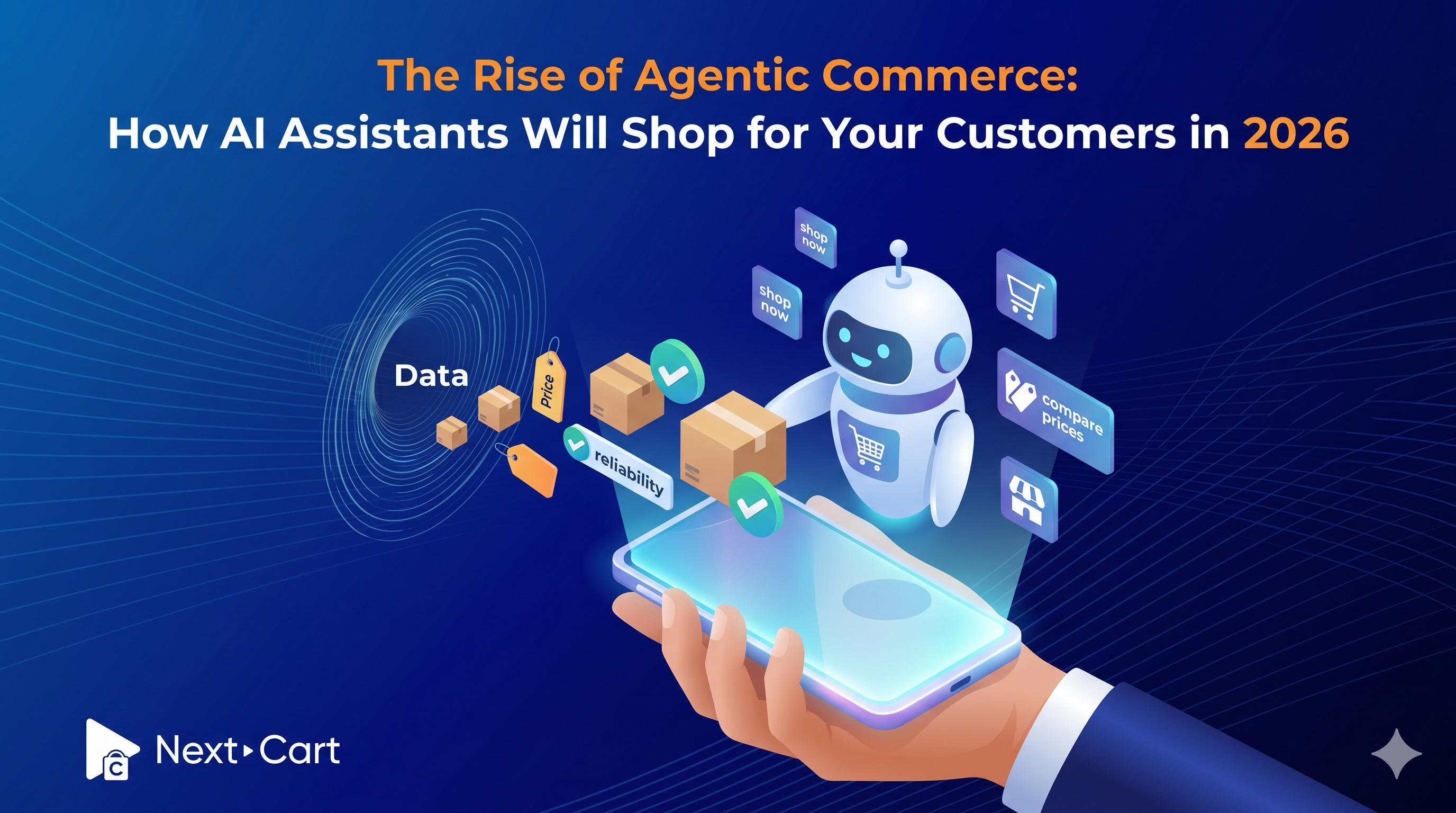
From “Searching” to “Delegating”
For over two decades in eCommerce, its foundation had been built on “searching” behaviors. Customers typed keywords into search engines, browsed top results, compared options, and made purchase decisions by themselves. But in 2026, that journey is fading into the background.
A new paradigm is taking over: Agentic Commerce, where customers no longer search; they delegate.
Imagine a shopper requesting, “Find me the best espresso machine under $400 with fast delivery and strong reviews, and order it.” That single instruction can become a reality with next-generation AI assistants. These assistants understand the shopper’s intent and complete transactions autonomously.
More importantly, these are not traditional chatbots that simply respond with scripted answers. But they are intelligent AI agents that are designed to act on behalf of users. Without constant human input, these agents can still browse products, compare prices across platforms, assess quality through reviews, and finalize purchases.
When AI agents act as intermediaries, your online stores will face a profound challenge: no longer competing solely for human attention, but for AI understanding. If an AI agent cannot discover and interpret your product data, neither will your customers.
This is the beginning of Agentic Commerce.
What is Agentic Commerce?
Agentic Commerce is an emerging eCommerce model in which AI agents act as decision-makers, executing purchases on behalf of users. These agents give recommendations and can actively participate in the buying process.
In this process, AI systems evaluate multiple factors simultaneously, including product specifications, pricing patterns, stock availability, seller reliability, delivery timelines, and customer feedback. Based on the user’s preferences and constraints, AI compares these factors and makes the final aligned decision.
From a merchant’s perspective, the decision made by an AI agent can feel like a “black box.” While traditional SEO ranking factors are quite understandable, AI agents prioritize structured data, trustworthiness, and real-time accuracy.
This is where a new concept emerges: AI Optimization, or AOI.
In comparison, SEO was designed for search engines, focusing on keywords, backlinks, and content relevance for human users. AIO, on the other hand, is designed for AI agents, prioritizing machine-readable data and semantic clarity over human-centric storytelling.
In Agentic Commerce, your product page becomes a data endpoint. It must be structured, consistent, and accessible across all attributes, from product dimensions to shipping conditions, so that AI agents can integrate your data programmatically.
In other words, success in visibility is no longer determined by how attractive your homepage or copy looks. Instead, it depends on how clearly your data communicates to machines.
How to make your store “AI-ready”
Online stores must undergo a fundamental transformation to thrive in the era of Agentic Commerce. But it is not about adding a chatbot widget or integrating a new plugin. It is more about structuring, presenting, and maintaining your data.
The foundation of this transformation is data structuring.
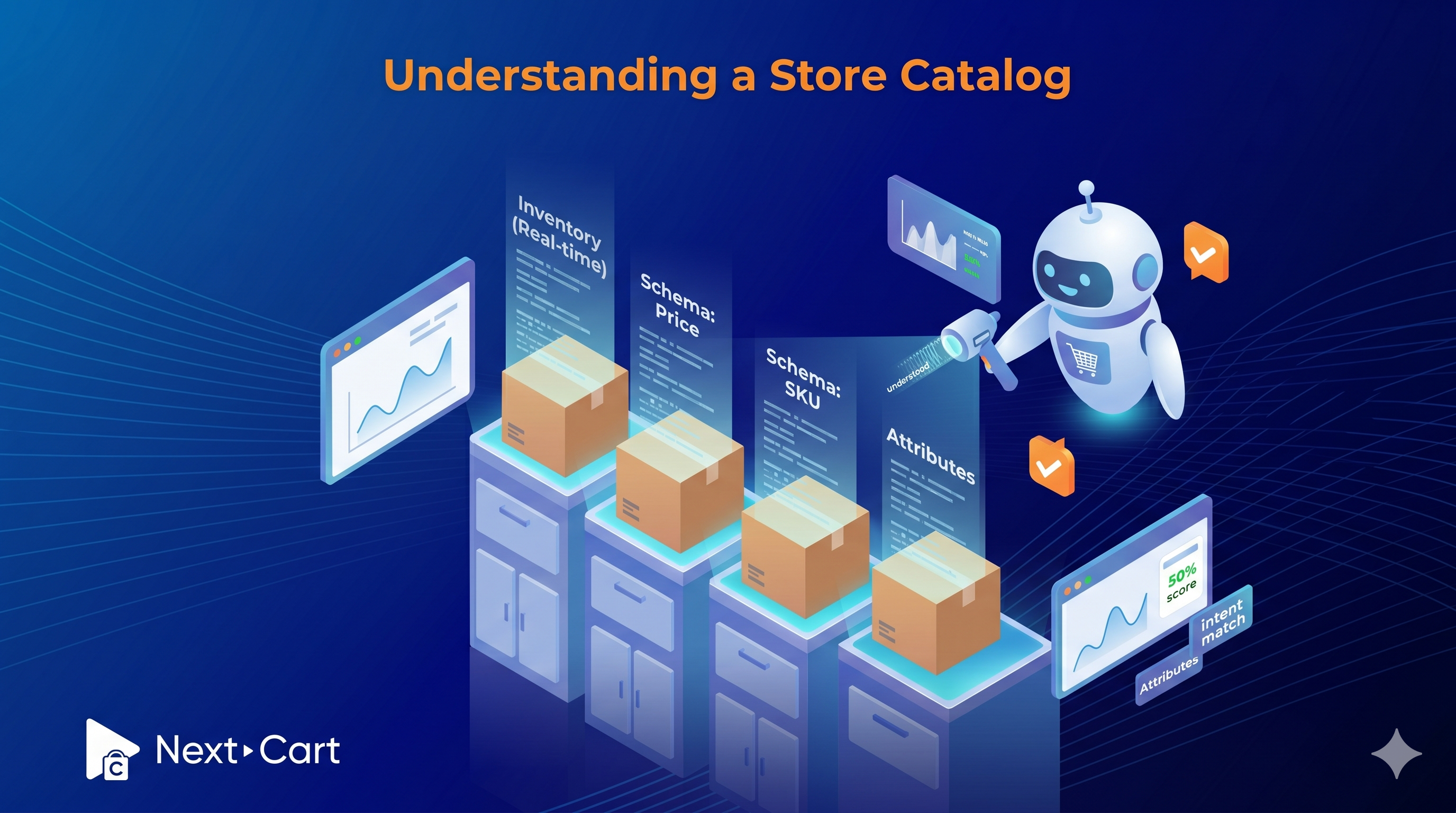
Data will be structured strategically using standardized frameworks such as schema markup. This enables AI systems to interpret your product information with precision. A store with structured data, rather than ambiguous text, allows AI agents to easily understand its key attributes, such as price, availability, ratings, brand, and specifications. This significantly increases your chances of being selected.
However, structured data alone is not enough. It is also about the way you describe your products.
Traditional product descriptions often focus on persuasive language and keyword density. In contrast, AI-ready descriptions prioritize user intent, directly answering their specific questions. For example, what problem does the product solve? Who is it best suited for? What are its limitations? How does it compare to alternatives?
The shift goes from keyword-based to intent-based, allowing your products to align more closely with the criteria AI agents use.
Another critical factor in making your online store more “AI-ready” is the availability and accuracy of real-time data.
If your product is listed as available but turns out to be out of stock, or if pricing is discrepant during checkout, the AI will deprioritize your store in its recommendations. Reliability is its core ranking signal.
To meet this expectation, your inventory, pricing, and shipping data must be synchronized in real time through robust APIs. Static or delayed updates, therefore, are no longer acceptable in a machine-speed system.
In essence, becoming AI-ready means building a store that communicates clearly, consistently, and truthfully for both humans and machines.
The role of platform scalability
With Agentic Commerce, the limitations of legacy eCommerce platforms become more apparent.
Many older systems, such as outdated versions of Magento or OpenCart, were not designed for real-time data exchange or API-driven architectures. Instead, they rely on rigid structures and limited integration capabilities. While they may still function adequately for human shoppers, they struggle to meet the requirements of the AI ecosystem.
In contrast, modern eCommerce platforms embrace an API-first approach. This architecture accommodates seamless communication between your store and AI agents or third-party services. An API-first platform enables your store to expose product data for AI agents to access up-to-date information at any time. It also supports the quick, efficient indexing and analysis of large catalogs.
Moreover, modern platforms are designed to be flexible. Merchants can optimize data structures without extensive redevelopment.
In the Agentic era, your backend infrastructure determines how easily AI systems can discover, understand, and trust your products. Stores built on scalable, modern platforms gain a competitive advantage not because they look better, but because they communicate better with AI systems.
Why Next-Cart is your gateway to the future
While transitioning into the world of Agentic Commerce, you might realize that your current platform may not be equipped for what you are doing next. This is where migration comes into play, becoming a strategic upgrade for your business’s future.
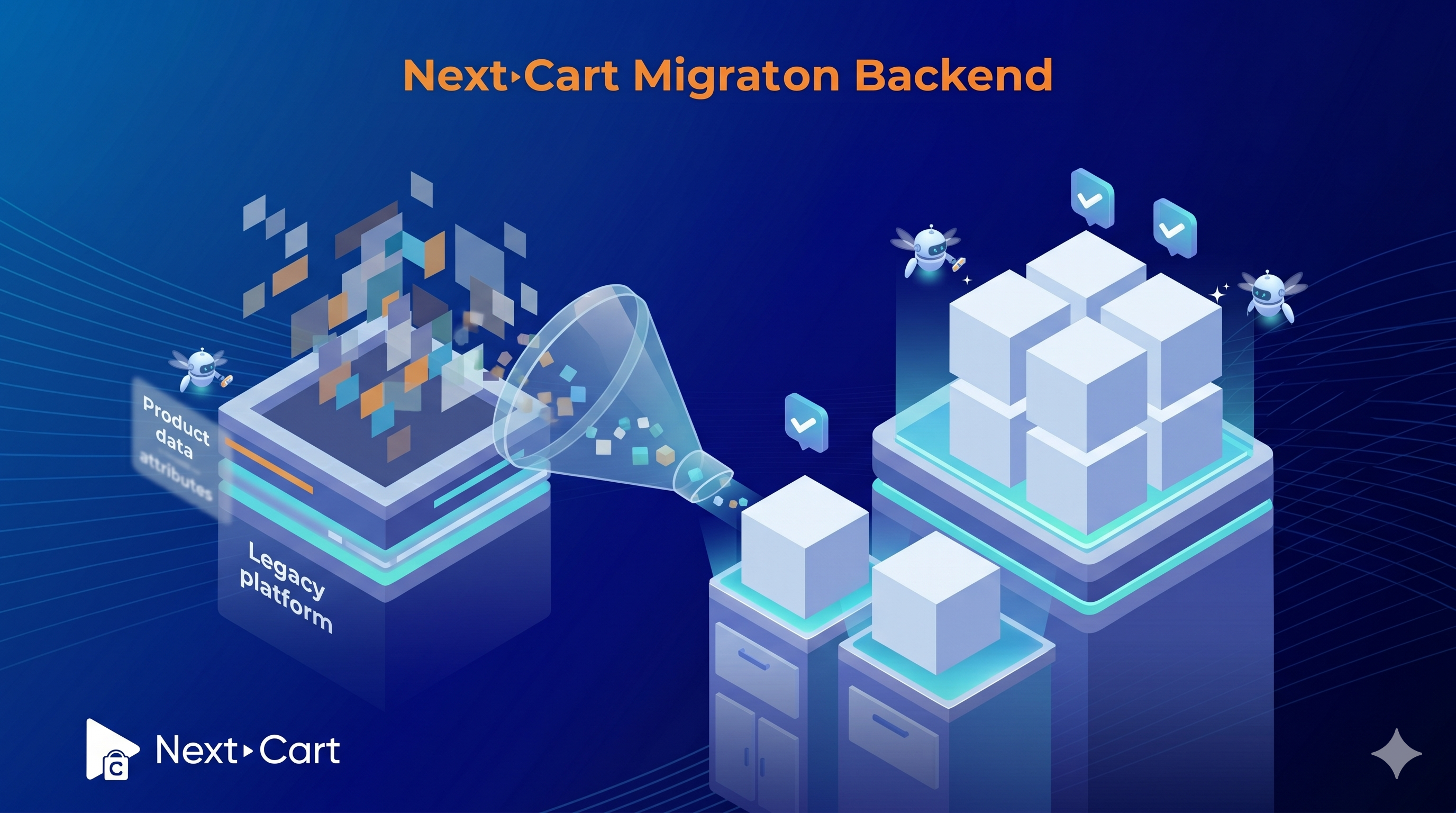
At its core, migration is the process of moving data from one platform to another. But in this scenario, migration helps transform your data into an optimized format for the future. Furthermore, during this process, you can refine the data structure, resolve inconsistencies, and align every product attribute with modern standards.
Even more, Next-Cart approaches migration with a broader vision in mind.
Rather than treating data as static records, Next-Cart enhances its quality and usability. Our tools map product attributes consistently across categories, variations, and metadata fields. The final result is clean, well-organized data that AI systems can trust and interpret. As a result, your visibility increases, and your chances of being recommended improve.
Another critical aspect that Next-Cart supports is flexibility. Next-Cart works on a wide range of platforms, including those better suited to API-driven ecosystems. Businesses, therefore, can move toward infrastructures that are more compatible with AI integration and more intelligent.
In the context of Agentic Commerce, where decisions are made algorithmically, clean data is truly a competitive advantage.
Expert opinion: Preparing for the “Zero-click” journey
As AI agents take on a role in purchasing decisions, the concept of a “zero-click” journey becomes more common.
In this circumstance, the traditional touchpoints of eCommerce, including search results, product pages, and checkout flows, are compressed into a single interaction between the user and their AI assistant. The user provides an initial instruction, and the AI handles the rest.
This raises an important question: Does brand loyalty still matter?
On one hand, AI agents are designed to prioritize objective factors, including price, availability, and reliability. Therefore, the influence of branding could be reduced, especially for commoditized products. Between two identical items in function, the AI is likely to choose the one with the best overall value.
On the other hand, trust signals become more important than ever. Reviews, ratings, and customer feedback are critical inputs for AI decision-making. Based on these signals, AI assesses a product’s credibility and a seller’s reliability. A store with a high percentage of positive reviews and transparent policies is more likely to be recommended. Social proof, therefore, does not disappear in the age of AI. It evolves.
At the same time, AI systems learn. A store that consistently delivers accurate information and maintains high customer satisfaction can build algorithmic trust.
In short, preparing for the zero-click journey means focusing on clarity, reliability, and trustworthiness – the factors that AI agents value. These qualities may not be as visible as branding or design, but they are influential in a data-driven system.
In Summary,
Agentic Commerce marks a fundamental shift in the eCommerce journey, from searching to delegating. This requires online stores to make appropriate changes in order to remain visible.
In this new landscape, your audience is no longer just humans, but also AI agents that act on their behalf. These agents do not respond to visual design or marketing language in the same way humans do. They rely on structured data, real-time accuracy, and consistent trust to make decisions.
In an AI-driven ecosystem, your platform is the foundation for your visibility. Stores that adopt modern architecture and optimize their data will be better positioned. Those who do not risk becoming invisible.
Don’t let your store get left behind in the AI era. Migrate to an AI-Ready platform with Next-Cart’s expert assistance today!