
In the early days of online retail, customers sent a request or question; it went to a ticketing system, and they would wait for a response. It used to take hours or sometimes days to get an answer. That model had worked when customer expectations were lower, but in today’s on-demand digital environment, it creates friction.
Modern customers expect clarity and immediacy. They expect brands to meet them at the exact moment when their intent peaks. This is where the eCommerce chatbot makes all the difference. This support tool has an increasingly direct impact on customer satisfaction and conversion rates.
However, not all eCommerce chatbots create the same performance. The difference between a chatbot that converts and one that frustrates lies in mindset. Businesses that see chatbots as cost-cutting tools often deploy rigid, scripted systems and eventually fail to engage users. On the other hand, those who approach chatbot design as part of a broader customer experience optimization strategy can create a dynamic, responsive interface that is meaningful for both customers and the internal team.
This article explores how to build a high-performing chatbot system, going from foundational thinking to operational execution.
The eCommerce chatbot mindset – Efficiency first
First, you must redefine what a successful eCommerce chatbot looks like. Beyond the number of conversations the bot handles, success is measured by how effectively it sustains customer intent.
The first 30 seconds of customer interaction are critical. During this period, customer curiosity easily turns into consideration and then purchase intent. If they receive no response during this window, their interest would quickly degrade. The delay creates uncertainty, leading to hesitation or even abandonment.
From an expert perspective, the true meaning of a chatbot is to eliminate “emotional drop-off point.” A chatbot ensures that no moment is wasted just because a human agent is unavailable.
This leads to the concept of the chatbot as a filter system. In most eCommerce environments, the majority of customer inquiries are repetitive and predictable. Questions about shipping timelines, return policies, payment options, or order tracking often do not require human creativity or empathy, but they need speed and accuracy.
In this case, the chatbot applies the 80/20 rule. It filters out the 80% of routine queries and allows human agents to focus on the remain 20% that truly benefit from personal attention. This not only improves efficiency but also enhances the quality of human interaction when agents are no longer overwhelmed.
The mindset shift here is profound. Instead of viewing customer support as a reactive function, see it as a proactive system. Your chatbot steps in early, guiding customers before friction arises. It transforms from a passive responder into an active participant in the customer journey.
Step 1: Mapping the “first line of defense”
With the right mindset, take the first step: define your chatbot’s role. Think of it as building the first layer of your customer interaction architecture, which is the first line of defense.
Begin with identifying “instant-answer” queries. These are the questions customers expect answered immediately: shipping costs, delivery timelines, return conditions, product availability, and order tracking.
However, mapping this layer requires more than listing FAQs. It involves understanding customer behavior patterns. For example, a question about return policy often arises at the decision stage, when customers are weighing risk. When it can be addressed clearly and confidently, the conversion rate is higher.
Then, it is important to define the hand-off point between the bot and the human. A chatbot should not handle every scenario. When conversations become complex, relating to disputes, exceptions, or emotional issues, the bot must transition to a human agent. Also, the transition should feel seamless, with the chatbot acting as a facilitator, gathering relevant information and preparing the context for the human agent to step in effectively. Customers should never feel like they are starting over or being “passed around.”
Another important element is the chatbot’s persona that should reflect your brand’s tone and values. A bot with a helpful, concise voice can make interactions feel natural and intuitive.
Step 2: Choosing the right engine
With a clear framework in place, the next step is selecting the technology that powers your chatbot.
The market offers a wide range of Conversational AI for eCommerce platforms, from lightweight tools like Tidio and ManyChat to more advanced, AI-native agents that can understand context and intent. Some tools focus on simplicity and ease of use, with prebuilt templates and quick deployment. Meanwhile, others include natural language understanding, contextual memory, and predictive recommendations.
The right engine aligns with your business’s operational needs. A small store with a simple product catalog may benefit from a lightweight solution, while a large-scale operation with diverse inventory demands a more robust system.
In addition, the bot must handle traffic surges during peak periods without compromising performance. As your business evolves, your chatbot should be able to grow with it. It should incorporate new data, new workflows, and new capabilities without requiring a complete overhaul.
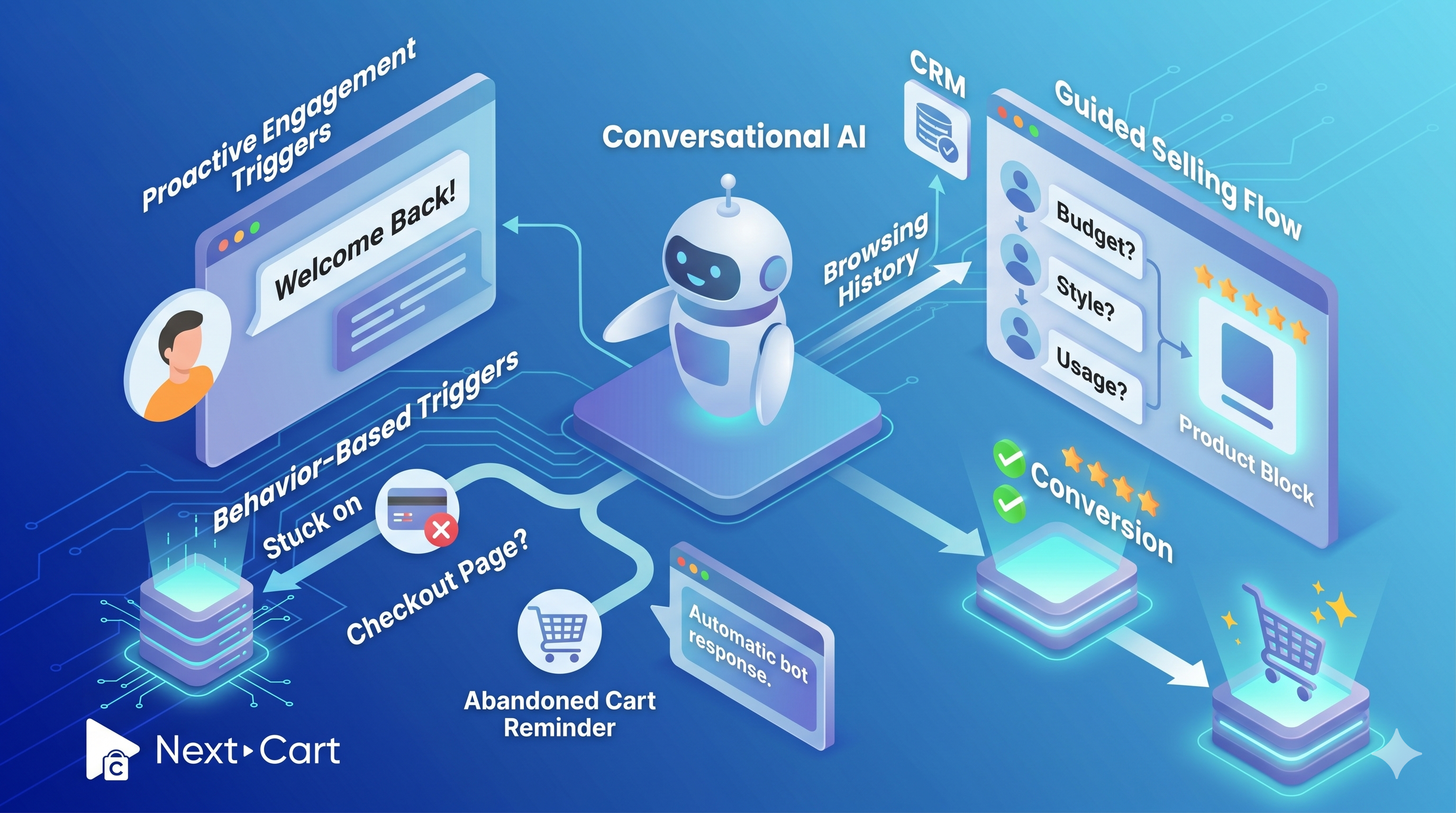
Equally important, remember that your chatbot cannot operate effectively in isolation from your existing systems. It must function as a true AI Sales Assistant that connects seamlessly with your CRM, inventory management, order processing, and analytics tools. This integration enables real-time data access, accommodating accurate and personalized responses.
Step 3: Creating proactive engagement triggers
One of the defining characteristics of a high-conversion eCommerce chatbot is its ability to engage customers. Rather than waiting for users to initiate interaction, the chatbot observes behavior and responds accordingly.
This is where behavioral triggers come into play. For example, when a customer spends a long time on a product page, it may indicate hesitation or uncertainty. Then a message can be sent to offer assistance and the reassurance needed to move forward. Similarly, when a shopper abandons their cart, a gentle reminder can bring them back into the purchase flow.
Each trigger is designed to address a specific moment of friction in the customer journey. Intervening at the right time, the chatbot helps maintain purchase momentum.
Moreover, personalize these triggers by addressing customers by name, referencing their browsing history, or suggesting relevant products. The interaction should feel like a tailored experience instead of a generic prompt.
In this context, the chatbot evolves into an AI Sales Assistant. It guides customers’ decisions, helping them navigate complex product catalogs, compare options, and find solutions that match their needs. By simplifying the decision-making process, the bot reduces cognitive load and increases confidence, leading to higher conversion rates.
Step 4: Connecting the dots
The core of an effective chatbot is a well-structured data layer that helps deliver meaningful value.
First, it is about real-time data synchronization – accurate, up-to-date information about product availability, pricing, and delivery time. Any inconsistency in this information can erode customer trust and disrupt the buying process.
Self-service capabilities are another cornerstone of automated customer support. Order tracking represents a significant portion of customer inquiries. When customers can access this information instantly, the number of support tickets reduces, and overall satisfaction improves.
Context preservation is also important when building the data layer. When a conversation transitions from chatbot to human agent, the entire interaction history should be available to ensure continuity.
The data generated by chatbot interactions is invaluable. Each conversation provides insight into customer preferences and pain points. Over time, this data can be used to develop products and improve operations. In this scene, the chatbot becomes more than a communication tool, but a listening system, capturing the voice of customers at scale.
Step 5: Iterative optimization & training
Designing a high-performing chatbot is not a one-time implementation. It requires continuous refinement to remain effective and keep evolving.
When a chatbot responds with “I don’t understand,” it represents a gap in its knowledge base. This moment should be treated as an opportunity for improvement. The system should update with new responses and gradually expand its capabilities.
Additionally, customer feedback plays a crucial role in this process. Allow users to rate the chatbot’s interaction, and then you will get direct insight into what works and what doesn’t. This feedback can guide you in making appropriate adjustments to tone, flow, and functionality, finally contributing to ongoing customer experience optimization.
At the same time, regular reviews are necessary. As your business grows and changes, your chatbot must adapt. It must adjust to new products, updated policies, or shifting customer expectations. If there is a little confusion or delay, it is time to reassess and refine.
Next-Cart perspective: The foundation of speed
Chatbot design and functionality depend heavily on the underlying infrastructure. A slow or outdated platform can undermine the chatbot system.
If your website takes too long to load or the database struggles to deliver real-time information, the chatbot will suffer. This could lead to delayed responses or inconsistent data.
This is where a clean data structure becomes essential. It can be created through professional migration and optimization. A strong foundation will support a high-performing eCommerce chatbot. When systems are effectively integrated and data is well-organized, the chatbot can operate with speed and accuracy.
However, from the Next-Cart perspective, this foundational layer is often overlooked. Businesses often invest in front-end features without building a robust structure to support these features.
Looking ahead, this foundation becomes more critical as new technologies emerge. Coming trends, such as voice commerce and agentic AI, require a system that can process and respond to customer intent in real time. A strong infrastructure ensures that your business is ready to adopt these innovations without disruption.
In summary,
Building a high-conversion eCommerce chatbot is not about replacing human interaction but about enhancing it. For repetitive tasks, the chatbot responds instantly to customer needs, while human involvement is preserved for complex, meaningful interactions to maintain empathy and trust.
In addition, leverage data to create a feedback loop and continuously improve the chatbot experience. The resulting customer support combines the speed of automation with the depth of human understanding. Then, customers receive immediate assistance when they need it, and thoughtful support when it matters most. As eCommerce continues to evolve, businesses that embrace this approach will be better positioned in the landscape.
Ready to build a smarter store? Consult with Next-Cart to migrate your data to a platform that supports high-performance AI tools and unlock the full potential of your chatbot.