
For many years, the path between customers and online stores was relatively simple. A shopper opens a search engine, types a product name, browses several websites, and eventually lands on a product page.
But what is the new commerce standard?
Today, that journey is changing. Customers are asking artificial intelligence tools to help them discover products and recommend the best purchase.
Instead of manually browsing store by store, users now interact with AI shopping assistants, voice search tools, and AI product advisors. These systems analyze information from multiple websites and summarize the best choices for the user.
From our experience working on eCommerce migrations and platform upgrades at Next-Cart, we have noticed an important pattern: stores that are well-structured for humans tend to be easy for AI systems to understand. On the other hand, when storefronts contain inconsistent data, AI systems struggle to understand them.
In the landscape of emerging AI-driven commerce, this difference matters greatly.
This is why a new commerce standard, where platform architecture and AI understanding must work together, takes place.
- The new commerce standard: If users understand your store, AI will too
- Product filters: A hidden signal that helps AI understand products
- A seamless checkout flow also matters
- Structured data: Helping AI read your store faster
- Custom metadata for deeper understanding
- Content organization also affects AI understanding
- AI agents inside the store can improve AI understanding
- The future standard: Stores must be AI-readable
- Conclusion: Architecture is the new competitive advantage
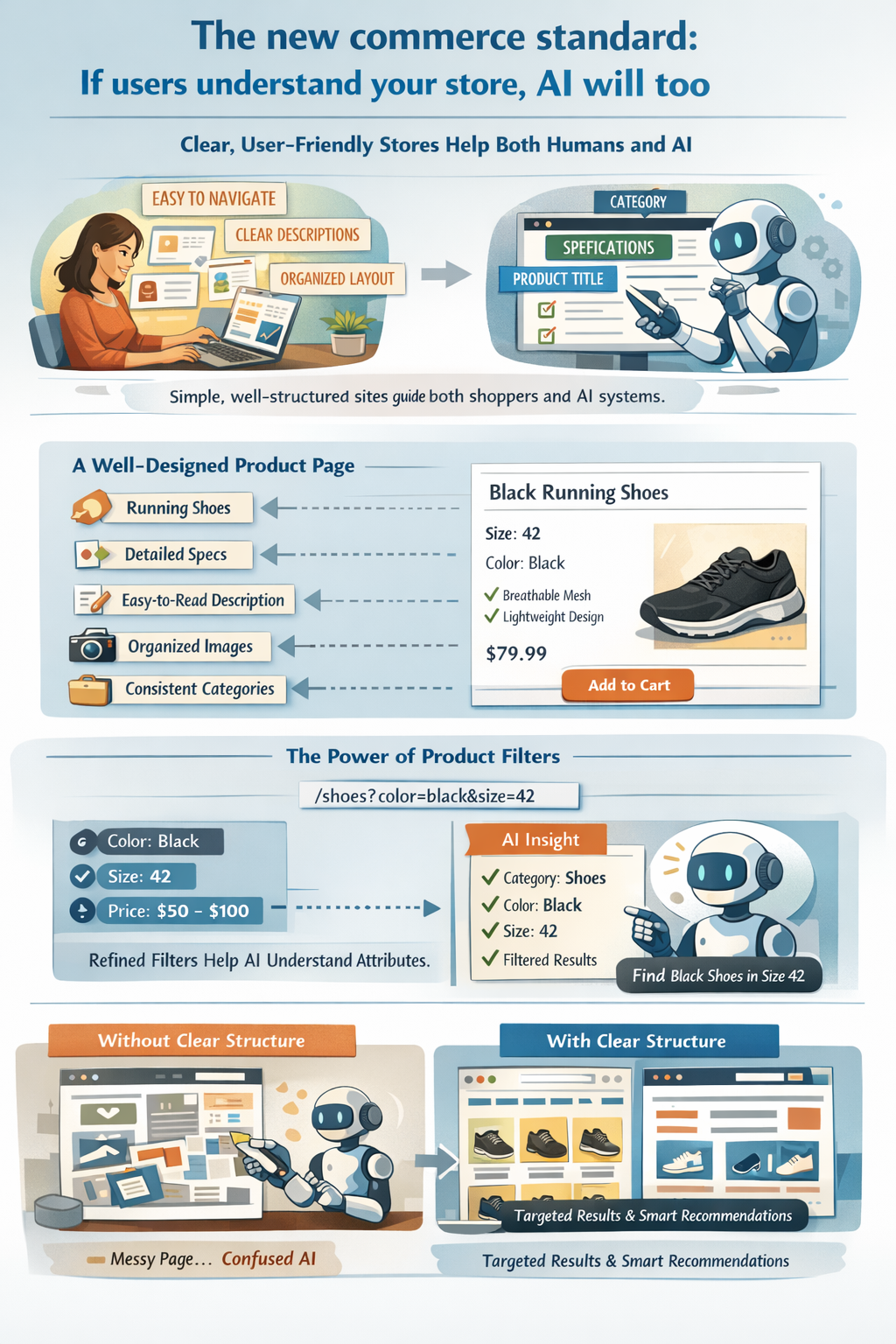
The new commerce standard: If users understand your store, AI will too
Many merchants assume that optimizing their websites for AI requires complex technical systems. In reality, the first and most important step is much simpler: creating a storefront that is easy for humans to understand.
User experience in eCommerce often comes with clear product descriptions, intuitive navigation, readable layouts, and logical categories. These elements help customers quickly find what they are looking for. At the same time, they also provide a structure that AI systems use to analyze a website.
When an AI assistant scans a product page, it analyzes the page structure through HTML, URLs, and content hierarchy. If a page contains clearly labeled sections, the system can interpret those elements with greater confidence.
For example, a well-designed product page might include:
- A clear product title
- Structured specification lists
- Consistent category placement
- Easy-to-read descriptions
- Organized images and attributes
These elements make the page intuitive for a shopper. But they also create strong signals for AI systems to parse the page content.
Conversely, when product information is scattered across inconsistent payouts or hidden scripts, both humans and machines struggle to integrate the content. Customers may abandon the page due to confusion, while AI tools may misread the information.
This is why the first layer of AI-friendly commerce is not artificial intelligence at all, but clarity.
Product filters: A hidden signal that helps AI understand products
One of the most overlooked aspects of an AI-friendly storefront is product filtering.
Filters are typically designed to improve user browsing, but they also provide structural information that helps AI systems understand how products are categorized.
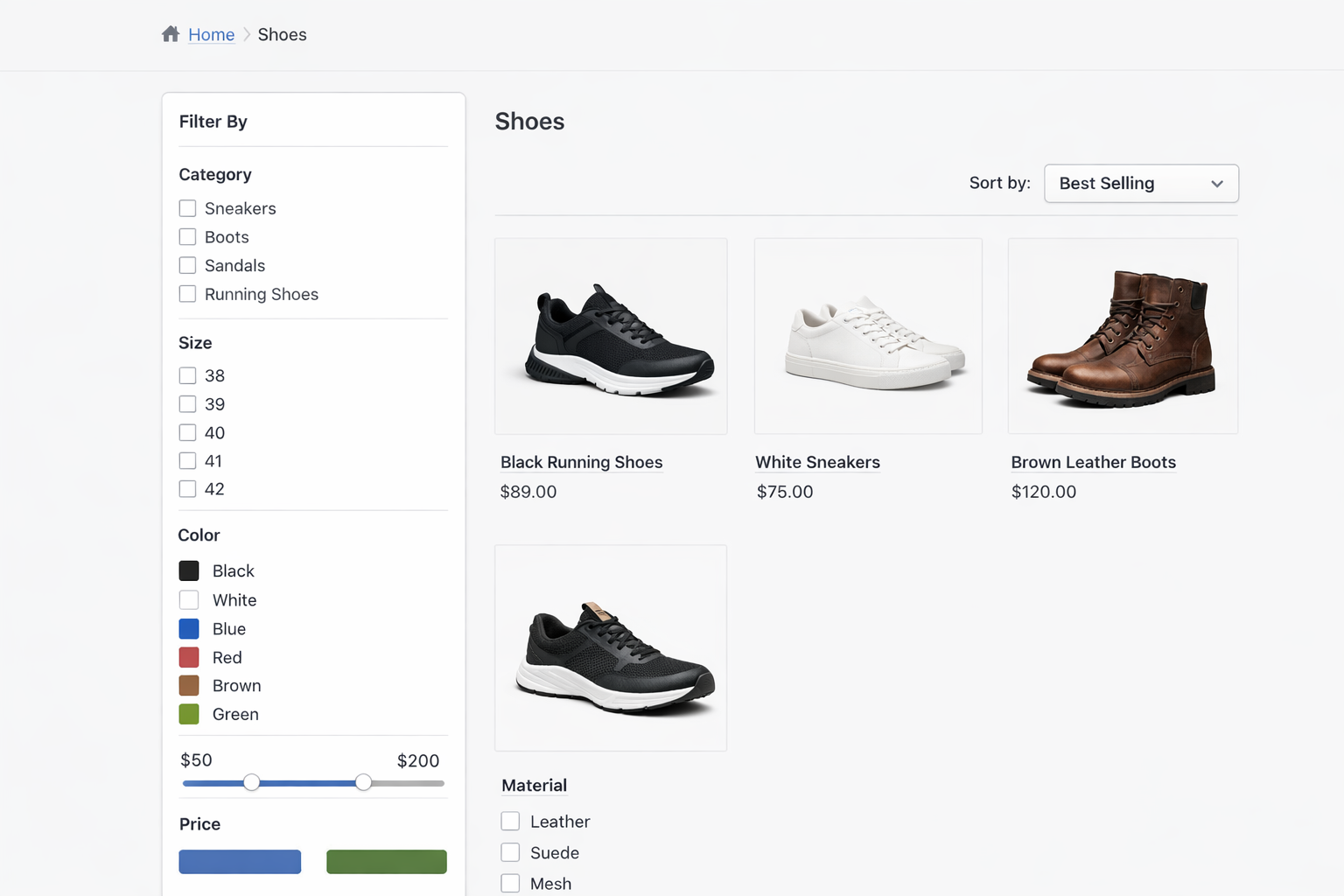
Good filtering systems allow shoppers to narrow down products based on color, size, material, price range, or technical features. These attributes create a structure between products and categories.
For instance, imagine a footwear store where shoes are filtered by color and size. A user might select black shoes in size 42 and immediately see products matching those criteria.
If the filtering system is well implemented, the URL may reflect this selection:
/shoes?color=black&size=42
When AI systems analyze such links, they can understand not only the product categories but also the associated attributes. They can take several pieces of information:
- The product category is shoes
- The attribute “color” includes a value of black
- The attribute “size” includes a value of 42
- The page contains results filtered by those attributes
This structure allows AI to generate accurate recommendations. If a user asks for black running shoes in size 42, the AI system can identify the relevant filtered URL.
On the other hand, without this structured filtering system, AI tools may still attempt to recommend products, but the links may lead to generic category pages or irrelevant product lists.
A seamless checkout flow also matters
The purchasing process is also important for AI-driven commerce. AI systems analyze the entire shopping journey, not just product listings.
This means that AI assistants also analyze the structure of your cart and checkout process to guide users toward completing a purchase.
A clear checkout experience often includes:
- A simple shopping cart interface
- Transparent pricing and shipping information
- Consistent checkout steps
- Multiple payment options
- Clear order confirmation pages
When these steps are logically organized, both customers and AI agents can easily understand how the purchase process works.
Otherwise, if the checkout process involves unpredictable steps and hidden costs, AI systems will find it difficult to explain the purchase process.
In the AI-driven commerce environment, simplicity in the purchasing journey is not only good for customers but also enables AI assistants to provide reliable guides.
What We See During Store Migrations: AI Has Changed What Customers Expect
Structured data: Helping AI read your store faster
Beyond user experience, the technical structure of data can help AI systems better understand websites.
Structured data provides meaning to the content on a page, labelling key elements directly. Then, algorithms don’t have to guess what information represents.
Common formats include:
- JSON-LD
- Microdata
- Schema-based markup
Among these, SON-LD is the most widely used approach, allowing structured information to be embedded in a page without disrupting the visible content.
Additionally, structured data often follows standards, such as those defined by Schema.org. These schemas provide predefined formats for products, reviews, organizations, and many other types of content.
For eCommerce stores, structured data can communicate essential information, such as:
- Product name
- Price
- Availability
- Brand
- Ratings and reviews
- Category relationships
When this information is presented in a structured format, search engines and AI systems can read it instantly. The AI receives clear semantic signals describing the product, without analyzing raw text or inferring meaning from the page layout.
This dramatically improves the accuracy of AI assistants when they summarize product information, compare items, or recommend products to users.
At that time, structured data acts as a translator between your storefront and the algorithms.
Custom metadata for deeper understanding
While standard schemas provide a strong foundation, many industries require additional product information beyond common attributes.
For example, technology products may include compatibility lists, hardware specifications, firmware versions, or detailed performance metrics. Industrial equipment may need to include operating parameters, certifications, and technical diagrams.
These types of attributes may not always fit within standard schemas. In these situations, custom metadata is an essential tool for helping AI systems understand products.
Merchants can define custom metadata using formats, such as JSON or XML, to describe specialized attributes unique to their industry. For example, a hardware store might include metadata describing voltage compatibility or mounting standards.
Think of custom metadata as providing AI with a detailed product manual. Then, instead of recognizing only the basic characteristics of an item, AI tools can interpret deeper technical details. This deeper data will play an important role in AI-driven product discovery.
Content organization also affects AI understanding
AI systems do not only analyze product pages. Many AI assistants also examine blogs, help centers, documentation pages, and frequently asked questions.
When this information is organized clearly, it provides a rich context for AI systems to answer user questions.
For example, a blog might categorize articles by product type, use case, or industry application. This helps both readers and AI tools understand the relationships between topics.
Similarly, a help center that organizes documentation step by step allows AI assistants to interpret the flow of instructions. If a user asks how to install a product, the AI can reference these structured resources.
Knowledge bases, FAQs, and support documentation also contribute to this ecosystem. When these resources are interconnected through logical links and categories, they form a coherent structure around the store.
This structure makes it easier for customers to find answers. At the same time, it helps AI systems understand how the store’s products relate to real-world usage and customer needs.
AI agents inside the store can improve AI understanding
Interestingly, integrating AI tools within a storefront can also help external AI systems interpret the store’s data.
Many modern eCommerce platforms now include internal AI agents that assist with customer interactions and operational insights. These tools could be AI live chat assistants, product recommendation engines, content generation tools, or AI analytics tools.
For instance, an AI chatbot interacts with customers and references product data to answer questions. Over time, it creates patterns of product relationships and customer inquiries.
Meanwhile, recommendation systems analyze browsing behavior to identify connections among products that frequently appear together. This helps clarify which items are complementary or comparable.
AI-generated content tools can also maintain consistent product descriptions and categorization. When content is produced within a framework, it helps clarify the store’s data architecture.
Also, AI analytics platforms further refine this ecosystem by identifying trends in customer behavior, product performance, and search patterns.
Together, these internal AI systems strengthen the store’s overall data environment. As this ecosystem evolves, external AI assistants gain access to clearer and more consistent information.
The future standard: Stores must be AI-readable
The future of eCommerce will not be defined solely by visually appealing storefronts or marketing strategies. Instead, stores must be readable by both humans and AI systems.
This concept relies on platform architecture that determines how data is structured, how metadata is managed, and how information is organized.
An AI-friendly storefront often includes several foundational elements:
- Clean and consistent data structures
- Flexible metadata systems
- Logical category hierarchies
- Scalable content organization
- Transparent product attributes
- Structured URLs and filters
With these elements, AI systems can interpret the store with accuracy. If the AI clearly understands your store, it can confidently recommend your products. Therefore, in this environment, AI readability becomes a competitive advantage.
Conclusion: Architecture is the new competitive advantage
Most eCommerce merchants invest heavily in advertising campaigns, marketing automation, and search engine optimization. Others experiment with chatbots, recommendation engines, or AI content generation tools.
But when it comes to AI-driven commerce, platform architecture is the most important foundation. It is about how products are organized, how data is formatted, and how content is structured.
When architecture is clear, AI assistants can interpret product information accurately and guide customers to relevant items.
This is why platform architecture is becoming increasingly important for modern eCommerce businesses. A well-designed foundation enables better user experiences and stronger communication with AI systems.
In the new era of digital commerce, your storefront should become a structured knowledge environment that both humans and AI can understand. And the better understanding, the faster customers can discover what they are looking for.