
Running multiple online stores is often seen as a major milestone in eCommerce growth. More storefronts mean more regions, broader market reach, and more opportunities to increase revenue.
That was exactly what Sarah believed.
After building a successful fashion brand in the United States, Sarah decided to expand internationally, launching separate storefronts in the UK and across Europe. On paper, everything looked promising. International traffic increased, sales numbers climbed, and her business felt like a truly global brand.
Behind the scenes, however, her business was actually experiencing increasing chaos. Every morning started with a maze of browser tabs and admin dashboards. Sarah had to log in to three separate systems just to review orders and repeatedly update a single product description across multiple stores. At the same time, inventory levels constantly drifted out of sync, resulting in oversold products and refund requests.
In other words, her business was growing, but the operations were falling apart.
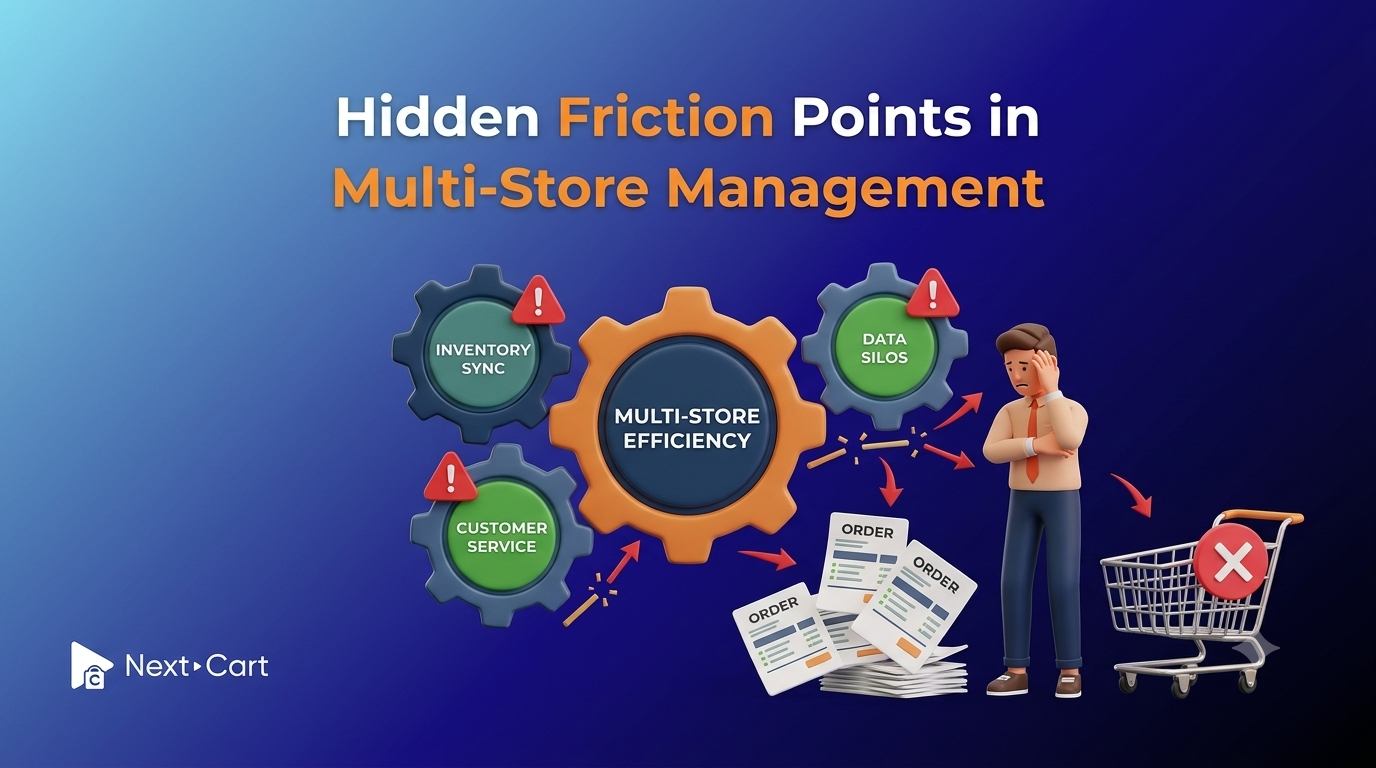
This is the hidden reality of multi-store management. Expanding across multiple storefronts may look straightforward at first, but managing products, inventory, customers, localization, and analytics across disconnected systems introduces operational friction.
Additionally, these issues rarely appear all at once. They build up in the background until the business realizes it is spending most of its time maintaining systems rather than growing the brand.
In this article, we’ll explore six hidden friction points in multi-store management and explain why many merchants migrate to centralized commerce platforms to simplify their operations.
- The “ghost stock” nightmare
- The “copy-paste” trap
- Fragmented customer profiles
- Localization & currency friction
- The high TCO of “glue & duct tape” integrations
- Reporting & analytics blind spots
- The real solution for multi-store management: Replatforming & centralization
- How Next-Cart simplifies the transition
- Final Thoughts
The “ghost stock” nightmare
One of the most frustrating problems in multi-store management is inventory desynchronization. A product may sell out in one storefront while still appearing available in another. This creates what many merchants call “ghost stock.”
Imagine a customer purchasing the last product from your US store. Since your inventory is not synchronized in real time, another customer visiting your UK storefront a few minutes later still sees the same product in stock and successfully places an order. Then, your team has to cancel the order, process a refund, and leave a negative impression on the customer.
This uncomfortable situation happens quite often when stores rely on disconnected inventory systems. The root issue comes down to how platforms communicate with each other: systems rely on APIs to synchronize inventory across multiple storefronts.
APIs can be understood simply as digital delivery messengers that carry inventory updates between your warehouse, storefronts, apps, and databases. Every time inventory changes, these messengers update all connected systems in real time. But when those messengers are delayed or disconnected, storefronts continue to display outdated information. That’s when ghost stock appears.
The impact extends far beyond operational inconvenience. Inventory inaccuracies directly damage customer trust, as shoppers expect accurate stock availability when placing an order. If customers experience a cancellation after checkout, their confidence in the brand disappears.
Many businesses initially attempt to solve this problem with third-party inventory plugins. But these temporary fixes often introduce even more complexity over time.
A more sustainable solution is centralization. Modern commerce platforms such as Shopify Plus, BigCommerce, and Adobe Commerce offer stronger native multi-store management capabilities, allowing merchants to control stock from a single unified backend.
With centralized inventory routing, businesses reduce the risk of overselling and create a more reliable customer experience across every storefront.
The “copy-paste” trap
As businesses expand into multiple stores, product management often becomes exhausting.
At first, manually updating products across several storefronts feels manageable. But as product catalogs grow, even small changes become repetitive daily work. For example, a simple price adjustment requires logging into multiple admin dashboards. Or when replacing a product image, you must upload the same file repeatedly. And updating product descriptions across stores becomes a tedious copy-and-paste routine that consumes hours every week.
Even worse, with these repetitive manual tasks, mistakes are unavoidable.
Beneath the surface, the issue comes down to database structure. Every eCommerce platform organizes information differently using a database schema. A database schema works like the blueprint of a filing cabinet, determining exactly where product titles, SKUs, descriptions, pricing, and inventory should be stored.
When businesses operate multiple stores across different platforms, these filing cabinets often fail to match. One platform may structure product attributes differently from another, forcing employees to manually bridge the gaps.
Over time, teams spend more energy simply maintaining consistency.
This is why many growing businesses move toward centralized product management, in which a single master product database automatically distributes localized variations across multiple storefronts. As a result, teams spend less time on manual tasks, product consistency improves, and the risk of human error decreases.
Fragmented customer profiles
Customer data is a valuable asset of a business. But in multi-store management, customer information often becomes fragmented.
A customer may purchase from your US storefront during one trip and later place another order through your UK store. From a business perspective, this is the same loyal customer. However, due to disconnected systems, the customer is treated as a completely separate person.
This creates what many merchants describe as a “split personality” problem.
In this situation, purchase histories remain isolated inside different databases, and loyalty systems fail to recognize repeat buyers. Also, customer support teams lose context during interactions, while businesses lose visibility into customer lifetime value.
Moreover, without unified customer profiles, personalization becomes weaker. Marketing campaigns become less accurate, and loyalty rewards become less effective.
This is where proper data mapping becomes critical during migration.
Data mapping simply means matching equivalent custom fields between systems. For example, a “Customer Email” field on one platform must correctly connect to an “Email Address” field on another. When done properly, purchase histories from multiple storefronts can merge into one unified custom profile.
A CRM or modern eCommerce platform can consolidate customer accounts globally across all of your localized stores. This is extremely important, especially in today’s eCommerce environment, as understanding customers will decide sustainable growth.
Localization & currency friction
Many merchants underestimate the complication of localization at scale.
Displaying multiple currencies is relatively easy. But true localization involves much more than simply converting prices, as every region introduces unique tax rules, payment gateways, shipping requirements, translation databases, and legal compliance standards.
Managing all these variables across multiple storefronts quickly becomes overwhelming.
For example, customers in Germany may expect precise VAT calculations, while customers in the UK may prioritize different shipping providers and delivery expectations. Also, customers in the US often expect seamless digital wallet integrations during checkout.
A storefront may initially appear fully localized, with the correct language and currency throughout the shopping experience. But during checkout, tax calculations suddenly change, or local payment methods stop functioning.
At that moment, customer confidence disappears, and cart abandonment increases. Businesses invest in regional marketing campaigns to lose conversions because backend systems cannot support localized operations.
To address this complexity, centralized multi-store platforms allow merchants to manage localization rules in a simple, unified system. Instead of configuring disconnected tax settings, payment integrations, and shipping logic separately, businesses gain centralized visibility and control over their international operations. The global commerce infrastructure becomes more scalable, and the customer experience is smoother.
The high TCO of “glue & duct tape” integrations
In multi-store management, it is common to address issues by connecting systems through apps, plugins, and custom integrations.
At first, this approach feels flexible and affordable. Need synchronization between two stores? Install a plugin. Need inventory updates? Hire a developer to create a custom connector.
Initially, these fixes appear manageable. But over time, the entire system becomes fragile. It could be one app update suddenly breaking another integration, API limitations changing, or custom code conflicting with platform upgrades. Then, developers spend more time fixing broken connections than improving business functionality.
This is where Total Cost of Ownership, or TCO, becomes important.
Many merchants calculate only the visible platform fees as their operational costs. In reality, the true cost also includes developer maintenance, third-party subscriptions, emergency troubleshooting, downtime recovery, operational inefficiencies, and customer service expenses caused by system instability.
What initially looked like a cheap solution becomes an expensive operational burden.
At Next-Cart, our experts frequently encounter businesses spending $ 2,000+ per month just to maintain disconnected systems. In many cases, these headaches could be reduced by migrating to operate in a specialized platform designed for centralized multi-store management.
Solutions like Shopify Plus and BigCommerce often provide native functionality that can replace multiple third-party tools. Instead of fragile “glue and duct tape” integrations, businesses can rely on a stable infrastructure that requires far less ongoing maintenance.
Reporting & analytics blind spots
One of the most overlooked frictions in multi-store management is fragmented reporting.
Many merchants try to understand their business performance through their own analytics of each storefront. But isolated reports rarely provide a complete picture of the business as a whole. Therefore, teams often end up exporting multiple spreadsheets and manually combining data to better understand total revenue, customer acquisition costs, inventory performance, or global sales trends.
In this process, they have to convert different currencies, standardize product names, or align date ranges across multiple systems. Even after hours of manual work, the final reports may still contain inconsistencies.
This also creates dangerous blind spots in decision-making, as leadership teams make strategic decisions using incomplete information.
Centralized commerce systems eliminate this complexity by consolidating reporting into a unified environment. Businesses can avoid manually stitching disconnected reports and gain real-time visibility across all storefronts from a single source of truth.
The real solution for multi-store management: Replatforming & centralization
Eventually, many growing multi-store businesses reach the same problem. It is not about their team, but about their system architecture.
When operating on disconnected storefronts, fragmented databases, and endless integrations, businesses cannot avoid friction. That’s why many successful brands decided to replatform.
Replatforming means migrating from a system to a better one – from an outdated or disconnected platform to a more centralized commerce environment that supports their long-term growth.
This could involve consolidating multiple stores into a single platform, adopting native multi-store management functionality, centralizing inventory, or moving toward a headless commerce architecture.
The goal is simplicity.
Instead of juggling disconnected systems, businesses create a unified operational foundation that supports international growth. Centralization eliminates the above friction points, improving inventory synchronization, unifying customer profiles, and making product management and localization easier and more efficient. At the same time, analytics becomes more accurate, and operational costs decrease.
Of course, many merchants hesitate to make the change because migrating sounds intimidating, and they are concerned about losing customer data, damaging SEO rankings, or disrupting operations.
Fortunately, modern migration technology has evolved dramatically. Proper planning and expert support help businesses safely migrate products, customers, order histories, categories, and SEO structures without disrupting daily operations.
Migration goes beyond manually copying data from one platform to another, building a stronger operational foundation for business future growth.
How Next-Cart simplifies the transition
For many merchants, terms like API mapping, data integrity, and database structures can sound intimidating, especially for businesses without development teams.
That is why Next-Cart focuses on making migration simpler and more accessible. Merchants don’t have to navigate complex technical processes themselves, as Next-Cart provides tailored migration solutions to different business needs and support levels.
The Standard Migration option is ideal for merchants with a hands-on approach. These businesses can configure and manage the migration process themselves while still benefiting from automated migration technology and guided support.
For busy store owners who want professionals to handle the process from start to finish, the Managed Migration option offers a fully supported experience. The Next-Cart technical team oversees setup, monitoring, troubleshooting, and validation throughout the migration process. Meanwhile, merchants can focus on running their businesses rather than managing technical details.
Larger enterprises often require more flexibility. Their custom database structures, advanced product attributes, or unique operational logic may need specialized migration workflows. For these situations, Next-Cart offers Custom Migration services to address complex enterprise requirements.
In addition, one of the most valuable features for growing businesses is Recent Data Migration, also known as Delta Migration. This feature allows the old stores to remain fully operational during the migration, so businesses can continue to accept orders. Then, right before launch, only the newest orders and updated records are transferred into the new system. This minimizes downtime and prevents lost sales, while still maintaining a smooth transition experience.
Final Thoughts
Reaching the multi-store milestone, many businesses create complexity by scaling on disconnected systems, fragmented databases, and unstable integrations. Operational friction begins with duplicate product updates, inconsistent inventory counts, or reporting inefficiencies. Over time, these issues compound into serious operational challenges, causing the customer experience to suffer and teams to become overwhelmed.
Fortunately, by consolidating operations into a centralized commerce environment, businesses can entirely resolve these problems. And with experienced migration partners like Next-Cart, the transition becomes far less intimidating than many merchants initially expect.
Finally, sustainable eCommerce growth is not about managing more chaos but about removing friction in a centralized commerce environment that suits your business potential.