
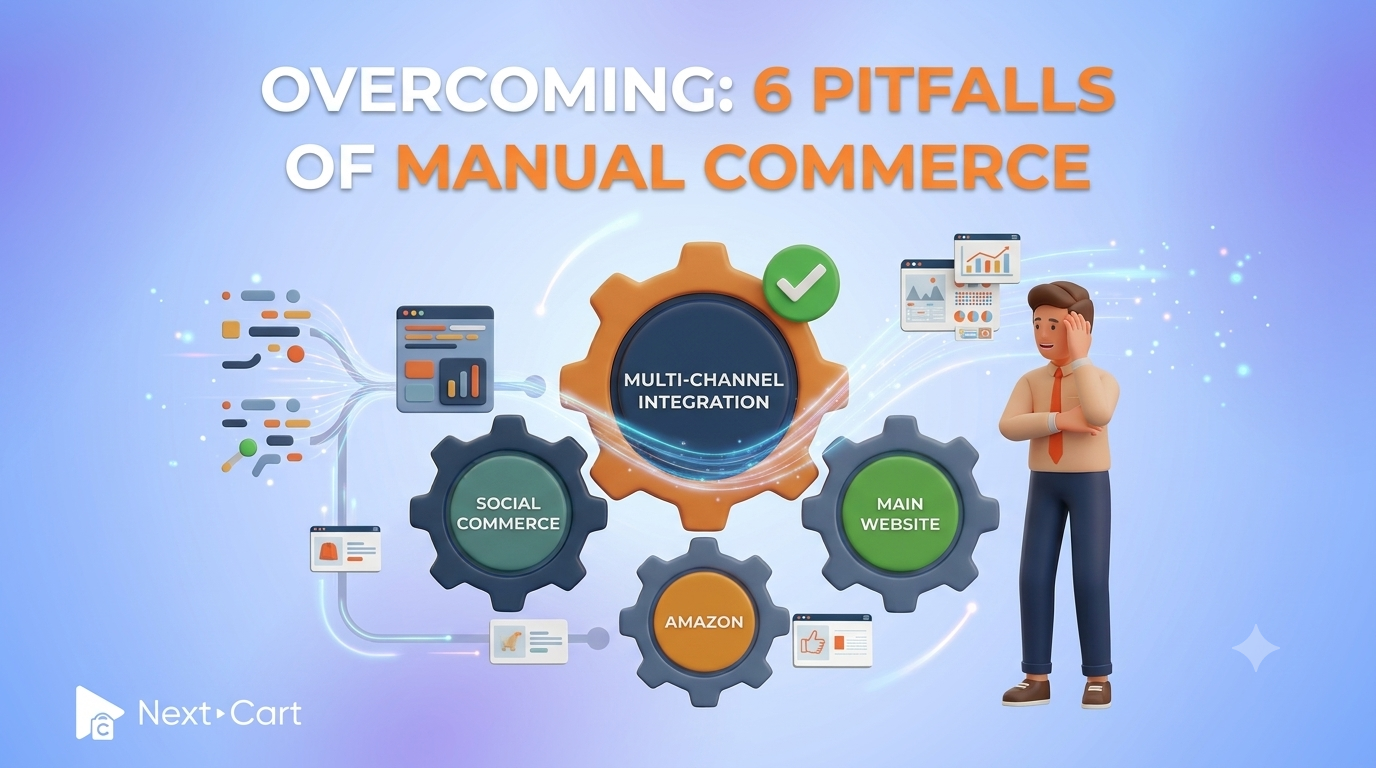
In modern eCommerce, brands can launch a storefront on Shopify or WooCommerce, expand to Amazon, and start selling through TikTok Shop, Facebook Shop, or Instagram Shopping. This multichannel selling strategy looks like the perfect growth.
Yet for many merchants, this growth introduces a hidden paradox. The more sales, the more operational complexity. The business expansion, unfortunately, turns into a daily struggle, requiring business owners to manage multiple spreadsheets for product information, inventory checks, orders, and scattered customer data.
This is the reality of managing social commerce manually.
Imagine a circus performer juggling three balls: a main website, an Amazon store, and social commerce stores. As long as every ball stays synchronized, the performance continues. But as one ball slips, perhaps inventory sells out on TikTok Shop while Amazon still shows stock, the entire act begins to unravel.
The true cost of manual management is not simply wasted time, but also threatens data accuracy, profitability, and ultimately the trust of customers. To scale safely, businesses must protect their data integrity across all frontends.
- Pitfall #1: The out-of-stock nightmare
- Pitfall #2: Disjointed buyer journeys and siloed CRM data
- Pitfall #3: The “Chinese whispers” effect of product information
- Pitfall #4: Shipping delays and address typos
- Pitfall #5: The monthly finance Excel hell when managing social commerce and selling channels manually
- Pitfall #6: Brand erosion and poor customer experience (EX)
- Shifting to automated multi-channel harmony
- In Conclusion
Pitfall #1: The out-of-stock nightmare
One of the most common challenges in managing social commerce manually is maintaining inventory consistency. It often starts with a simple delay.
For example, a customer purchases the last red running shoe on TikTok Shop, but the inventory counts on Amazon and your main website remain unchanged because no one has updated them yet. An hour later, another customer places an order for the same item through Amazon.
Now, the problem arises: the customer will receive a cancellation notice.
If repeated inventory discrepancies occur, they can have even more serious consequences: damaging customer trust. Customers expect the product to be available when they place an order, but when the order is canceled due to inaccurate information, they become very dissatisfied.
In addition, marketplace platforms are equally unforgiving. Frequent stock-related cancellations can negatively affect seller performance metrics and trigger account health warnings.
The challenge becomes more severe as businesses grow. A store processing a handful of orders each day with manual inventory checks may survive. A brand handling hundreds of daily transactions across Amazon, social channels, and its own website cannot rely on spreadsheets or periodic updates.
The root issue of manual management is synchronization. In fact, every selling platform has its own inventory database, and without automated communication, stock levels will drift apart. This is where API-driven integrations become critical.
An API allows systems to exchange information automatically, ensuring that every inventory change is reflected across all connected channels in near real time. Then, instead of relying on employees to manually update stock levels hourly, businesses can achieve accurate inventory automatically.
Pitfall #2: Disjointed buyer journeys and siloed CRM data
Fragmented customer data can be just as damaging. Today’s shoppers often interact with brands through multiple channels. A customer “Alex Smith” might discover your product through Instagram, compare options on Amazon, and eventually complete a purchase on your website.
From the customer’s perspective, these interactions belong only to Alex. Unfortunately, many businesses store these actions in separate systems. As a result, Alex appeared as three different people across the business’s databases.
In this situation, the purchase history becomes fragmented. This creates major limitations for attempts to build meaningful relationships with their audience. Without a unified CRM (Customer Relationship Management) strategy, it is difficult to calculate customer lifetime value (CLV) and create targeted personalized marketing campaigns.
Moreover, the impact of Customer Experience (CX) is significant. Customers expect businesses to recognize them everywhere they shop. But when information is scattered across systems, their interactions feel inconsistent. Over time, these frustrations weaken loyalty and reduce opportunities for repeat purchases.
Pitfall #3: The “Chinese whispers” effect of product information
As businesses expand into multiple sales channels while still relying on manual management, product data suffers as well. Every time product information is copied, reformatted, exported, or manually entered into a new platform, there is a risk of errors.
One reason this happens is that every platform uses its own Database Schema. In simple terms, a Database Schema defines how information is organized and stored. For example, Amazon may require product weights in ounces, while Shopify or another platform may require them in grams. Similarly, dimension measurements, product variants, category mappings, and specifications can vary between systems.
When merchants manually move information between platforms, product descriptions can become inconsistent, and prices might fail to update. Eventually, customers encounter conflicting information and, even worse, receive products that do not match expectations.
Many successful brands address this challenge by leveraging a centralized PIM (Product Information Management) solution. A PIM serves as a single source of truth, managing product information centrally and distributing it consistently across all channels. This tool significantly reduces errors and preserves data integrity as the business scales.
Pitfall #4: Shipping delays and address typos
Fulfillment processes are another area where manual workflows frequently introduce costly errors.
Many merchants still rely on manually transferring order information from Amazon Seller Central, TikTok Shop, or other marketplaces into their shipping and fulfillment software. While this is manageable at lower volumes, every manual entry creates an opportunity for errors, especially as order volumes increase.
A single typo in a postal code, street address, or apartment number can result in delayed deliveries, returned or lost shipments. From the customer’s perspective, the cause of the mistake is irrelevant. The only thing they experience is their package arriving late or never arriving at all.
Meanwhile, automation significantly reduces these risks by routing orders directly from sales channels to fulfillment systems without manual intervention. Automation helps maintain consistent customer information and generate shipping labels without human errors.
In a multichannel environment, automated order routing is about protecting the customer experience.
Pitfall #5: The monthly finance Excel hell when managing social commerce and selling channels manually
For many growing merchants, the operational burden becomes most visible at the end of the month. This is when teams attempt to reconcile sales, taxes, refunds, and expenses across multiple platforms.
Without integrated systems, reporting becomes an exhausting exercise in spreadsheets. Data must be exported from Amazon, social commerce platforms, payment gateways, and accounting software before everything can be combined.
A large portion of this process involves Data Cleansing, which refers to identifying and correcting inaccuracies, duplicates, and formatting issues in records. Manual Data Cleansing consumes valuable time and resources.
On the other hand, businesses often focus on the software subscription cost while overlooking the broader concept of Total Cost of Ownership (TCO). TCO includes labor, maintenance, inefficiencies, training, error correction, and lost productivity. When experienced employees spend days each month cleaning up spreadsheets instead of working on strategic initiatives, it means operational costs rise.
Many businesses attempt to save money by avoiding automation investments but end up manually processing tasks, resulting in a much higher TCO over time.
Pitfall #6: Brand erosion and poor customer experience (EX)
While inventory discrepancies, dirty data, shipping errors, or manual reporting each create their own problems, they all ultimately lead to the same result: a declining customer experience.
Customers never see all of the spreadsheets, databases, or manual processes behind your operations. They only experience the result. It is when products are oversold, and customers experience cancellations. It is when product information inconsistencies create confusion and shipping errors create delays. And when support agents lack access to complete customer histories, customers experience frustration during their shopping journey. Each issue gradually erodes trust.
One common misconception in eCommerce is that growth can compensate for operational weaknesses. In reality, growth amplifies them. As order volumes increase, every inefficiency becomes more visible. Businesses managing social commerce manually often find their operational challenges outpace their revenue growth.
Ultimately, customer experience becomes the final scorecard. Protecting CX requires addressing the actual operational systems that influence every stage of the customer journey.
Shifting to automated multi-channel harmony
Your sustainable growth comes from a system that enables information to move automatically, accurately, and consistently across platforms.
Modern multichannel businesses rely on integrated ecosystems rather than isolated tools. At the heart of these systems are secure API connections that enable platforms to exchange information automatically.
In these systems, product information is maintained in centralized databases or PIM platforms; customer data is synchronized through CRM systems; inventory updates occur automatically via API connections; order flow is directed to fulfillment systems; and reporting becomes more reliable.
To build this foundation, businesses must undertake careful planning, database mapping, and data migration to ensure that information is structured correctly. However, once systems are connected, the benefits extend far beyond operational efficiency.
At Next-Cart, years of experience with shopping cart migrations and data transferring have shown that successful multichannel commerce depends on strong data foundations. For example, Next-Cart specializes in helping businesses migrate and manage eCommerce data across a wide range of platforms. The whole transition process prioritizes data security, accurate data transfer, and operational continuity.
When implemented correctly, automation can help protect data integrity, improve CX, and create a scalable foundation for future growth.
In Conclusion
Selling across platforms, from Amazon to social commerce channels and a primary website, is no longer optional for long-term growth, as customers expect businesses to be present wherever they choose to shop. However, managing social commerce and selling platforms manually introduces operational risks, including inventory discrepancies, fragmented CRM data, inconsistent product information, fulfillment errors, heavy reporting, and declining customer experience.
These challenges all stem from the same underlying issues: disconnected systems and insufficient automation. While this may seem manageable in the early stages of growth, they eventually create hidden costs.
The businesses that scale successfully are not necessarily those with the largest teams. They are the ones who prioritize data integrity while investing in automation and building connected systems. In today’s competitive eCommerce environment, selling across multiple channels and managing social commerce are essential. Managing manually is a liability for growing brands.